
How Voice Observations Improved Parental Engagement Scores
Every primary school in the country has sat through the same conversation at a leadership meeting. Parental engagement is flat, or quietly falling. The newsletter goes out and nobody reads it. The annual survey comes back with forty responses from three hundred families. Parents' evening is half booked by the Thursday deadline. Everyone agrees it matters, and nobody is quite sure which lever to pull.
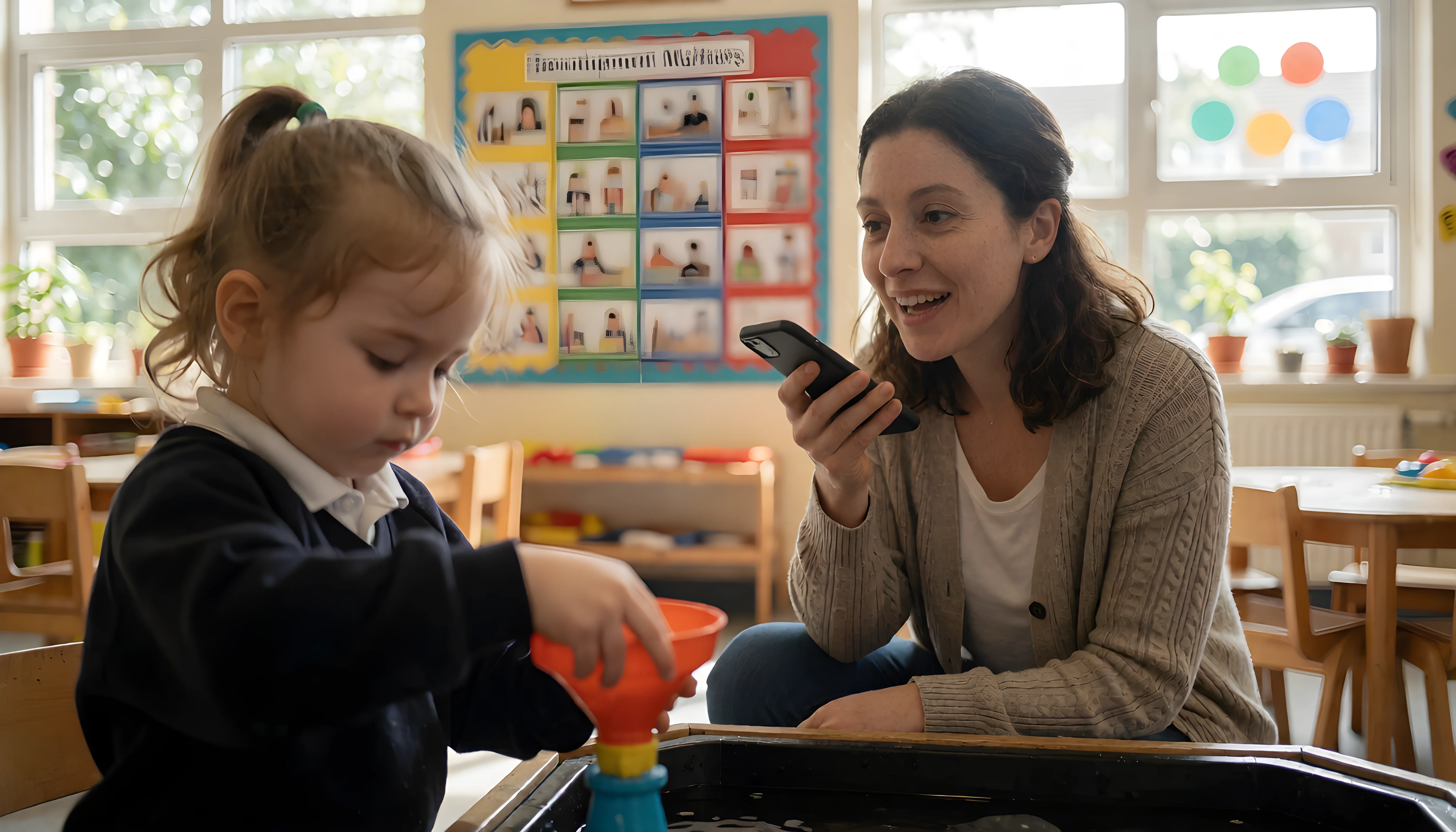
Over the last two years a surprising number of schools have found that lever in an unglamorous place: a teacher holding a phone, talking for forty seconds about what a child has just done at the sand tray. Voice observations have become one of the most effective parent engagement tools available to primary and early years settings, and the reason has very little to do with technology.
What a voice observation actually is
A voice observation is a thirty to sixty second audio note recorded by a teacher in the moment. No form, no laptop, no waiting until the end of the day when the detail has already gone. A child finally counts past ten unprompted, or shares the glue stick without being asked, or explains why the ice melted. The teacher presses record, says what happened in a sentence or two, and carries on teaching.
In Parent Portal the recording is transcribed automatically, tagged to the child, and linked to the relevant curriculum objective — Development Matters statements and Early Learning Goals in early years, National Curriculum objectives further up the school. It then sits in an approval queue until a teacher or leader releases it, so nothing reaches a parent unreviewed. The whole cycle, from moment to shared observation, can take under a minute of adult time.
Why parents listen to voice when they ignore everything else
Written observations tend to flatten. Teachers under time pressure reach for the same safe vocabulary, and parents receive something that reads like a form: engaged well in child-initiated play, making good progress towards age-related expectations. It is accurate and it is forgettable.
A voice note does not flatten. A teacher who is genuinely delighted that a child has cracked something sounds delighted. Parents hear the pause, the laugh, the background hum of a classroom their child spends thirty hours a week in and has never been able to describe to them. That is the entire mechanism, and it is why the effect shows up in engagement data rather than just in anecdote.
Parents do not disengage because they do not care. They disengage because what the school sends them does not sound like it is about their child.
There is a secondary effect that schools usually notice before any score moves. Voice observations give families something concrete to talk about at home. Instead of the dead end of how was school today, a parent can ask about the bridge she built or the worm he found, which pulls the child into the conversation too.
The workload maths that makes it sustainable
Any engagement initiative that costs teachers an extra hour a week dies by half term. This is the part school leaders should interrogate hardest, and it is where voice observations hold up better than most ideas in the edtech 2025 wave.
Typing a meaningful observation takes three or four minutes once you include finding a device, logging in and hunting for the right assessment statement. Speaking one takes forty seconds and happens where the learning happened. Across a class of thirty, that difference compounds into hours. The observations are also not single use: because they live inside the same school admin software that handles reports and consultations, accumulated voice notes feed AI progress summaries, pre-meeting reports for parents' evenings, and end-of-term report comments grounded in real evidence rather than reconstructed at the kitchen table in July. One forty-second recording ends up doing four jobs.
Which engagement scores actually move
Parental engagement is a vague phrase until you decide what you are counting. Schools that report real improvement tend to baseline a handful of specific indicators before rollout, and the pattern across them is fairly consistent: the measures tied to reciprocity move first.
App open rate per family per week, and the proportion of families opening anything at all.
Parent replies and reactions to observations, not just views.
Parents' evening booking rate, and how quickly slots fill.
Response rate on parent surveys and consultation forms.
Attendance at open mornings, workshops and celebration assemblies.
Harder-to-reach groups specifically: fathers, EAL households, and families who have never replied to anything.
That last line matters most. Voice observations reach families that written communication never did — parents who find English easier to listen to than to read, parents with low literacy confidence, and working parents who can listen on a commute but will never open a PDF newsletter. Automatic translation of accompanying messages helps, but much of the gain is simply that audio asks less of the person receiving it.
Getting it right in practice
Three things separate the schools where this works from the schools where it fizzles out. The first is frequency over polish: two short notes per child per week beats a beautifully crafted monthly summary, because engagement is built by rhythm. The second is keeping the approval workflow light, because if every observation waits three days for release, the immediacy that made it work has gone. The third is telling parents what to do with it — families need explicit permission to reply, and a single sentence back from a parent changes the relationship.
What surprised me was who started replying. Dads. Grandparents doing pickup. Two families we had not heard a word from in a year.
Reception teacher, two-form entry primary, West Midlands
One further piece of advice: agree a floor, not a target. One observation per child per fortnight is achievable and auditable. A target of five a week turns good practice into a compliance exercise, and the warmth parents are actually responding to drains out of the recordings within a month.
A small change with a long tail
Voice observations will not repair a broken relationship between a school and its community on their own, and no set of school communication tools should be sold as though it will. What they do is strip the friction out of the single most valuable thing a school can offer a parent: specific, warm, timely evidence that somebody knows their child. Do that two hundred times a term and the engagement scores follow, because those scores were only ever measuring whether parents believed it.
Comments