
How to Structure Your Daily Observation Routine
Ask any Early Years practitioner what the hardest part of assessment is, and very few will say the professional judgement. They will say the capturing. The moment a child finally counts to twenty unprompted happens at 9.42am, somewhere between a spilled water tray and a missing cardigan, and by the time there is a free minute the detail has evaporated. What survives is a vague feeling that something good happened, which is not evidence and will not help anyone at report time.
The fix is rarely to observe more. It is to observe on a rhythm. A daily observation routine turns assessment from a guilty backlog into a handful of short, predictable moments spread across the day. What follows is a structure that works in nursery, Reception and Key Stage 1, along with the habits that make it survive a wet Wednesday in February.
Why ad hoc observation always falls behind
Observation without a routine has two failure modes. The first is volume: you capture everything for a fortnight, then nothing for a month, and the gaps stay invisible until moderation. The second is bias. Left to chance, we notice the loudest children and the quietest ones, and the steady middle goes undocumented for weeks. Neither is a reflection of professionalism. Both are a reflection of a system that depends on spare time, and in a primary classroom there is no spare time.
A routine solves both by deciding in advance who you are watching and when you will write it down. Everything else, including the technology, exists to make those two decisions cheap.
Morning: set a focus list before the children arrive
Start the day by naming three or four focus children. Not a plan of what you expect to see, just a short list of who you are deliberately watching. Rotate the list so every child comes round roughly once a fortnight, and keep it somewhere visible — a lanyard card or a note on your phone. The point is not to ignore the other twenty-six; it is to guarantee that the steady middle gets documented on purpose rather than by luck.
If you use Parent Portal, each child's learning profile shows when they were last observed, so the focus list almost writes itself. Five minutes with the register before the door opens is enough.
In the moment: capture, do not compose
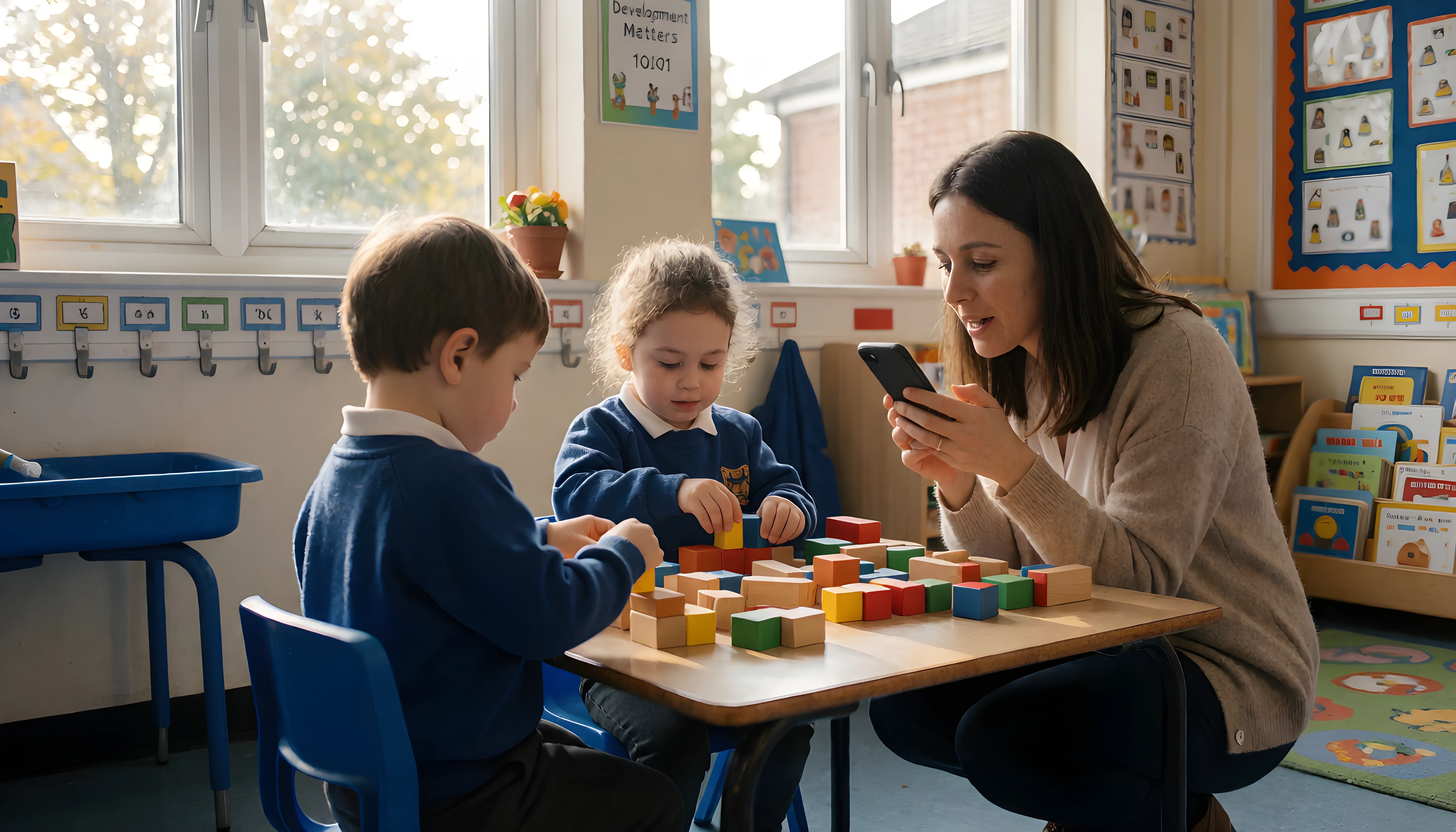
The single biggest change most teachers can make is to stop writing observations in the moment and start recording them. A thirty to sixty second voice note captures the context, the language the child used and your professional read on it, in roughly the time it takes to write one sentence. Parent Portal transcribes voice observations automatically, so you speak once and the text is waiting for you later. Photos and short videos work the same way — grab the image, add the caption at a calmer moment.
If a voice note is running past ninety seconds, you have started writing a report rather than taking an observation.
Say what the child did, the words they used, and what you think it shows. Context and curriculum links can be added later in the day.
Midday: tag while it is still fresh
Snack time, lunch cover or the gap after PE is the moment for the thinking that in-the-moment capture deliberately skips. Open the morning's observations and link them to Development Matters statements, Early Learning Goals or National Curriculum objectives while you still remember the room. Tagging a week later is guesswork; tagging within three hours is accurate. This is also the natural point to spot a child drifting off your radar and add them to tomorrow's focus list.
The routine is not about recording more. It is about recording the right amount, at a point in the day when recording is actually possible.
End of day: ten minutes to review and approve
Protect ten minutes before you leave. Read through the transcriptions, correct anything the microphone misheard, tidy a caption, and approve what is ready to share with parents. An approval step matters more than it sounds: it means staff can capture freely during the day knowing nothing reaches a family until a professional has read it back. Anything incomplete stays in draft rather than becoming tomorrow's problem.
Done consistently, those ten minutes replace the Sunday evening catch-up entirely, which is the honest measure of whether a system meant to reduce teacher workload is actually working.
Weekly: let the pattern do the talking
Individual observations are anecdotes. Twenty of them are a picture. Once a week, step back and look at each focus child across the whole set rather than entry by entry. The AI progress analysis in Parent Portal reads the accumulated observations and surfaces patterns, emerging strengths, gaps against age-related expectations and suggested next steps, giving you something concrete to confirm or challenge with your own judgement. It is a prompt for professional thinking, not a replacement for it.
Nursery and keyworker routines
In nursery the rhythm is different, because care and learning are interleaved. Keyworkers are already logging meals, naps and nappy changes, so the observation routine should ride along with those touchpoints rather than compete with them. One voice note per keyworker child per day, captured during a natural pause, builds a longitudinal record without anyone setting aside separate observation time. Families receive updates as the day unfolds, which is often the single thing parents value most.
Now I record three or four voice notes a day and spend ten minutes before I leave approving them. My end-of-term reports took a fraction of the time, because the evidence was already there in my own words.
Reception teacher, two-form-entry primary school, West Midlands
Where the routine pays off
The return on a daily observation habit arrives in the weeks that are usually worst. At parents' evenings, pre-meeting reports pull together months of voice notes and progress data, so consultations begin from evidence instead of recollection. At report time, an AI report writing assistant drafts comments from what you genuinely recorded, child by child. Parents see learning as it happens through push notifications rather than twice a year, which is the kind of parent engagement no newsletter has ever achieved.
Making it stick
Introduce the routine as a whole-school expectation rather than a personal discipline, and keep it small enough to survive a hard term: a focus list, short captures, a midday tagging window and ten protected minutes at the end of the day. Good school admin software and school communication tools remove the friction, but the structure is what shifts the workload. Of everything on an edtech 2025 shortlist, a routine your staff are still following in July is worth more than any single feature.
Comments