
From Skeptic to Advocate: Teacher Stories of Voice Note Adoption
Few things divide a staffroom faster than a new piece of technology. When schools first introduce voice-recorded observations, there is usually a clear split: a handful of early adopters who start recording on day one, and a larger group who quietly decide to wait and see how it goes. That second group is where the interesting stories come from.
Over the past few years we have spoken to hundreds of teachers using Parent Portal, and a pattern keeps repeating itself. The staff who were most resistant to voice notes often end up being their strongest advocates. Here are three of those journeys — composites of the conversations we hear again and again in UK primary schools and nurseries.
Objection one: 'I simply haven't got time for this'
Hannah teaches Reception. When their school announced that observations would move to voice notes, their first reaction was blunt: another system, another login, another thing to do at half past four. Written observations already ate into every spare moment of the week, and the idea of adding audio on top felt like a workload problem dressed up as a solution.
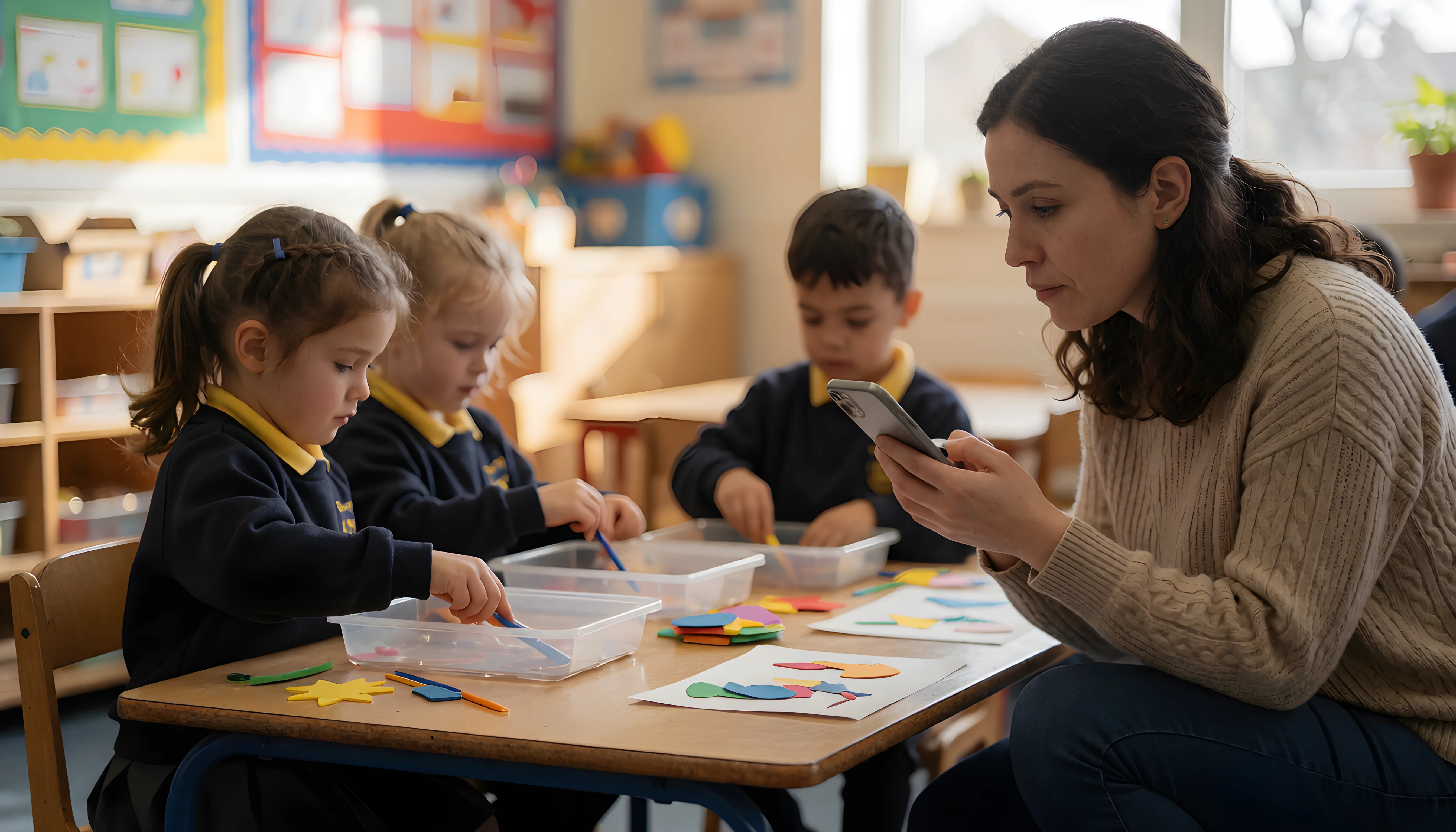
The shift came in week two, during a water tray activity. A child who rarely volunteered an idea suddenly started narrating what they were doing in full, connected sentences. Hannah picked up their phone, recorded forty seconds of it, and carried on with the session. No notebook, no retyping that evening, no trying to recall the exact words three hours later.
That is the detail that converts people. A voice-recorded observation takes thirty to sixty seconds and is captured while the learning is still happening. It is transcribed automatically, linked to Development Matters and the Early Learning Goals, and tracked against age-related expectations without anyone opening a spreadsheet. Hannah now records eight or nine a day and describes it as thinking out loud instead of writing it up twice.
Objection two: 'I'm not a technology person'
Marcus teaches Year 5 and had spent a decade perfecting a paper system of sticky notes, mark book codes and memory. Their worry was not workload but competence — a fear of fumbling with an app in front of thirty children, or of recording something important and then losing it somewhere in the cloud where only the confident staff could find it.
What changed their mind was report season. Instead of facing thirty blank comment boxes in July armed with half-remembered impressions, Marcus had months of evidence already sitting in each child's learning profile. The AI report writing assistant drew on those accumulated observations to produce comment drafts grounded in actual moments rather than generic phrasing.
I used to write reports from memory and hope I was being fair to everyone. Now I write them from evidence, and the difference in how honest they feel is enormous.
Marcus makes an important point about trust. Teachers do not adopt tools because the tools are impressive; they adopt them because they remove one specific piece of pain. For them, that pain was the end-of-year scramble. For a colleague it might be parents' evenings, where pre-meeting reports pull voice observations, progress data and behaviour records into a single place before the first family sits down.
Objection three: 'What if a parent takes it the wrong way?'
The third objection is the most serious of the three, and it usually comes from experienced staff and safeguarding leads. A written observation can be edited and softened before anyone else reads it. A voice note feels raw and permanent. Priya, a nursery keyworker, worried about a throwaway phrase being heard out of context by an already anxious family.
The answer was the approval workflow. Nothing reaches a parent until a member of staff has reviewed and approved it, so recording and sharing become two separate decisions rather than one nervous one. Priya records freely throughout the day, then reviews at a natural pause, knowing that anything sensitive stays internal and can be logged as a concern instead.
Nine months on, Priya's families receive short audio updates alongside the daily routine of meals, naps and nappy changes. Parents hear their child's own voice and their keyworker's warmth in it. It turns out that genuine parent engagement is less about the volume of updates a school sends and much more about how real those updates sound.
What this means for school leaders
If you lead a school, the lesson from these stories is that adoption is not really a training problem. Every one of these teachers could operate the app competently within ten minutes. What they needed was a reason to believe the tool would give them time back rather than take it, and then one concrete experience that proved it.
Start with one year group or key stage rather than the whole school at once.
Ask staff to record three observations a week, not thirty.
Keep written observations available for the first half term so nobody feels trapped.
Review together after six weeks and let the pilot staff, not senior leaders, present what they found.
Play one example recording in a staff meeting so the format stops feeling mysterious.
There is a wider point here for anyone comparing school admin software or school communication tools. Features win demonstrations; workflows win staffrooms. The question worth asking a supplier is not how many tools they offer, but how many steps each one genuinely removes from a Tuesday afternoon that is already over-subscribed.
It also changes what evidence looks like across a school. Instead of a thin file of written notes produced near a deadline, leaders see a longitudinal picture built up daily, with AI-powered progress analysis surfacing patterns, strengths and suggested next steps for each child.
— Headteacher, two-form entry primary
Skepticism about edtech is healthy and usually well earned. Teachers have been promised time savings before and received extra admin instead. The teachers in these stories did not become advocates because somebody convinced them in a training session; they became advocates because thirty seconds of audio replaced twenty minutes of typing, repeatedly, until it was simply how they worked.
If voice notes are on your agenda this year, start with the skeptics rather than around them. Give them a fortnight, a small target and a genuine way out. Then listen carefully to what they tell you — because to reduce teacher workload, you have to convince the people actually carrying it.
Comments