
Voice-First Data Collection: The Future of Teacher Assessment
Ask a primary teacher what they would change about assessment and you will rarely hear a complaint about the assessing. Teachers are extraordinarily good at noticing. They can tell you which child has started self-correcting their sentences this week, which one no longer reaches for the number line, and which one spent twenty minutes building a bridge out of blocks and narrating the engineering to nobody in particular. The noticing has never been the bottleneck.
The record is. A moment of learning happens at 10:42 on a Tuesday, somewhere between a spilled water bottle and a fire drill, and the teacher who saw it has about four seconds to act before the next thing starts. So it gets written down at four o'clock, from memory, in a form that is shorter, blander and further from the truth than what actually happened. Multiply that by thirty children and thirty-nine weeks and you have the quiet problem at the heart of primary assessment: the best evidence a school holds is the evidence it never managed to capture.
Typing Was Always the Wrong Tool for a Classroom
Typing is a classroom-incompatible activity. It needs two hands, a flat surface, a sustained attention span and, crucially, the teacher's eyes somewhere other than the children. Every observation system built around a text box therefore carries the same hidden instruction: stop teaching, then record. Teachers, being sensible people, mostly decline, and the evidence base suffers for it.
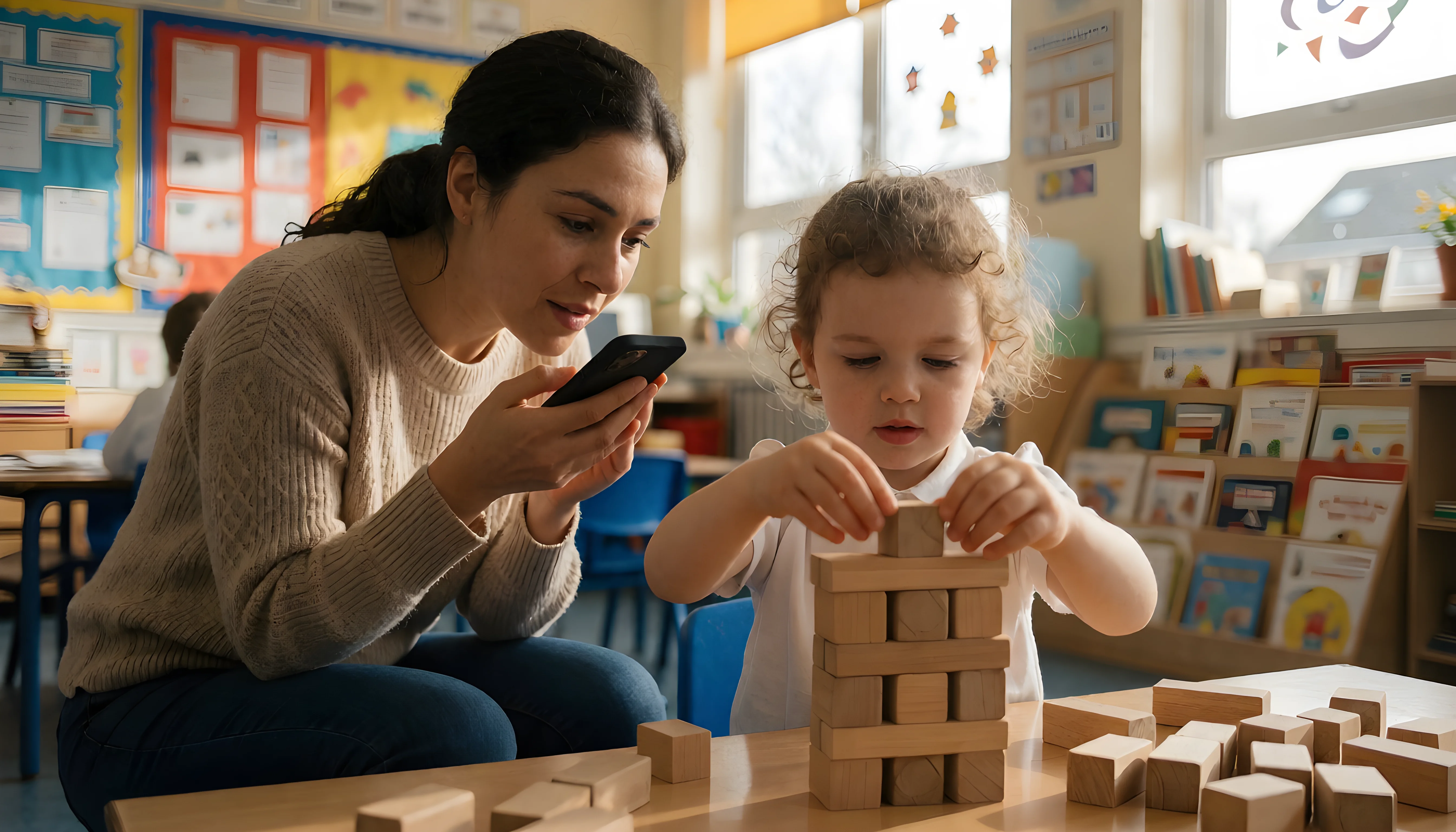
Speech is different. A teacher can describe what they are watching while they are still watching it. Thirty to sixty seconds, spoken quietly into a phone at the sand tray or over by the reading corner, costs almost nothing in attention and captures what a tick-box never will: the actual language the child used, the question they asked, what the teacher did next and why it mattered. This is the premise behind voice-first data collection, and it is steadily reshaping the edtech 2025 conversation about assessment and teacher time.
From a Spoken Moment to Structured Data
A voice note on its own is just audio, searchable by nobody and reportable on nothing. What makes voice-first assessment more than a dictaphone is what happens in the thirty seconds after the teacher stops talking. In Parent Portal, each recording is transcribed automatically, attached to the child or group it concerns, and linked to curriculum objectives: Development Matters statements and Early Learning Goals in Early Years, National Curriculum objectives further up the school. Progress against age-related expectations updates itself from the same single act of recording.
That step is what turns a workload saving into an assessment advantage. The teacher does one thing, which is talk, and the system produces the transcript, the timestamp, the curriculum link, the progress data point and an item ready to share with parents. Nothing is re-entered and nothing is reconstructed at four o'clock.
Transcription, curriculum tagging and progress tracking all happen automatically in the background.
Teachers review and approve every observation before any of it reaches a parent.
That approval step matters more than it sounds. Spoken notes are candid by nature, and schools are right to want a gate between a teacher's in-the-moment phrasing and a parent's phone screen. An approval workflow keeps the recording honest and the sharing deliberate, two things usually in tension.
The Compound Interest of Small Observations
One voice note is an anecdote. Two hundred of them, gathered across a year and tagged to objectives, are something closer to a longitudinal study of one child. Patterns no human can hold in working memory become visible: a child who thrives in every collaborative task and stalls in every independent one; a reader whose fluency has plateaued while comprehension has quietly accelerated; a summer-born pupil whose progress curve looks worrying in November and entirely typical by March.
Parent Portal's AI progress analysis reads the accumulated record and surfaces strengths, areas for development, suggested next steps and teaching strategies suited to how that particular child learns. Professional judgement still decides everything. It simply arrives at the decision holding the evidence instead of hunting for it.
The teacher who speaks their observations is not doing more assessment. They are keeping the assessment they were already doing in their head.
The downstream effect lands hardest at the points in the year that usually cost teachers their evenings. Pre-meeting reports for parents' evenings assemble themselves from observations already captured. End-of-term comments can be drafted from real evidence about a real child rather than composed from scratch at the kitchen table in a fog of similar-sounding sentences. The writing still needs a teacher's voice and a teacher's eye. It no longer needs a teacher's archaeology.
What Parents Actually Receive
Schools invest heavily in parent engagement and then, through no fault of their own, hand parents the thinnest possible version of their child's school life: a termly report, a ten-minute consultation and a book bag. Voice-first observation changes the texture of that relationship. A parent reads a short, specific account of what their child did on Thursday morning and why their teacher found it significant. Not a grade, not a level, but a moment.
- Reception teacher, two-form entry primary school
It is also a quiet fix for a problem many schools have stopped trying to solve: the parent who never comes in. Someone working two jobs, reading English as an additional language, or simply uneasy about the building will often engage readily with a one-minute update on their phone. By the time a consultation arrives, both sides already share a picture of the child.
Making It Work in Your School
Voice-first assessment fails in schools that treat it as a quota. Three observations per child per half term, set as a target, produces three dutiful recordings and no change in culture. It works where leaders make the opposite move and take something away. If spoken notes now carry the evidence, the parallel paper trail, the duplicate spreadsheet and the Friday evidence-gathering slot should go with them. Replacement, not addition is the only version of this that genuinely helps reduce teacher workload rather than relocating it.
Settle three things early. Agree what a good thirty-second note sounds like and model it in a staff meeting, because most teachers over-narrate at first and find their register within a fortnight. Decide who approves what. And be straight with staff about data: observations sit inside a UK GDPR-compliant system alongside messaging, registers and safeguarding records, which is both a reassurance and a reason to agree retention and access rules before the volume builds.
Assessment That Sounds Like Teaching
The appeal of voice-first data collection is not that it is clever. It is that it finally runs with the grain of the job. Teachers already talk about children constantly, in the corridor, at the photocopier, in the five minutes before the bell. Capturing a fraction of that in the moment and letting good school communication tools do the filing is a smaller change than most assessment initiatives and a far larger one in effect.
Any school reviewing its school admin software this year will find no shortage of platforms that store observations. The sharper question is how long it takes a teacher to create one, and what the system does for them afterwards. When the answer is thirty seconds and almost everything, the paperwork problem starts to solve itself.
Comments