
End of Year Reports: How Technology Makes Them Easier
The Last Fortnight Of The Summer Term
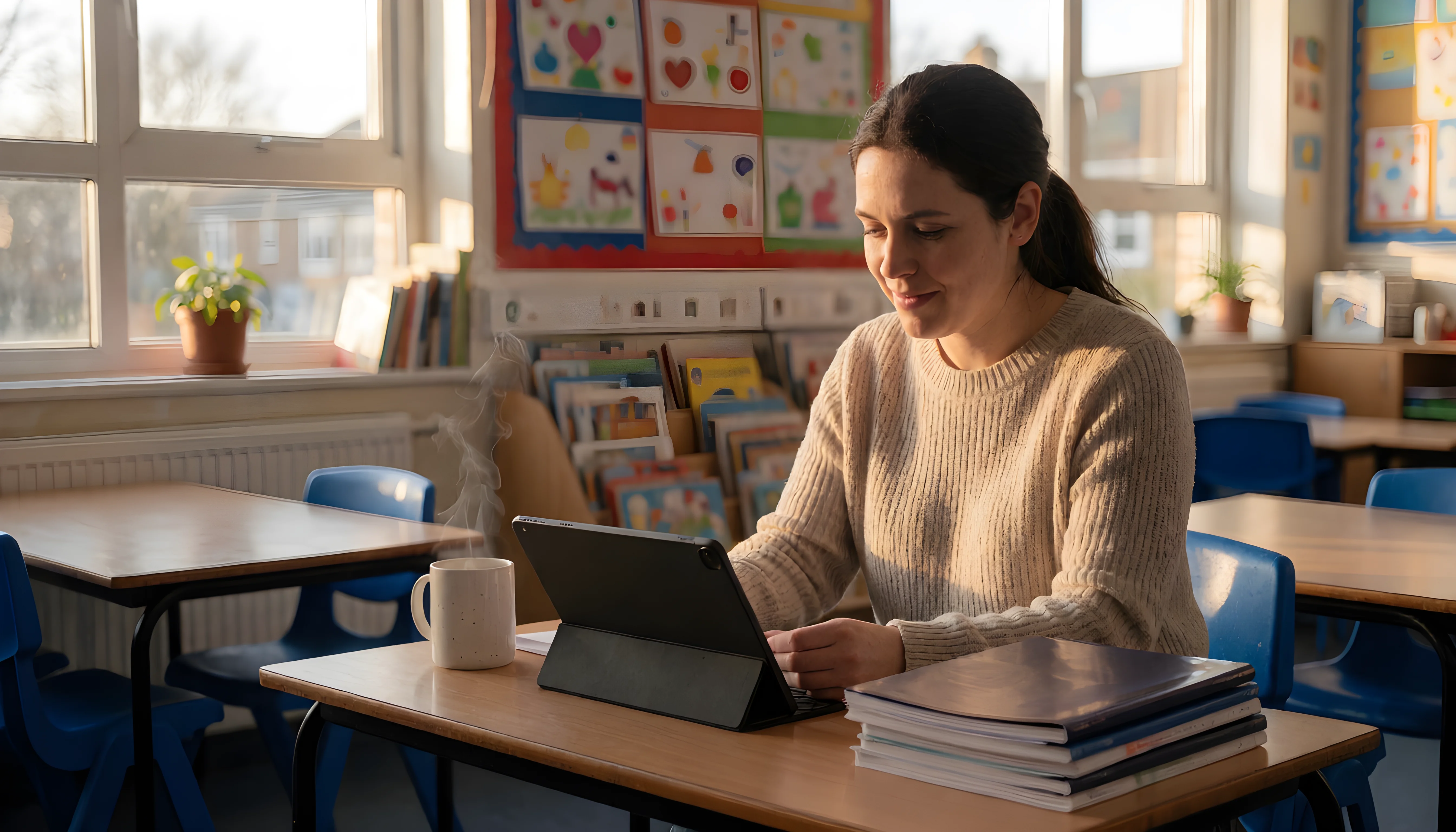
Every primary school has its own version of the same scene. It is late June, the classroom door is shut, and a teacher is staring at a list of thirty names trying to remember what one particular child did in maths back in February. The tea went cold two hours ago. Reports are due on Friday.
End of year reports cannot be delegated, cannot be rushed without somebody noticing, and cannot be done well at speed. For most teachers they are the biggest workload spike of the year. The encouraging part is that the hardest element of report writing is not the writing at all, and that is precisely where technology has started to make a real difference.
Why Reports Actually Take So Long
Ask a teacher what makes reports difficult and very few will say the prose. What they will say is the reconstruction. Writing a fair, specific comment about a child means recalling a whole year of small moments, and those moments were never stored anywhere retrievable. They lived in a chat at the classroom door, a mental note during guided reading, a minute at the sand tray that changed how you saw a child's confidence.
By July most of it has gone, so teachers rebuild a year from books, data drops and memory, then write something true but general. The result swallows four hours per class and still reads like every other report, because generic language is what you reach for when the evidence underneath you is thin. This is a data problem wearing the costume of a writing problem.
Capturing Evidence When It Happens
Voice-recorded observations are the clearest example of what has changed. A teacher notices something worth keeping, taps record, and talks for thirty seconds about what just happened and why it mattered. It is transcribed automatically and filed against that child. No form, no laptop, no sitting down at four o'clock to write up something you only half remember. Photographs and short videos work the same way, tagged to individual children or groups with a caption and a link to the objective in play.
Across thirty-nine weeks these micro-observations become something far more useful than scattered notes: a longitudinal picture of how a child has genuinely developed. That is the raw material a report needs, and exactly what has always been missing.
Linking Observations To Objectives As You Go
Capturing evidence is only half the job. The other half is making sure it maps onto the framework you report against. In Early Years that means tying an observation to Development Matters or an Early Learning Goal as you record it, and in Key Stage 1 and 2 it means linking to a National Curriculum objective. Progress against age-related expectations then builds itself in the background, and by July the question is not where the evidence is but which piece of it best tells this child's story.
School leaders get a second dividend. Report writing becomes a reading of something that already exists rather than an exercise bolted onto the end of the year, which eases moderation, pupil progress meetings and transition handovers too.
Are observations being linked to curriculum objectives, or just filed as loose notes?
Does every child have evidence from across the whole year, not only the summer term?
Can a teacher see one child's complete history on a single screen in under a minute?
If the answer to any of those is no, that is where your report workload is coming from.
None of that can be fixed retrospectively, which makes these March questions rather than June ones.
Where AI Genuinely Helps
Artificial intelligence has dominated the edtech 2025 conversation in UK schools, and staffrooms are right to be sceptical about parts of it. On reports the distinction is simple: AI is useful when it works from your evidence and close to worthless when it works from nothing.
A tool that invents a paragraph about a child it knows nothing about produces the bland filler teachers already resent writing. One that reads a year of voice notes, photographs, homework feedback and progress records for a named child and drafts a comment grounded in all of it is doing something entirely different: analysing patterns, surfacing strengths and next steps you might not have spotted, and turning twelve months of detail into a first draft in seconds.
Artificial intelligence does not write a better report than a teacher. It writes a faster first draft from evidence the teacher already gathered, and that is a very different claim.
The shape of the task changes. Instead of four hours per class generating sentences from a standing start, a teacher spends an hour editing and personalising drafts that already carry the right specifics. The professional judgement stays where it belongs. It is the archaeology that disappears.
Keeping Teachers In Control
The objection that comes up most often, and it is a fair one, is accountability. Who is answerable for what a report says?
The teacher, and any system worth adopting should enforce that structurally rather than merely promise it. An approval workflow means nothing reaches a parent until a member of staff has read it and signed it off, whether that is an AI-drafted comment, a shared observation or a parents' evening summary. It also makes the approach easier to defend when a judgement is queried, because a comment supported by eleven dated observations stands on firmer ground than one written from memory in the last week of term.
Reports Parents Actually Read
The last piece is delivery, which schools think about least and families experience most. A report printed on Thursday, pushed into a book bag on Friday and found crumpled in a coat pocket in August has not really been communicated to anyone.
Sending reports through the platform parents already use for messages, homework and absence reporting transforms parent engagement. They arrive with a push notification, sit alongside the observations that evidence them, and stay available rather than getting lost. Family group accounts mean separated parents both receive the report directly, and automatic translation means families with English as an additional language can read it in their own language.
This year I opened each child's profile, read back through a year of my own voice notes, and the drafts were already specific and accurate.
I was editing rather than inventing, it took a fraction of the time, and they were the best reports I have written.
Year 4 teacher, primary school in Greater Manchester
A Better Way To Spend July
Nobody went into teaching for the admin, and no technology will make end of year reports enjoyable. But there is a difference between work that is demanding and work that is unnecessarily painful, and the pain here comes from recalling a year that was never properly recorded.
Schools that capture evidence as it happens, link it to objectives automatically, use AI to turn that evidence into accurate drafts and deliver the finished reports through the app parents already check are not cutting corners. They are writing better reports, with stronger evidence, in a fraction of the time. That is what good school communication tools are for: to reduce teacher workload without reducing quality, and to hand the time back to the children the reports were written about.
Comments