
The Role of Natural Language Processing in Education
Language Is the Real Workload in a Primary School
Walk into any primary staffroom at half past four and count the laptops still open. Very little of what keeps them open is teaching. It is words: observation notes typed up from scribbles on a sticky label, report comments for thirty children who all deserve something specific, a safeguarding log that has to be precise, next week's lesson plans, feedback on a stack of fraction work.
Every school runs on language, and language is slow to produce. That is the real reason natural language processing has become one of the most quietly useful technologies in education. It is not fashionable for its own sake. It happens to work on exactly the part of the job that creates the most administration and the least joy.
What Natural Language Processing Actually Is
Natural language processing, usually shortened to NLP, is the branch of artificial intelligence concerned with understanding and producing human language. Strip away the jargon and it does four things that matter in a school.
It recognises speech, turning spoken words into accurate text. It summarises, condensing a long or scattered body of writing into something short and readable. It translates between languages. And it generates, producing new text from a short brief — a comment, a task, an explanation. None of this is science fiction any more. All four are already running inside platforms UK schools use every day, including Parent Portal.
From a Spoken Moment to a Written Record
The clearest example is observation. Teachers see learning moments constantly and capture almost none of them, because capturing one means stopping, finding a pen or a device, and writing. By the time the day ends, the detail has gone.
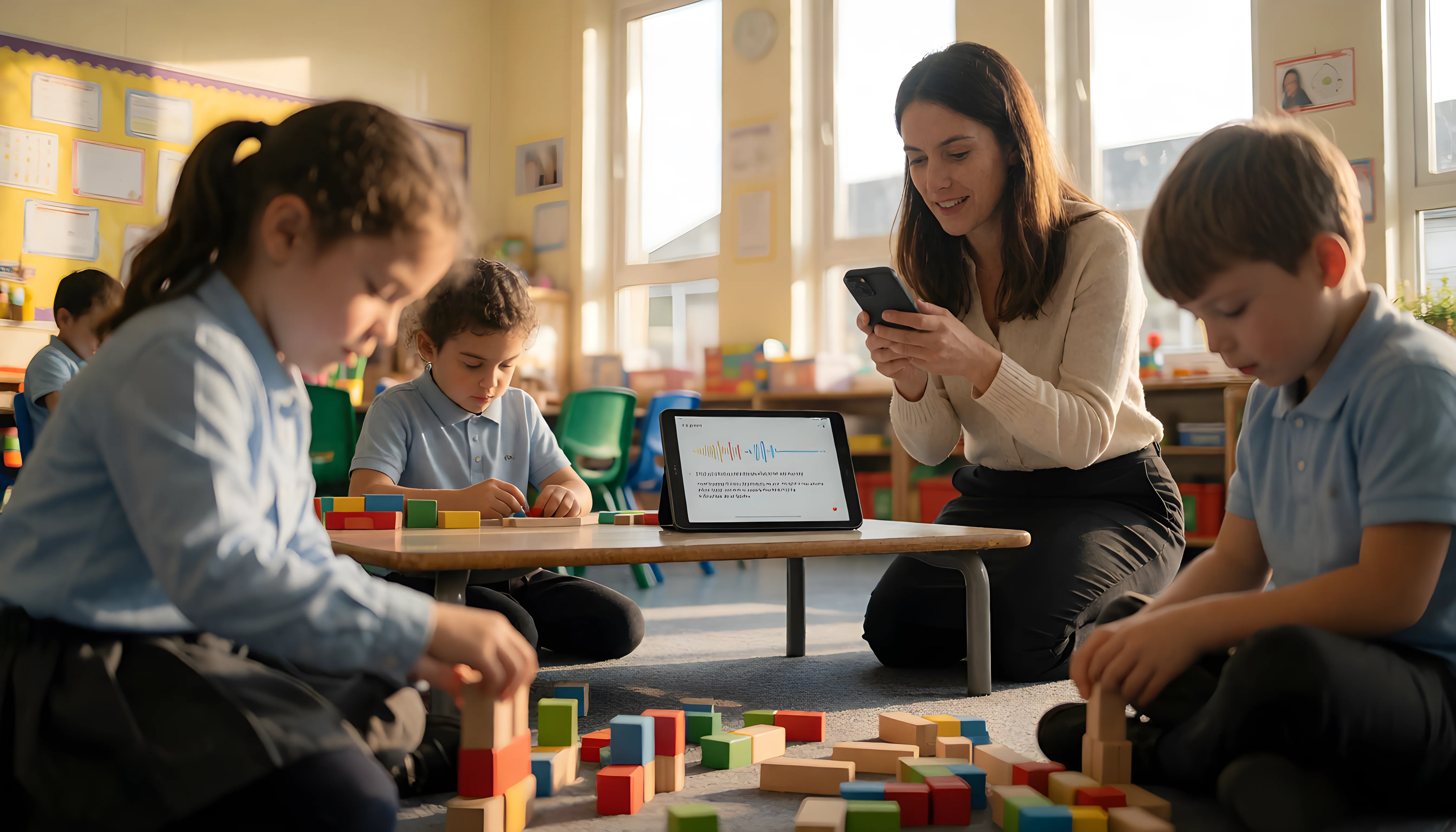
Speech recognition changes the economics of that. A teacher records a thirty-second voice note while the moment is still fresh — what the child did, what they said, what it showed — and the platform transcribes it into searchable text attached to that child's profile. Nothing is typed. Over a term, dozens of these micro-observations accumulate into something no single written assessment can match: a longitudinal, dated, evidence-rich picture of one child's development, linked to Development Matters, Early Learning Goals or National Curriculum objectives.
Speech recognition turns a teacher's spoken voice note into searchable, shareable text.
Summarisation condenses a term of records into a few clear, accurate sentences.
Translation delivers a school announcement in a family's home language.
Generation drafts a comment, a homework task or a lesson plan from a short instruction.
Every one of these is already working inside Parent Portal today.
Turning a Term of Observations Into Insight
Collecting evidence is only half the value. The harder question has always been what the evidence adds up to. Reading back through sixty voice notes to spot a pattern is not something a class teacher has time to do, which is why so much assessment data is gathered and then never really used.
This is where summarisation earns its place. Once observations exist as text, they can be analysed as a body of evidence: recurring strengths, areas that have stalled, the kinds of activity a particular child consistently engages with, sensible next steps. The teacher receives a draft reading of the child rather than a folder of raw material, and can then do the thing only a teacher can do — judge whether it is right.
The most valuable thing NLP gives a teacher is not a finished document. It is the forty minutes they were going to spend producing one.
Report Season Without the Dread
Nowhere is the gap between effort and value wider than end-of-term reports. Teachers know their children well, yet still lose entire weekends to the mechanical act of turning that knowledge into thirty sets of prose that sound individual.
An AI report writing assistant built on a term of real observation data approaches this differently. Rather than offering generic sentence banks, it drafts comments grounded in what was actually recorded about that specific child — the voice notes, the progress against objectives, the achievements logged along the way. The teacher edits, reshapes and signs off in their own voice. The blank box, which is the genuinely expensive part, disappears.
Reaching the Families Schools Find Hardest to Reach
Translation is the NLP application school leaders tend to underestimate. In a school with a significant number of families who speak English as an additional language, communication quietly becomes unequal. The newsletter goes out, the trip deadline passes, and the same families miss it every time — not through disengagement but through language.
Automatic message translation removes that barrier without creating extra work for the office. A parent reads an announcement, a homework instruction or a message from their child's teacher in a language they are comfortable in, and replies in it. For parent engagement, few features do more. It turns one-way broadcasting into an actual conversation with the families who were previously hardest to include.
A Planning and Teaching Partner, Not Just an Admin Tool
NLP is equally at home on the teaching side. Generation models are good at producing structured, age-appropriate material fast: a differentiated lesson plan from a topic and a year group, a reading comprehension at three difficulty levels, SPAG exercises targeting one grammar rule, a child-friendly explanation of evaporation with analogies that actually land, constructive feedback on a photographed piece of work.
None of this replaces subject knowledge or planning judgement. What it replaces is the first draft — the typing, the formatting, the hunt for a text at the right reading age. The shift is from creating resources to curating them.
Year 2 teacher, two-form-entry primary, West Yorkshire
Where NLP Should Never Be Left Alone
Any honest account of this technology has to include its limits. Language models produce fluent text, and fluent text is persuasive whether or not it is accurate. A transcription can mishear a name. A summary can overstate a pattern drawn from thin evidence.
That is why the approval step is not an inconvenience to be engineered away — it is the design. Observations should be reviewed before parents see them. Reports should be read, edited and owned by the teacher whose name is on them. Safeguarding records, which carry the highest stakes of all, should stay restricted to designated leads with every access logged. The technology drafts; a professional decides.
Questions Worth Asking Before You Buy
For school leaders assessing school communication tools and school admin software, the useful questions are rarely about the model. Ask where data is processed and whether the arrangement is UK GDPR compliant with a proper data processing agreement. Ask whether staff can review and amend anything generated before it reaches a parent. Ask whether the features solve a problem your teachers actually complain about, or simply demonstrate that the supplier has discovered AI. And ask whether the tools sit inside one system, because separate apps for messaging, observations, homework and payments mean separate logins, duplicated data and a worse experience for parents than the paper they replaced.
The Point Was Never the Technology
The edtech conversation has spent years talking about models and capabilities. For schools, the only measure that matters is simpler: does this give time back to the people who should be spending it with children?
On that test, natural language processing has a genuinely strong case. It takes on transcription, summarising, translating and drafting — work that is necessary, enormous in volume, and almost entirely mechanical. Used carefully, with human judgement firmly in the loop, it does not make teaching more automated. It makes it more possible.
Comments