
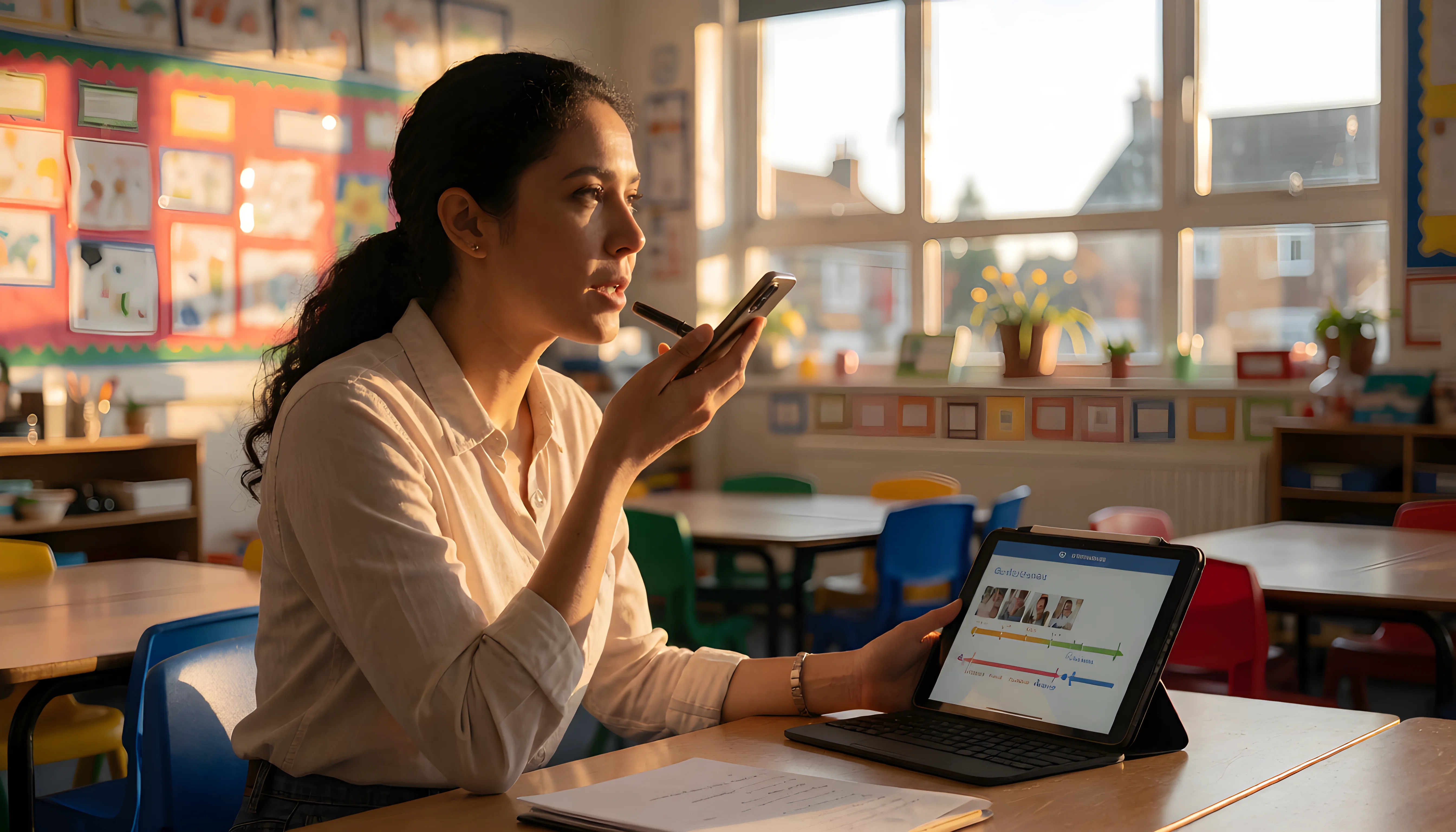
How to Review a Year of Voice Notes in Minutes
Every primary teacher knows the feeling. It is the final fortnight of the summer term, reports are due, and somewhere in your classroom, your phone and your memory sits a year's worth of brilliant evidence about thirty children. You remember that Amara finally cracked number bonds to twenty in February. You remember the afternoon Jacob explained the water cycle to the whole carpet without a single prompt. You just cannot remember when, and you certainly cannot prove it.
Voice-recorded observations solved the first half of that problem years ago. A 30-second voice note is the lowest-friction way yet invented to capture a learning moment while it is still happening, without breaking off from the children to type. The second half of the problem, though, has taken much longer to crack: once you have hundreds of recordings, how on earth do you review them? This is where the right school admin software stops being a storage cupboard and starts being genuinely useful.
Why voice notes won the observation war
Written observations have a hidden cost. Typing anything meaningful takes two or three minutes, which means it happens after the moment has passed, usually at the end of the day when the detail has already blurred. Teachers end up writing what they think they saw rather than what they actually saw.
Voice changes the economics completely. Speaking for thirty to sixty seconds captures far more nuance than three lines of typed text, and it happens in the moment, with the child's actual words included. Early years practitioners took to this first, because EYFS assessment has always depended on noticing fleeting things, but Key Stage teachers have followed quickly. A quick voice note after a guided reading session captures reading behaviours that no tick-box tracker ever will.
The catch is obvious. Audio is the least searchable format there is. A folder of 400 recordings labelled by date is, functionally, a shoebox of unlabelled cassettes.
Transcription is the unlock, not the extra
The single change that makes a year of voice notes reviewable is automatic transcription at the point of capture. When every recording becomes searchable text the moment you stop speaking, the archive flips from a liability into an asset. You can search for a child's name, a curriculum objective, a phrase like "without support" or "needed modelling", and surface every relevant moment across twelve months in seconds.
In Parent Portal, voice observations are transcribed automatically and can be linked to Development Matters statements, Early Learning Goals or National Curriculum objectives as they are recorded. That tagging takes a teacher a couple of taps at the time, and it is what allows the system to later assemble a coherent story rather than a pile of anecdotes. Observations also pass through an approval workflow before anything reaches parents, so quality control sits with the adults who know the children.
At three minutes each to type up and file manually, you are looking at roughly 55 hours of admin.
Captured by voice and transcribed automatically, that same evidence base costs close to nothing in extra time.
The important point here is that nobody is asking teachers to do more. The recording was already happening in good practice. What changes is that the effort finally compounds instead of evaporating.
Letting AI do the pattern-spotting
Transcription makes the archive searchable. Analysis makes it readable. No human being can hold 1,100 observations in their head and spot that one child's confidence consistently dips in open-ended tasks but soars in structured paired work. A pattern spread thinly across nine months is invisible to memory and obvious to a model reading every entry at once.
This is what AI-powered progress analysis is actually for in schools, and it is a long way from the gimmicks that gave edtech 2025 a slightly inflated reputation. Accumulated observations are analysed to surface strengths, areas for development, learning preferences and suggested next steps, with each point traceable back to the specific moments that produced it. The teacher is not handed a verdict; they are handed a summary with its evidence attached, which they can accept, challenge or ignore.
The goal was never to replace teacher judgement with a dashboard. It was to stop teacher judgement being lost because nobody had time to write it down.
In practice, reviewing a year of voice notes for one child looks like this: open their learning profile, read an AI-generated progress summary built from every observation, scan the highlighted moments it has drawn on, and jump into the original audio for anything that needs checking. Five minutes per child rather than an evening per class. Thirty children becomes an afternoon, not a fortnight.
Where the time actually comes back
Four moments in the school year change character once this is in place.
End-of-term reports. Report writing is painful mainly because teachers are reconstructing a year from memory under deadline. An AI report writing assistant drawing on real observation data produces genuinely personalised, evidence-based comments for each child, which the teacher then edits into their own voice. The blank page disappears.
Parents' evenings. Pre-meeting reports pull a child's voice observations, progress data and behaviour records into one place, so you walk into a ten-minute consultation already knowing what you want to say. Booking happens in the app, meetings can run as video calls where families cannot attend in person, and AI-generated meeting summaries capture agreed actions afterwards so nothing depends on scribbled notes.
Moderation and pupil progress meetings. Senior leaders asking "what is your evidence?" get an answer in seconds rather than a promise to dig something out.
Transition. A complete longitudinal record travels with the child to their next teacher, which is worth more than any summative grade.
Having them transcribed, tagged and summarised changed what they were for. Report week was the calmest it has been in nine years, and parents' evenings felt like conversations rather than guesswork.
— Deputy Head, two-form entry primary
The parent engagement side effect
There is a second benefit that school leaders tend to notice before teachers do. Observations that are easy to review are also easy to share. Parents receiving a short voice note or photo about their child's learning, with a caption explaining why it matters, engage differently from parents receiving a termly grade. They start conversations at home about specific things. Attendance at consultations improves. Trust rises, which makes every other conversation easier, including the difficult ones.
That is the quiet argument for integrated school communication tools over a patchwork of apps. When observations, messaging, homework, attendance and reporting share the same record, parent engagement stops being a separate initiative and becomes a by-product of ordinary teaching.
Starting small
You do not need a whole-school rollout to test this. Pick one year group, agree a realistic target of one voice note per child per week, and insist on tagging to objectives from day one, because untagged audio is the only version of this that fails. Review after half a term and ask the teachers involved a single question: did that make your reports easier to write?
If the honest answer is yes, you have found one of the few genuine ways to reduce teacher workload without reducing the quality of what schools know about children. A year of voice notes is not a backlog. Handled properly, it is the most detailed picture of a child's learning your school has ever had, and it should take minutes to read.
Comments