
Writing Observations: Recording Student Progress in Real-Time
Ask any early years practitioner what fills their evening and you will usually get the same answer: writing up. The learning happened at ten past ten, when a child in Reception finally cracked one-to-one correspondence while laying out the snack cups. By the time there is a quiet moment to record it, it is half past five, there are eleven other moments competing for attention, and the detail has gone soft. What gets written down is a serviceable sentence that could describe almost any child. The thing that actually mattered — the exact words the child used, the expression on their face when it clicked — has evaporated.
This is the central problem with how most schools still handle observations. Not that staff do not care about them, but that the recording happens hours after the learning, in a format that rewards tidy prose over honest evidence. Real-time observation flips that. Instead of reconstructing the day from memory, you capture it as it happens, in seconds, and let the system do the organising afterwards.
Why Retrospective Observations Quietly Lose Their Value
There are three costs to writing observations after the fact, and schools tend to only notice the first one. The obvious cost is time — an hour or more a week per member of staff, stacked on top of planning, marking and everything else. That alone makes a strong case for change when you are looking seriously at how to reduce teacher workload.
The second cost is accuracy. Memory compresses. Observations written in bulk at the end of the day start to sound alike, because the brain reaches for familiar phrases rather than specific ones. The third cost is the one that hurts most at report season: coverage. When recording is effortful, staff unconsciously ration it. The confident children who perform for an audience get observed. The quiet child who had a breakthrough at the water tray while nobody was looking does not. Months later, their learning profile is thin, and nobody can quite say why.
An observation written six hours after the moment is not a record of learning. It is a recollection of one — and recollections average out the very details that make a child distinct.
Real-time capture addresses all three at once, and it does so not by asking staff to work harder but by shrinking the act of recording down to something that fits inside the lesson itself.
Voice Notes: Thirty Seconds Is Usually Enough
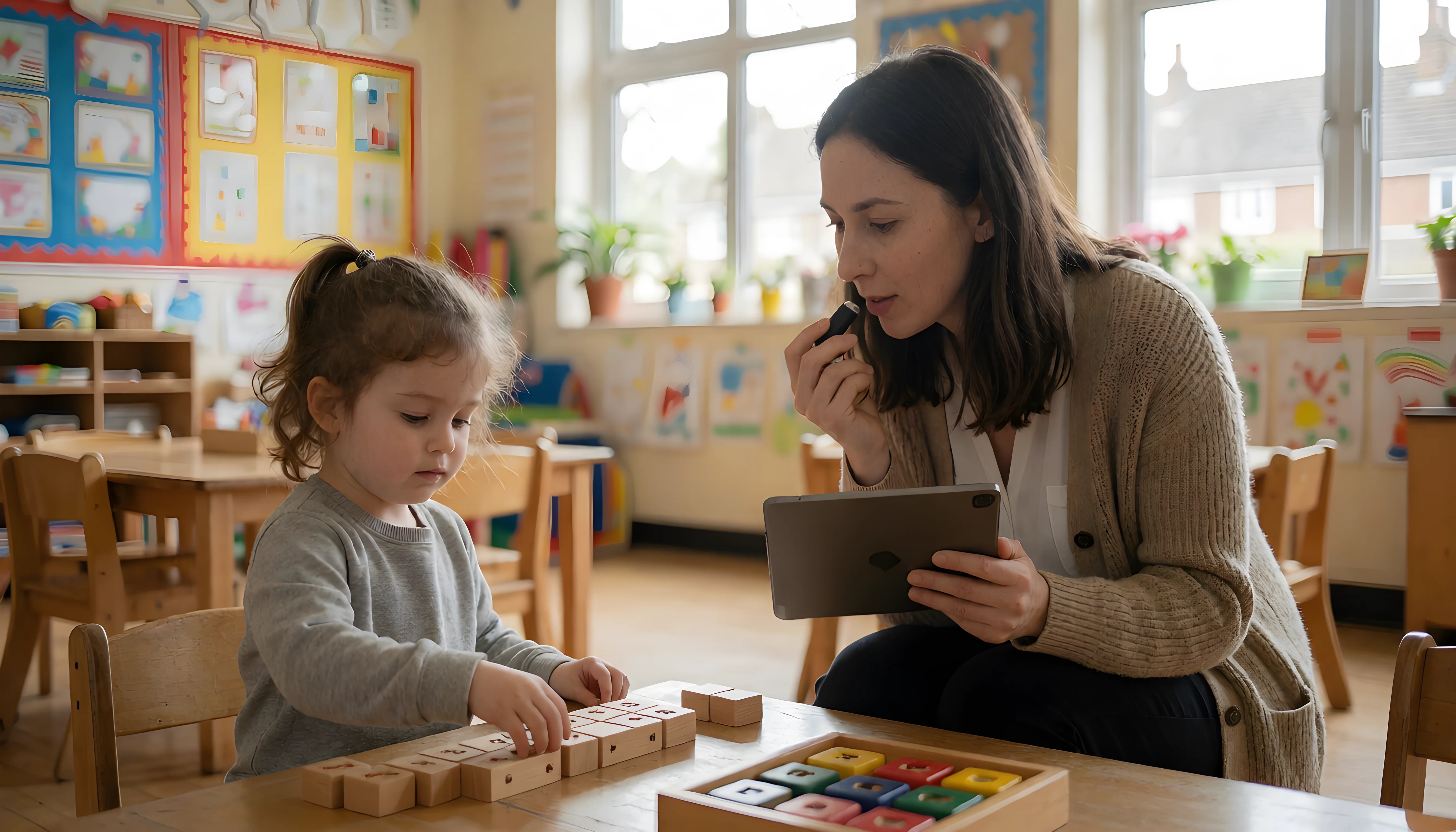
The single biggest shift most settings make is moving from typing to talking. A teacher watching a child solve a problem can hold up a phone or tablet, record a thirty to sixty second voice note describing exactly what they just saw, and carry on. There is no form to fill in, no laptop to find, no sentence to craft.
In Parent Portal, those voice-recorded observations are transcribed automatically, so what starts as a spoken aside becomes searchable written evidence attached to that child's profile. The quality difference is striking. Spoken observations are specific in a way written ones rarely are — practitioners naturally quote the child, describe the context, and mention what they tried next. Over a term, dozens of these micro-observations accumulate into a longitudinal picture that a handful of polished paragraphs could never match.
Ask each member of staff to record just three sixty-second notes per day, focusing on a different group of children each day of the week.
Across a half term, that produces well over a hundred observations per class — and every child gets observed on a predictable rotation rather than by chance.
Most settings find staff exceed the target within a fortnight because the format feels so much lighter than writing.
Photos and short videos work alongside voice notes rather than replacing them. A photograph of a child's block tower with a tagged caption carries evidence that no amount of description can convey, and parents respond to it immediately. Teachers can tag individual children or whole groups in a single image, which solves the awkward problem of recording collaborative learning without writing the same note six times.
Linking to the Curriculum Without the Spreadsheet
Capturing evidence is only half the job. The question leaders actually face at moderation is whether that evidence maps onto the framework you are assessed against. Done manually, this is where observation systems collapse into tracking spreadsheets that one person understands and everybody else resents.
Purpose-built school admin software handles this at the point of capture instead. When a practitioner records an observation, they link it to the relevant Development Matters statement, Early Learning Goal, or National Curriculum objective in a couple of taps. Progress against age-related expectations then updates on its own. Nobody transcribes anything into a separate tracker, and nobody spends the week before a moderation visit reverse-engineering evidence to fit the grid — because the link was made while the memory was fresh and the judgement was sound.
Turning a Pile of Observations Into Actual Insight
Here is the risk with high-volume capture: two hundred observations per child is data, not understanding. Nobody has time to read a term's worth of notes before a parents' evening.
This is where AI earns its place in edtech 2025 conversations rather than just appearing in them. Parent Portal's progress analysis reads across a child's accumulated observations and surfaces the patterns a human reader would need hours to spot — recurring strengths, emerging gaps, how a child prefers to approach new learning, and sensible next steps. Teachers get a summary they can read in two minutes before a consultation, grounded in evidence they recorded themselves. The same evidence base feeds the report writing assistant at the end of term, producing comments that are genuinely specific to each child because they are drawn from real recorded moments rather than a bank of stock phrases.
The honest surprise was the quality, not the time saved — our notes are far more specific now, and at parents' evening we can point to the exact moment something changed for a child.
Our end-of-year reports took a fraction of the time and read like they were written about real individuals.
— Deputy Head, two-form entry primary school, West Yorkshire
None of this means observations go out unchecked. An approval workflow sits between recording and sharing, so a designated member of staff reviews each observation for tone, accuracy and appropriateness before any parent sees it. That safeguard is what makes fast, informal capture viable — practitioners can record freely knowing there is a quality gate, rather than self-editing in the moment and losing the detail.
What Changes for Parents
The side effect schools report most often is a shift in the parent relationship. When a parent receives a photo and a short note about their child's learning on a Tuesday afternoon rather than a grade in July, the conversation changes character entirely. They stop asking whether their child is doing alright and start asking how to build on what they just saw.
Good school communication tools make this a by-product of work staff are already doing rather than an extra broadcast task. The observation that evidences an Early Learning Goal is the same observation that lands as a push notification on a parent's phone. Parent engagement stops being a separate initiative with its own workload and becomes a function of recording learning properly in the first place.
Embedding the Habit Across a Staff Team
Real-time observation is a cultural change more than a technical one, so introduce it as a routine rather than a rollout. Start with one year group or your nursery, where keyworker observations already form part of the daily rhythm. Model it yourself in a lesson so staff see how brief it genuinely is. Agree a floor rather than a ceiling — three observations a day is better than an aspirational ten that nobody hits. And be explicit that evening write-ups stop, because staff will not trust a new method that arrives on top of the old one.
Review coverage after a fortnight. If a handful of children have almost no observations, that pattern is information in itself, and it is the kind of blind spot that stays invisible in a paper system. Within a term, most settings find the question has quietly shifted from how to find time to write observations to what to do with the much richer picture they now hold of every child.
Comments