
The Data on Micro Observations: Teacher Time Savings Quantified
Ask any primary teacher what really eats into their evenings and you will rarely hear the word teaching. You will hear typing. Writing up observations from scribbled sticky notes. Catching up learning journals on a Sunday. Drafting report comments from memory in July for a child whose breakthrough moment happened back in October. The learning happened in the classroom. The workload happened at nine o'clock on the sofa.
Over the last few years, micro observations have moved from a niche early years experiment to one of the most quietly effective workload interventions available to UK primary schools and nurseries. The premise is almost too simple to sound serious: instead of writing a long observation after the fact, a teacher records a thirty to sixty second voice note in the moment, which is then transcribed, tagged against curriculum objectives and filed automatically. The concept is not what convinces school leaders, though. The arithmetic is.
What a micro observation actually looks like
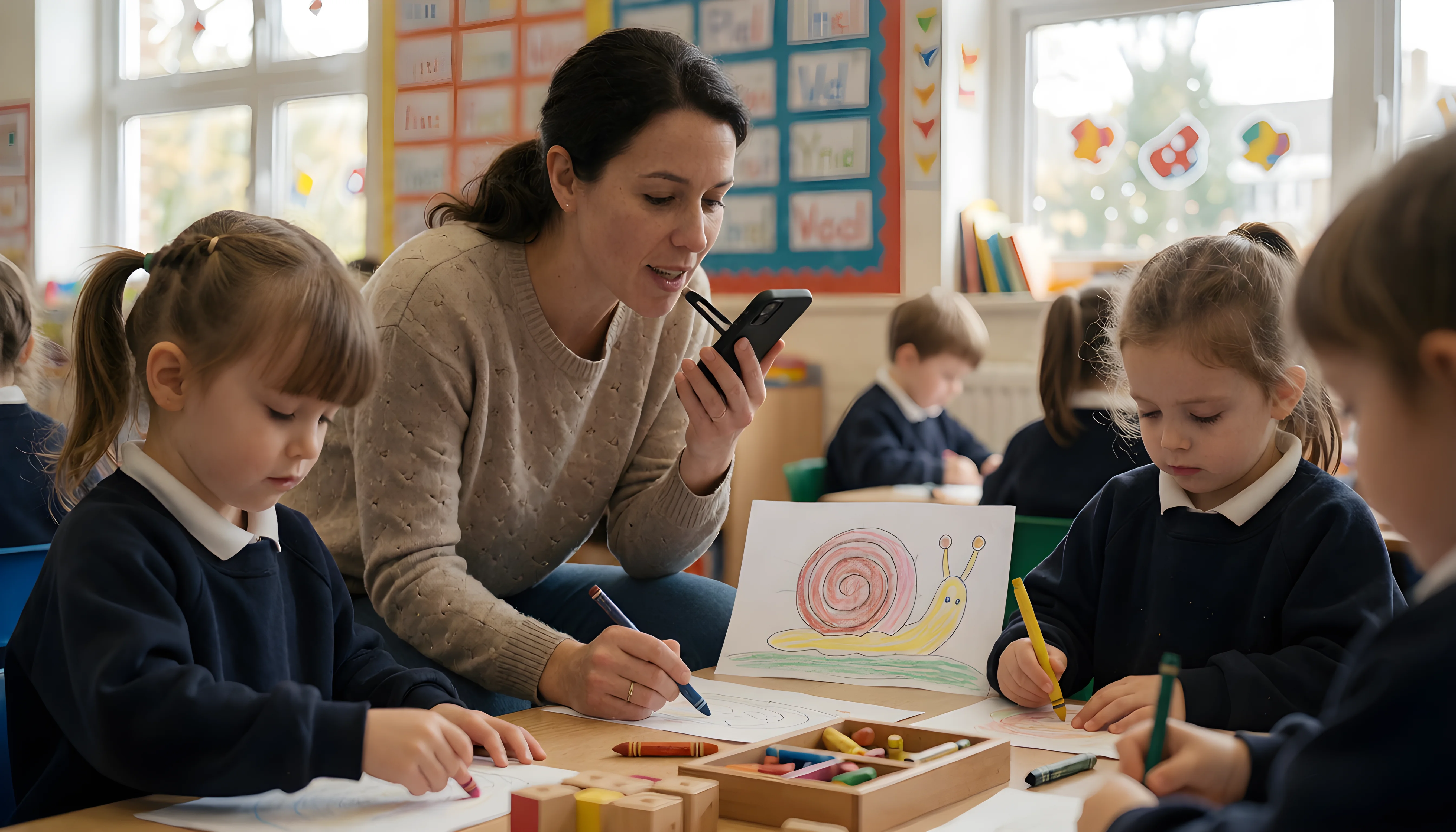
Picture a Reception classroom at ten past ten. A child who has spent six weeks avoiding the writing area has just independently labelled a diagram of a snail. In a traditional system, the teacher either stops the lesson to write it down, or trusts their memory until lunchtime, or more realistically loses the moment entirely.
With voice-recorded observations, the teacher taps once, speaks for forty seconds while the moment is still fresh, and carries on teaching. The recording is transcribed, linked to the relevant Development Matters statement or Early Learning Goal, attached to that child's learning profile, and queued for approval before it is shared with parents. No retyping. No end-of-day backlog. No lost evidence.
The same mechanic works beyond early years. In Key Stage 1 and 2, a micro observation might capture a child explaining their reasoning in maths, or reading aloud with expression for the first time. The format changes, but the principle holds: capture at the point of learning, not at the point of paperwork.
The arithmetic: where the minutes actually go
This is where the case becomes concrete. Run the numbers for a typical class and the picture is hard to ignore.
A written observation that is handwritten in the moment and then typed up properly in the evening realistically takes eight to twelve minutes end to end, once you include finding the right curriculum link and locating any photographs. A voice micro observation takes under a minute of teacher time, because the transcription, tagging and filing happen without human input.
Say a teacher aims for three meaningful observations per child per half term across a class of thirty. That is ninety observations. At ten minutes each, you are looking at roughly fifteen hours of admin per half term, or around ninety hours across the academic year. At one minute each, the same ninety observations cost ninety minutes. Even allowing generously for review and approval time, most schools running this model report reclaiming somewhere between three and five hours of teacher time per week. That is a full working day a fortnight, handed back to every member of teaching staff.
Scale that across a two-form entry primary with fourteen class teachers and the annual figure runs into the low thousands of hours. For school business managers and leaders assessing school admin software, that is not a soft benefit. It is the single largest line item in any honest workload audit.
The observation was never the problem. The transcription, the tagging and the filing were the problem, and those are precisely the jobs a computer should have been doing all along.
The compounding return at report season
The weekly savings are the headline, but the compounding effect is arguably more valuable. Micro observations accumulate into something a termly written observation never does: a genuinely longitudinal record.
By the end of a term, each child has thirty or forty time-stamped moments attached to their profile rather than three laboured paragraphs. When AI-powered progress analysis runs across that body of evidence, it surfaces patterns a human simply cannot hold in working memory. Which contexts does this child thrive in? Where has progress plateaued? Which Early Learning Goals are evidenced and which are still thin?
Report writing then stops being an act of recall and becomes an act of editing. An AI report writing assistant drafts evidence-based comments from the actual observation record, and the teacher refines them. Schools consistently describe this as the point at which the time savings become obvious to everyone, including the staff who were sceptical in September. The same record does the work twice over at parents' evenings, where pre-meeting reports pull voice observations, progress data and behaviour records into one place instead of requiring an evening of preparation per class.
Ask staff to log the time they currently spend on observation write-ups, learning journals, report drafting and parents' evening preparation for two typical weeks.
Without that figure, any workload claim your edtech provider makes is unverifiable — and you will have no way to demonstrate impact to governors.
That baseline matters for another reason. Time savings only count as workload reduction if the hours are genuinely returned to staff rather than silently absorbed by new expectations. Leadership teams that are explicit about this from the outset see far better buy-in.
What teachers actually do with the hours back
The honest answer is that some of it goes back to their families, and that is a legitimate outcome in a profession with a well-documented retention problem. But the professional dividend is real too.
Teachers report using reclaimed time for the things that genuinely move outcomes: adapting planning for the children in front of them, preparing targeted interventions, moderating assessment with colleagues, and actually responding to parent messages rather than letting them stack up. When school communication tools and observation tools share the same system, a photo observation can become a conversation with a parent in two taps, which is where meaningful parent engagement starts.
My staff are not staying late to type up learning journals any more, and the quality of evidence we have at report time is better than anything we produced on paper.
It is the first piece of technology I have introduced that teachers thanked me for. — Deputy Headteacher, two-form entry primary
Quality, not just speed
A fair challenge from any experienced school leader is whether faster means shallower. The evidence from schools running this model suggests the opposite, for one structural reason: immediacy improves accuracy.
An observation recorded forty seconds after the event captures specifics — the exact phrasing a child used, what they were holding, who they were working alongside. An observation written up eleven hours later captures a generalised impression. Quantity also changes the nature of the evidence. Three polished observations per term describe moments. Forty brief ones describe a trajectory.
The safeguard is the approval workflow. Teachers review and approve observations before parents see them, so speed of capture never compromises appropriateness or professional judgement.
The leadership case for 2025 and beyond
Workload remains the defining staffing issue in UK primary education, and the edtech 2025 conversation has rightly shifted from adding tools to removing tasks. Micro observations matter because they target the right thing: not the professional judgement of teachers, which should never be automated, but the clerical overhead wrapped around it.
If you are reviewing systems this year, the question to ask any provider is not how many features they offer. It is how many minutes per teacher per day their platform removes, and whether they can show you the working. Parent Portal was built around that question, bringing voice observations, curriculum linking, AI progress analysis, parent communication and reporting into a single platform so the evidence a teacher captures in the morning is still doing useful work at report season.
The learning was always going to happen. The only real decision is how much of your teachers' time it costs to record it.
Comments