
Lunchtime and Playtime: Managing Behaviour Outside the Classroom
Ask any primary school teacher where the trickiest moments of the day happen, and very few will point at the classroom. The flashpoints tend to arrive somewhere between the lunch hall and the playground gate — a disputed football goal, a friendship group that has quietly closed ranks, a child who has eaten almost nothing and is now in tears over a lost cardigan. Unstructured time can account for up to a fifth of the primary school day, yet it is routinely the least planned, least staffed and least recorded part of it.
For school leaders, that gap matters. Behaviour outside the classroom shapes inspection judgements, parental confidence and the emotional temperature of every afternoon lesson. Getting it right is partly cultural and partly logistical — and increasingly, the logistics are solved by better school admin software rather than by simply adding more adults in high-vis jackets.
Why lunchtime and playtime behave differently
Classrooms are highly structured environments. Children know where to sit, when to speak, what success looks like and which adult is responsible for them. Step outside and almost all of that scaffolding disappears at once. The space is larger, the noise is louder, the adult-to-child ratio drops sharply, and the social rules become negotiable. For children with additional needs, sensory sensitivities, or a shaky grasp of unwritten social codes, this is the hardest hour of the day by a considerable distance.
It is worth being honest about the staffing picture too. Midday supervisors are often the least trained and least paid members of the school community, yet they handle the most volatile part of it. They may not know which child has an active safeguarding plan, which friendship has just fractured, or which pupil has a behaviour target about keeping hands to themselves. Information, not goodwill, is usually what is missing.
The handover problem
Here is the pattern most schools will recognise. Something happens at 12:40. A supervisor deals with it, reasonably well, in the moment. The child returns to class at one o'clock carrying all of the emotion and none of the context. The teacher spends twenty minutes reconstructing events from three unreliable witnesses, and the afternoon's planned writing lesson quietly collapses.
Worse still, that incident often leaves no trace. It never reaches a record, so when the same child is involved in a similar dispute three weeks later, nobody can see the pattern. Paper notebooks in the playground get rained on, slips of paper get lost, and verbal handovers happen only if the right two adults happen to cross paths. Multiply that by a term and schools lose an enormous amount of genuinely useful behavioural intelligence.
The behaviour you see in the classroom at ten past one was usually decided at twenty to one, somewhere near the far end of the playground.
Closing that loop does not require a new policy document. It requires a way to capture what happened, in under a minute, from wherever it happened — and then to put it in front of the adults who need it next.
Capturing incidents on the move
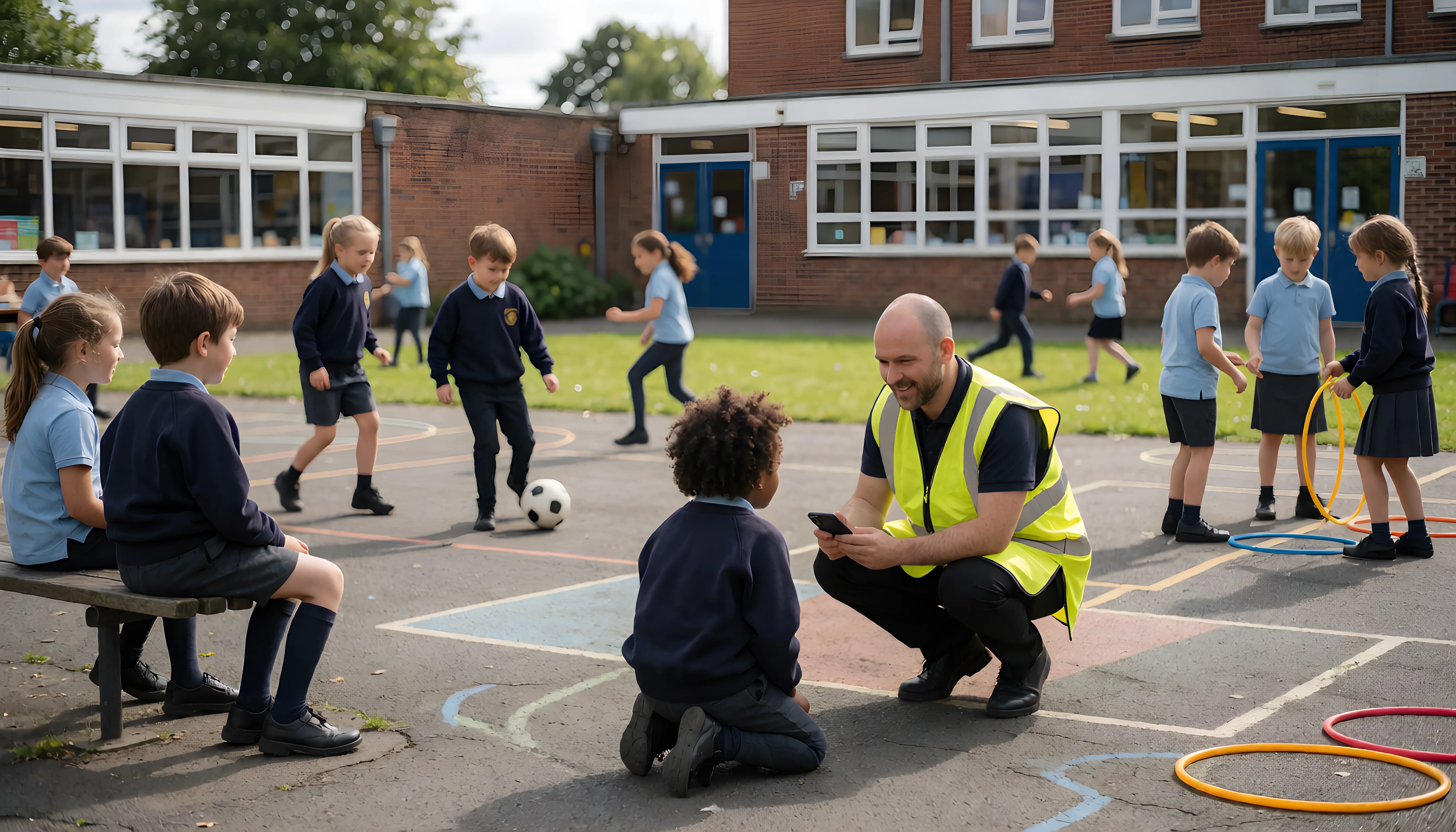
This is where mobile-first school communication tools change the day-to-day reality. A supervisor standing by the climbing frame can open an app on a phone, log a concern or an incident against the right child, and move on. Voice-recorded notes are particularly well suited to playground duty: a thirty-second spoken observation is far quicker than typing with cold hands, and it can be transcribed automatically so it becomes searchable later.
Platforms such as Parent Portal let staff log behaviour, award points, record a safeguarding concern or add a quick observation from any device, with everything flowing into the same student learning profile. By the time the class teacher sits down after lunch, the context is already there. No detective work, no guesswork, no lost afternoon.
Can the class teacher see it before the afternoon register?
Can the designated safeguarding lead view the full history for that child across a term?
If the answer to any of these is no, the gap is in your systems, not your staff.
That last question matters most. Isolated incidents are rarely the real story. A child involved in three minor playground disputes in a fortnight is telling you something that none of those incidents says on its own, and only a shared record makes that visible.
Rewards work best when they are immediate
Behaviour management outside the classroom tends to be framed entirely around sanctions, which is a missed opportunity. Lunchtime is full of genuinely admirable behaviour that usually goes unremarked — the child who includes a younger pupil in a game, the one who takes a dropped tray back without being asked, the group that tidies the equipment shed voluntarily.
Digital rewards shift that balance. When a supervisor can award house points on the spot and the child's parent receives a notification that same afternoon, the recognition lands while it still means something. Live house point leaderboards turn playtime into something children are invested in rather than something that merely happens to them. Several schools report that visible, immediate reward systems do more for lunchtime culture than any amount of additional supervision.
Now our midday team log it on their phones as they go, and I can read the whole picture before the children walk in.
It has given me back the best part of an hour a week, and parents hear about the good things far more often than the bad.
— Year 4 teacher, primary school in Greater Manchester
The workload argument is not incidental. Anything that genuinely helps reduce teacher workload at the pinch points of the day — the start of the afternoon being a classic one — compounds across a whole year.
Structure the space, not just the behaviour
Technology records and communicates; it does not design a playground. The most effective schools pair good systems with deliberate structure: zoned areas so that football does not dominate the whole space, a quiet zone for children who find the noise overwhelming, rotating equipment to keep things fresh, and trained play leaders drawn from older year groups. Many also stagger lunch sittings by key stage, which reduces both queue time and friction.
Where digital tools help is in showing you whether any of it is working. If incident logs cluster at the same time, in the same corner of the playground, or around the same activity, that is actionable intelligence rather than a vague staffroom impression.
Bringing parents into the picture
Parents almost never hear about lunchtime unless something has gone wrong, which makes every conversation about it feel adversarial. Flipping that is one of the quickest wins available in parent engagement. A photo of a child's lunchtime den-building project, a note about a kindness award, or a reward notification creates a shared, positive vocabulary — so that when a difficult conversation is genuinely needed, there is trust in the bank already.
When concerns do need raising, having the accumulated record to hand transforms the discussion. Instead of "there have been some issues at lunchtime," a teacher can describe what has been observed, when, and what has already been tried. Parents respond far better to evidence than to impressions, and AI-generated summaries of accumulated observations make preparing for those conversations a matter of minutes rather than an evening's work.
Where to start
You do not need to redesign your behaviour policy to make progress here. Start by including midday supervisors in behaviour training and giving them logging access on a device they already carry. Agree a small, shared set of categories so records are consistent. Review the data monthly with your pastoral lead and look for clusters by time, place and child. Then make sure at least half of what you communicate home about unstructured time is positive.
Lunchtime and playtime are not the gaps between the real school day. They are where children learn to negotiate, include, lose gracefully and repair a friendship — the curriculum nobody writes down. The schools making the most progress in edtech 2026 are not the ones with the most software; they are the ones that have stopped treating the playground as an information black hole and started treating it as part of the record. Give those hours the same attention you give the classroom, and the afternoons largely look after themselves.
Comments