
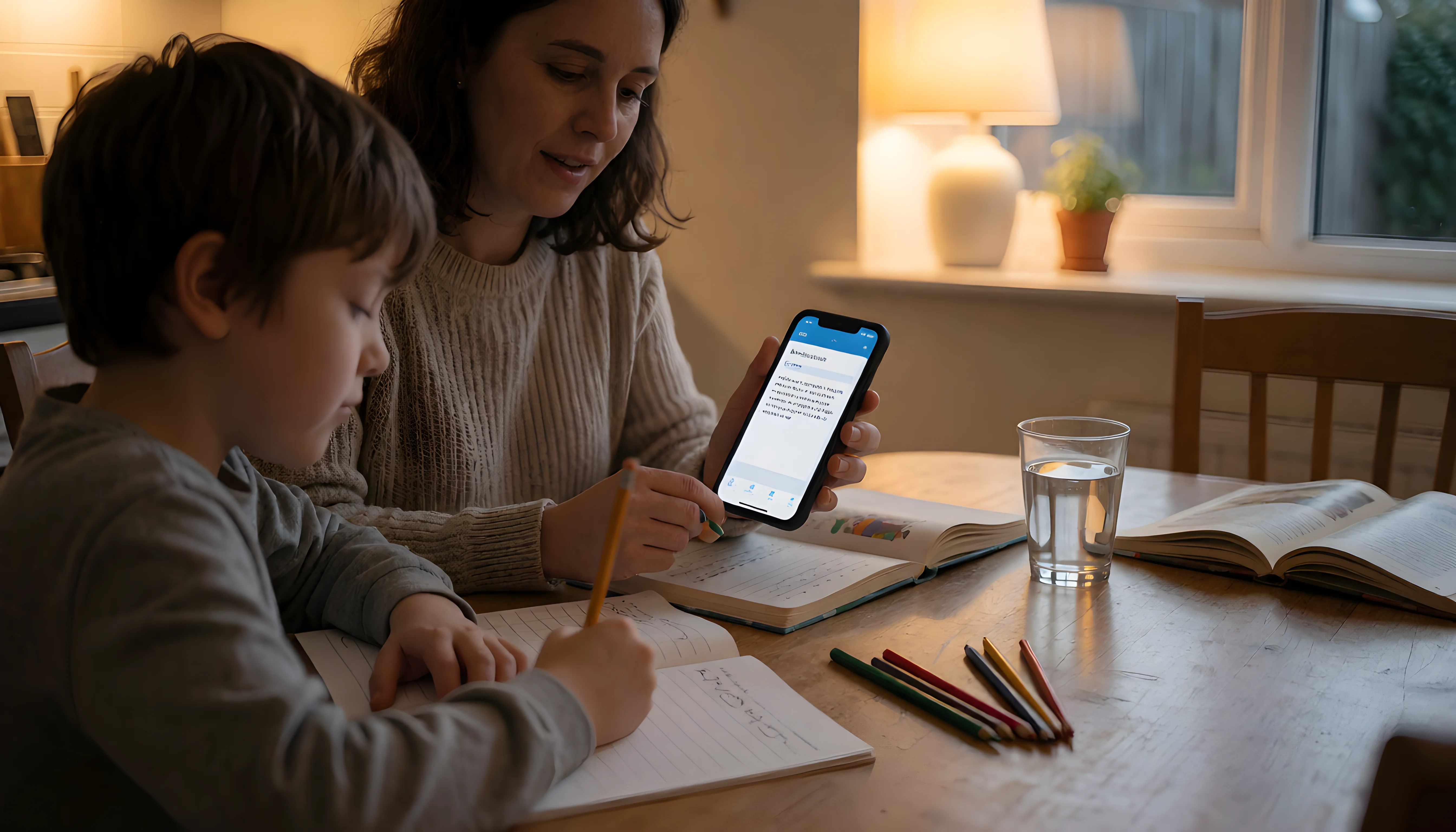
Creating Meaningful Homework That Parents Can Support
Ask ten primary teachers what they genuinely think about homework and you will probably get eleven different answers. Some see it as an essential bridge between school and home. Others see it as a Sunday evening battleground that produces more tears than learning. Most sit somewhere in between, setting it because it is expected, chasing it because it is policy, and quietly wondering whether anyone is getting much out of the exercise at all.
The research is honestly mixed, particularly at primary age. The Education Endowment Foundation has consistently noted that homework in primary schools has a smaller impact than at secondary, and that the effect depends heavily on quality rather than volume. In other words, what you set matters far more than how much you set. But there is a third factor that rarely appears in a homework policy and yet decides almost everything: whether the adult at home actually understands what they have been asked to do.
That is the gap worth closing. Not more homework, not less homework, but homework that a working parent, a grandparent, a carer with English as an additional language, or an older sibling can realistically support on a Tuesday evening at half past six.
Why Good Homework Fails at the Front Door
Most homework is not badly designed. It is badly translated. A task that makes perfect sense in the classroom, where it follows three days of modelling and a shared vocabulary, arrives home stripped of all that context. The child says the teacher explained it. The parent cannot see what was explained. The worksheet says "use the column method" and the parent learned something entirely different thirty years ago.
From there, one of three things happens. The parent does it for them, which teaches nothing. The parent teaches it a different way, which creates confusion the teacher then has to unpick. Or the homework simply does not come back, and the child starts the week already behind on a task that was meant to help them.
None of these outcomes is a parenting failure. They are design failures, and they are fixable. The fix starts with accepting that the parent is a user of your homework, not just a supervisor of it.
What Meaningful Actually Means in Practice
Meaningful homework at primary level tends to do one of four jobs well. It consolidates something already taught and understood, through short, spaced retrieval practice. It builds fluency in the handful of things that genuinely need automaticity, such as number bonds, times tables and reading. It gathers something from home that the classroom cannot provide, like a family story, a measurement from the kitchen or an interview with a relative. Or it prepares the ground for upcoming learning by sparking curiosity.
What meaningful homework almost never does is introduce brand new content, require resources a family might not have, or depend on a parent being confident in the subject. If a task only works when a parent can teach, it is not homework. It is outsourced instruction.
The best homework asks a child to practise what they already know and a parent only to show interest. The moment it asks a parent to teach, it has quietly changed into something else.
This is why reading remains the most reliable primary homework ever invented. It is low-prep, highly effective, needs no explanation, and the parent's role is simply to be present and interested. Most good homework design is an attempt to recreate those same conditions in other subjects.
Make the Instructions Do the Heavy Lifting
If there is one change that transforms homework completion overnight, it is writing instructions for the adult as well as the child. That means stating the purpose in one line, giving an estimated time, showing one worked example in the method the class actually uses, and making it explicit what parents should do if their child is stuck.
That last point matters enormously. Families need permission to stop. A line such as "if this takes more than fifteen minutes, please stop and let me know" removes the guilt, prevents the kitchen-table meltdown, and gives you better diagnostic information than a completed sheet ever would. A task that was abandoned at question three tells you something genuinely useful.
Can they tell what the child is meant to do, how long it should take, what success looks like, and what to do if it goes wrong?
If any of those four answers is unclear, the homework is not ready to go home yet.
Delivery matters as much as wording. Paper slips get lost in book bags, and a homework diary only works if someone remembers to open it. Setting homework digitally, so that the task, the instructions, the due date and any supporting resources all arrive on a parent's phone with a notification, removes an entire category of excuses. Parents can see exactly what was asked, when it is due, and whether it has been submitted.
Differentiation Without the Extra Hours
The honest objection to all of this is time. Writing clear, differentiated, well-exemplified homework for thirty children across several subjects is a serious workload, and it lands on top of planning, marking and everything else.
This is where edtech in 2025 has genuinely moved on. AI-assisted task generation means a teacher can specify a year group, an objective and a difficulty level, and get a draft set of maths, reading, writing or SPAG activities in seconds, including simplified and extension versions of the same task. The teacher's job shifts from writing from scratch to reviewing, adapting and approving, which is both faster and a better use of professional judgement.
Platforms like Parent Portal build this directly into the homework workflow, alongside comprehension generators, concept explainers that produce child-friendly versions of a tricky idea, and feedback tools that draft constructive comments on submitted work for a teacher to refine. The result is not less teaching. It is less typing.
Completion across Key Stage 2 went from about sixty per cent to over ninety in a term, and the number of parent emails asking what the task meant dropped to almost none.
Deputy Head, two-form entry primary school, Yorkshire
Closing the Loop With Feedback
Homework that disappears into a tray and returns with a tick trains children and parents alike to treat it as compliance. Feedback is what converts it into learning, and it does not need to be lengthy. A sentence naming one thing done well and one thing to try next is enough, provided the parent can see it next to the original task.
That visibility is the quiet engine of parent engagement. When a parent can see what was set, what their child submitted and what the teacher said about it, they stop guessing. They start reinforcing the right things. Conversations at parents' evenings become specific rather than general, because both sides are working from the same evidence rather than competing recollections.
Getting the Policy Right
For school leaders, the lever here is policy, and the best homework policies are short. Agree the purpose, cap the time per year group, specify what parents can expect in every task, and be explicit that incomplete homework is diagnostic information rather than a disciplinary matter. Then communicate it clearly to families at the start of the year and stand behind it when a task misfires.
Consistency across a school matters more than brilliance in individual classrooms. When every teacher sets homework the same way, through the same school communication tools, with the same structure and the same expectations, parents learn the system once and then simply use it. That consistency is worth more to a busy family than any individual clever task.
Meaningful homework, in the end, is not a question of rigour versus kindness. It is a design problem with a clear brief: short enough to finish, clear enough to start, purposeful enough to matter, and simple enough that the adult at home can support it without needing to become a teacher for the evening. Get that brief right and homework stops being a weekly negotiation. It becomes one of the most ordinary and effective partnerships a school has.
Comments