
Privacy and Safeguarding: Voice Recording Student Observations Safely
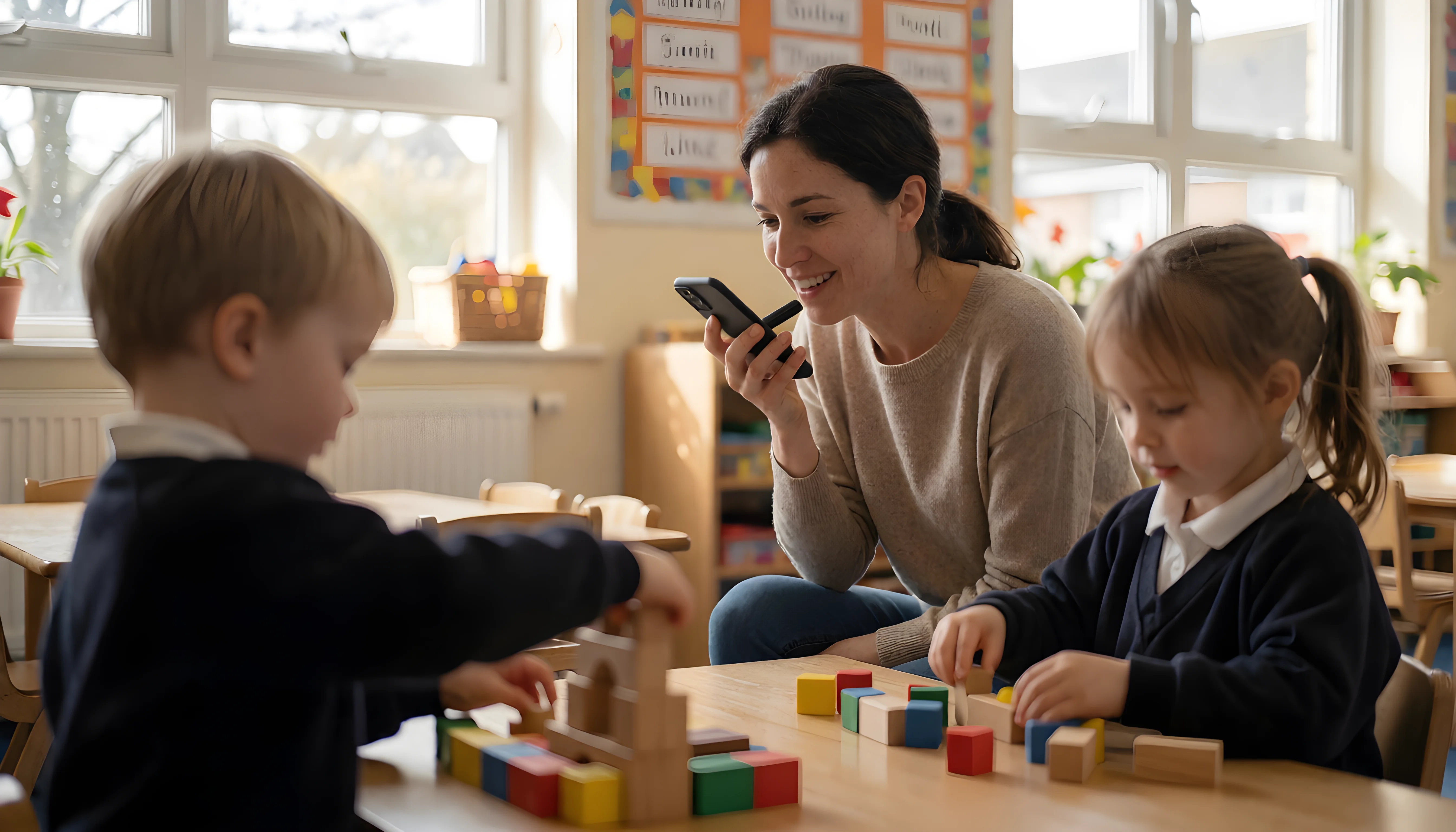
Voice-recorded observations have quietly become one of the most useful tools in the early years classroom. Instead of scribbling on a sticky label at the end of a busy session and hoping memory fills the gaps, a practitioner speaks for thirty seconds while the moment is still warm — what the child did, what they said, what it reveals about their thinking. The detail is richer, the admin burden is lighter, and the picture that builds across a term is genuinely longitudinal rather than a scatter of disconnected snapshots.
But a voice note is not a sticky label. It is a recording of a real child's voice. It often names other children. Occasionally it captures a passing remark about a family situation that was never meant for a wider audience. That is personal data, and sometimes special category data. Schools adopting voice observation tools need to be as confident about the privacy architecture as they are about the pedagogy — and in the current edtech 2025 and 2026 landscape, where AI transcription and analysis sit on top of those recordings, that confidence has to be earned rather than assumed.
The question most schools skip
Before anyone asks which platform, the better question is: what are we actually recording, and why? Observation audio exists to evidence a child's learning and inform what happens next. It is not a general-purpose classroom microphone, and it is not a behaviour surveillance tool. Getting that purpose written down — plainly, in one or two sentences — makes almost every subsequent decision easier, because every feature, permission and retention rule can be tested against it.
Schools that struggle with observation privacy usually struggle because the purpose was never defined. Staff record whatever feels useful, recordings accumulate indefinitely, and nobody is quite sure who can hear them. A tight purpose statement is the cheapest compliance control available.
Lawful basis, and why consent is usually the wrong one
Under UK GDPR, a maintained school processing observation data for assessment is almost always relying on public task — the statutory duty to educate and assess children — rather than consent. Independent settings and nurseries typically rely on legitimate interests. This matters practically: consent must be freely given and withdrawable, so if you build your observation programme on consent, a parent withdrawing it means deleting the evidence base for that child's EYFS assessment. That is a bad place to be in March of a reception year.
Consent still has a role, but a narrower one. Sharing photographs and video with wider audiences, using images in newsletters or on social media, or including a child's likeness in displays — those are separate purposes that genuinely do need separate, specific, recorded consent. Keep the two apart in your documentation and your systems.
1. Your privacy notice names voice recording and AI transcription explicitly — not just "observations".
2. You have a Data Protection Impact Assessment on file, since this is systematic monitoring of children.
3. Your provider's Data Processing Agreement states where data is stored and whether it is used to train models.
4. Your retention schedule says how long audio is kept and what triggers deletion.
That DPIA is not a formality. The ICO treats children's data as warranting particular care, and systematic observation of young children sits squarely in the territory where a DPIA is expected. Done properly it takes an afternoon, and it is the single document most likely to make an inspection or a parental complaint straightforward rather than stressful.
Data minimisation is a staff habit, not a setting
No platform can stop a practitioner recording more than they need. Training does. The useful rule of thumb is: record the learning, not the room. A good voice observation describes one child's action and the practitioner's interpretation of it. A poor one is ninety seconds of ambient classroom noise with three other children audible and a staff conversation in the background.
Practical habits that make a measurable difference: name the focus child, refer to other children by initial rather than full name, stop recording the moment the observation is complete, and never use the observation tool to vent about a child's behaviour or a parent. Anything you would not want read aloud at a parents' evening does not belong in an observation.
The test is not whether a recording is technically secure. It is whether you would be comfortable sitting beside the child's parent and pressing play.
That test is deliberately uncomfortable, and it is the most effective staff training line we know of. It reframes privacy from a compliance chore into professional judgement, which is where it belongs. It also tends to improve the quality of observations, because recordings made with an audience in mind are sharper and more focused on learning.
Who can listen, and who approved it
Access control is where good school communication tools earn their keep. Observation audio should be visible to the child's class team and leadership, not to every member of staff with a login. Nursery keyworker arrangements need their own permission boundary. And crucially, there should be an approval step between recording and sharing: a practitioner records, reviews, and only then releases the observation to parents.
That workflow catches the realistic mistakes — the recording that accidentally names another child, the one where the practitioner trailed off mid-sentence, the one tagged to the wrong profile. In Parent Portal, observations sit in an approval queue until a teacher releases them, and every parent-facing share is logged. Reviewing before sharing takes seconds and prevents the kind of incident that erodes parental trust for a whole year.
What changed our minds was the approval step. Nothing reaches a parent until the class teacher has listened back and released it.
Our DSL has her own access route for anything that becomes a concern, and every listen is logged.
Two terms in, our EYFS evidence is the strongest it has ever been and we have not had a single privacy query.
— Deputy Head, two-form entry primary, West Midlands
When an observation becomes a safeguarding concern
Sometimes a child says something in an observation that is not about learning at all. The moment that happens, the recording changes category — it is no longer assessment evidence, it is safeguarding information, and it needs to move into a different system with different rules.
Your process should be unambiguous: the observation is not shared with parents, the designated safeguarding lead is notified, and the content is recorded in the safeguarding log with the audio preserved as evidence under restricted access. Staff should never have to improvise this. Write it into your safeguarding policy alongside your observation policy, and rehearse it in September training.
Retention: the control schools forget
Most settings get consent and access right, then keep every recording forever because deleting things feels risky. It is the opposite. Audio held beyond its purpose is pure liability. A defensible position is to retain observation audio for the academic year plus the transition period, retain the transcription and assessment judgement for the statutory period, and delete the raw recording once the evidence it supported has been written up. Set it as a policy, automate it where your platform allows, and audit it annually.
Getting the balance right
None of this is an argument against voice observations. They are one of the clearest wins available for parent engagement and for reducing teacher workload, and the schools using them well are producing assessment evidence that written notes could never match. The point is that the privacy work is small, front-loaded and entirely achievable: a purpose statement, a lawful basis, a DPIA, a privacy notice that mentions audio, trained staff, an approval workflow, access controls and a retention rule.
Do that once, properly, and your practitioners can get on with the part that matters — noticing children, and telling their parents what they noticed. If you would like to see how approval workflows, safeguarding routing and retention controls work in practice, the team at Parent Portal is happy to walk your leadership and DPO through it.
Comments