
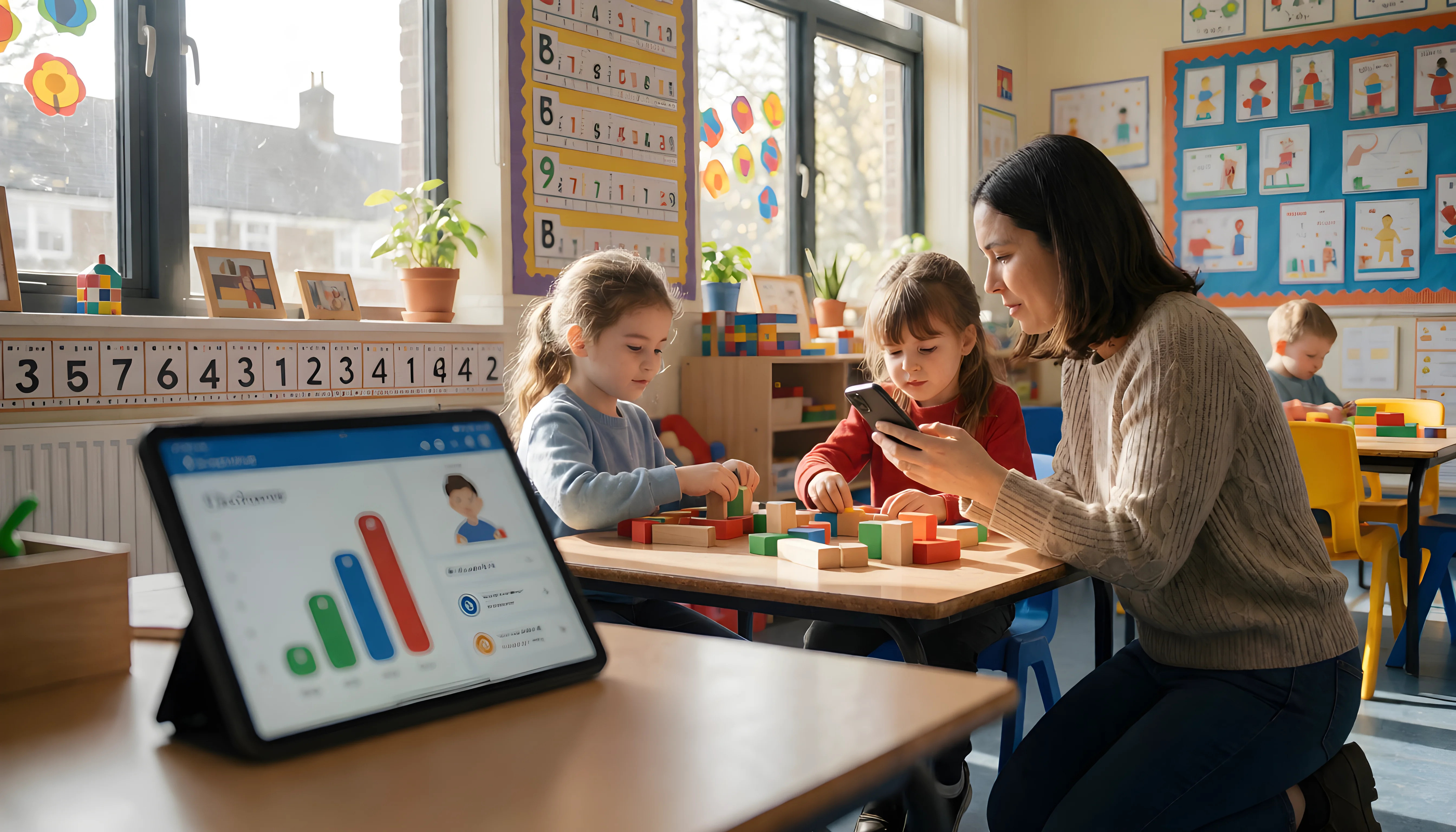
The Rise of AI-Powered Student Progress Analysis
Ask an experienced primary teacher what they know about a child in their class and you will hear something remarkable. They know who needs a nudge to start writing and who needs silence. They know which child has suddenly started counting beyond twenty at the snack table. They know the quiet one who has begun joining in at carpet time. The problem has never been that teachers don't notice. The problem is that all of this noticing lives in notebooks, memories, sticky notes and half-finished spreadsheets — and almost none of it survives to the moment it matters most.
That is the gap AI-powered student progress analysis is starting to close, and it is quickly becoming one of the most talked-about developments in edtech 2025. Not because it replaces professional judgement, but because it finally does something useful with the mountain of evidence teachers were already generating.
The observation problem every school recognises
Observation has always been the beating heart of formative assessment, particularly in Early Years. Development Matters, the Early Learning Goals and age-related expectations across the Key Stages all depend on teachers capturing authentic moments of learning as they happen. In theory it is beautiful. In practice, it collapses under its own weight.
A teacher with thirty children cannot write meaningful prose about each of them every week. So observations get batched, written retrospectively on a Sunday evening, or quietly abandoned. When report season arrives, staff are left reconstructing a year of learning from fragments. When a parent asks how their child is really getting on, the honest answer is often an impression rather than an evidence trail. And when a child moves classes, most of that accumulated insight simply evaporates.
This is not a motivation problem. It is a data problem — and it is exactly the kind of problem machines are good at.
What AI-powered progress analysis actually does
Strip away the hype and the mechanism is straightforward. Teachers capture small, frequent observations in whatever format is fastest — most commonly a 30 to 60 second voice note recorded in the moment, alongside photos and short videos. Those recordings are transcribed automatically and tagged to the child, the class, and where relevant the curriculum objective. Nothing is retyped. Nothing is lost.
Over a term, those micro-observations accumulate into something no single note could ever provide: a longitudinal picture. AI then analyses that body of evidence and surfaces what a human would struggle to see across hundreds of fragments — recurring strengths, emerging gaps, learning preferences, plateaus, and suggested next steps. A teacher might record forty short notes about a child without consciously registering that eighteen of them describe collaborative play and only two touch on independent writing. The pattern was always there. It just wasn't visible.
Observations should be linkable to Development Matters, Early Learning Goals and National Curriculum objectives — not stored as loose notes.
Voice capture should take seconds, not minutes, or staff won't use it in a busy classroom.
AI summaries should cite the underlying observations so any judgement can be traced back to real evidence.
Teachers must be able to review and approve anything before it reaches parents.
All processing should be UK GDPR compliant with clear data processing agreements in place.
Within Parent Portal, this analysis sits alongside the observation tools themselves, so the evidence and the insight live in the same place. Teachers aren't exporting data into a separate assessment platform or reconciling two systems that disagree with each other — a familiar frustration for anyone who has managed school admin software over the past decade.
Where it genuinely reduces teacher workload
Workload claims in edtech deserve scepticism, so it is worth being specific about where the time actually comes back.
The biggest win is reporting. End-of-term report writing is one of the most disliked tasks in the profession, largely because teachers are asked to produce thirty unique, evidence-based paragraphs from memory under time pressure. When an AI report writing assistant can draw on a term's worth of real observations for each child, the starting point is no longer a blank box — it is a draft grounded in things that genuinely happened. Teachers edit, personalise and sign off rather than generating from nothing.
The second win is consultation preparation. Instead of hunting through folders the night before, staff open a pre-meeting view showing accumulated observations, progress data, behaviour records and attendance in one place. After the meeting, AI-generated summaries capture agreed actions and targets, so nothing depends on whoever remembered to scribble on the back of a timetable.
The goal was never to automate professional judgement. It was to stop asking teachers to hold a year of evidence in their heads and then perform it on demand in July.
The third win is less obvious but arguably the most valuable: intervention timing. Patterns that would previously have surfaced at a termly pupil progress meeting can surface within weeks. For SENCOs and senior leaders, that shift from retrospective to current is the difference between explaining a dip and preventing one.
What it means for parent engagement
There is a secondary effect that schools often underestimate. Once observations are captured consistently and analysed properly, they become shareable. Parents stop receiving a vague termly verdict and start receiving a running narrative — the photo of their child building a bridge, the voice note about them finally blending a tricky word, the achievement that would otherwise have passed unremarked.
This is where progress analysis and school communication tools converge. Evidence that exists only in a teacher's assessment folder helps the school. Evidence that reaches the family changes the conversation at home. Parent engagement improves not because schools communicate more, but because they finally have something specific to communicate.
Deputy Headteacher, two-form entry primary school
It also helps families who have historically been hardest to reach. Automatic message translation and multi-language support mean an observation shared with an EAL family lands in a language they read comfortably, rather than sitting unopened.
Keeping humans firmly in the loop
None of this works without guardrails, and school leaders are right to insist on them. Three principles matter.
First, approval before publication. Every observation and AI-generated summary should pass through a teacher's review before a parent sees it. Second, traceability. An AI summary that cannot be traced back to specific observations is an opinion, not evidence, and has no place in statutory assessment. Third, data protection by design — UK GDPR compliance, role-based access, and strict separation between general observations and sensitive safeguarding records.
Used this way, AI is doing clerical work, not pedagogical work. The teacher still decides what a child has learned and what comes next. The machine just makes sure the evidence is there when that decision is made.
Where this is heading
Progress analysis is becoming the backbone that other tools plug into. The same observation data that writes reports also informs differentiated homework, targeted lesson planning and honest parents' evening conversations. Schools that start capturing evidence properly now will have years of longitudinal insight by the time those capabilities mature. Schools that don't will still be reconstructing July from memory.
If your staff are already observing brilliantly and simply losing it, the technology is no longer the barrier. Explore how Parent Portal brings observations, progress analysis and parent communication into one platform at parentportal.com.
Comments