
Multilingual Voice Notes: Supporting EAL Students and Teachers
There is a moment familiar to almost every primary teacher. A child who has been in the country for six weeks does something genuinely brilliant — they explain a maths strategy to a partner, or they read a whole sentence aloud for the first time without stopping — and you desperately want their family to know about it. So you write a line in the reading record. You send a message home. And it comes back unsigned, unread, unacknowledged. Not because the family does not care. Because the note was in English, and nobody at home could read it comfortably.
Around one in five pupils in English primary schools speaks English as an additional language, and in some urban schools that figure is closer to nine in ten. Yet the default mode of school-to-home communication has barely changed in thirty years: it is written, it is in English, and it assumes a parent with the time, confidence and literacy to decode it. For a significant slice of our communities, that assumption quietly fails every single week.
Why the written word is the wrong default for many families
Written English is the hardest form of the language to access. A parent may be perfectly able to hold a conversation at the school gate while finding a formal written newsletter — with its idioms, its acronyms, its phonics screening checks and age-related expectations — genuinely impenetrable. Add the emotional weight of anything to do with your own child's progress, and the barrier gets higher still. Many parents simply stop engaging rather than risk misunderstanding something important.
Translation alone does not solve it either. A translated letter still requires reading. It still arrives detached from any sense of who the teacher is or how they feel about the child. And in practice, translated letters are expensive, slow, and produced only for the big set-piece communications — admissions, consent forms, safeguarding policies — never for the small daily moments that actually build a relationship between home and school.
What a multilingual voice note actually looks like
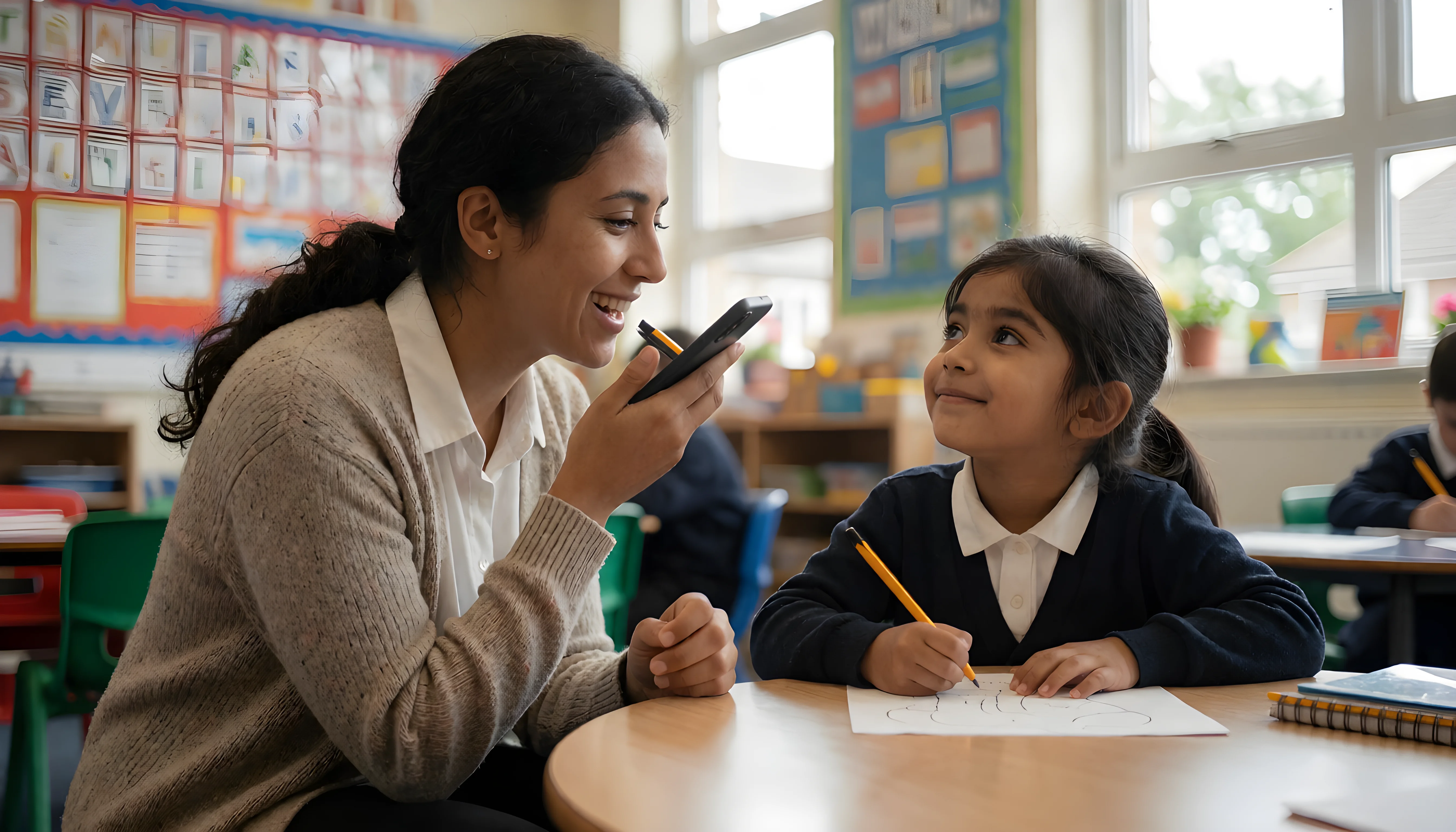
A voice observation is deliberately tiny. A teacher taps record, speaks for thirty to sixty seconds about what a child has just done, and moves on. No typing, no form, no end-of-day catch-up session. "Amira just used the word because for the first time in a full sentence to explain why the ice melted. She was so pleased with herself she told the teaching assistant twice." That is the entire observation. It took forty seconds to make.
From there, the technology does the heavy lifting. The audio is transcribed automatically, linked to the relevant curriculum or Development Matters objective, and — crucially — the written text can be translated into the family's home language before it reaches them. The parent receives a push notification, reads the update in the language they think in, and can still hear the teacher's actual voice underneath it. Warmth and clarity, in the same message.
The point was never to send parents more information. It was to send them information they could actually use.
That distinction matters more than it sounds. Schools are rarely under-communicating by volume. The problem is that the volume lands in a format a chunk of the community cannot absorb, which then gets misread as disengagement — and sometimes, unfairly, as not valuing education.
The quiet benefit for the child
There is a second, less obvious advantage, and it is about the pupils rather than the parents. EAL learners in the early stages of acquisition are frequently in a silent period: understanding far more than they can produce, and producing far more orally than they can write. If your evidence base for a child's progress is written work, you will systematically underestimate them. Voice-recorded observations capture the things that never make it onto paper — the gesture, the one-word answer that proves comprehension, the home-language conversation with a peer that demonstrates sophisticated reasoning.
Because each note is timestamped and linked to objectives, AI-powered progress analysis can surface patterns across a term — emerging vocabulary, growing confidence in group work, areas needing targeted support.
For EAL learners, that trajectory is often far more informative than any single assessment snapshot.
Over a term, those fragments accumulate into something genuinely useful: evidence of progress for a child whose written output has not yet caught up with their thinking. It is also exactly the evidence you need when writing reports, preparing for a consultation, or justifying additional support.
What it means for teacher workload
Any school leader reading this will immediately ask the right question: does this add to the job? Honestly, it can — if it is implemented as yet another thing to complete. The schools that get it right treat voice notes as a replacement for existing recording, not an addition to it. Speaking for forty seconds is quicker than typing an observation, considerably quicker than writing a report comment from a blank page, and infinitely quicker than chasing a parent who did not understand last week's letter.
The compounding effect comes at the pressure points. When report season arrives, an AI report writing assistant can draw on a term of accumulated observations to generate evidence-based draft comments for each child, which the teacher then edits and owns. The same data feeds pre-meeting reports before parents' evenings. For any school looking seriously at how to reduce teacher workload rather than just redistribute it, that shift — capture once, reuse everywhere — is where the real time is found.
Before this, our EAL parents got the same letters as everyone else and we hoped for the best. Now they hear my voice and read it in Romanian or Urdu the same afternoon.
Attendance at parents' evening went from about half our EAL families to nearly all of them.
— Early Years Lead, two-form entry primary
That last detail is the one leaders tend to seize on, because consultation attendance is a visible, measurable proxy for parent engagement — and it is usually the metric where EAL families appear to be falling behind.
Parents' evenings that actually include everyone
Consultations are where language barriers do the most damage, because they are time-boxed and high-stakes. Ten minutes is not long when meaning has to be negotiated, and the usual workaround — an older sibling or a bilingual staff member translating on the fly — is uncomfortable for everyone and occasionally inappropriate, particularly if the conversation turns to behaviour or wellbeing.
Shifting the groundwork into voice notes changes the shape of the meeting. If a parent has already received and understood twenty short observations across the term, the consultation is no longer an information dump; it is a conversation about next steps. Online booking removes the phone call that nobody wanted to make, virtual appointments remove the childcare problem, and AI-generated meeting summaries mean the agreed actions exist in writing afterwards — translatable, revisitable, and not dependent on anyone remembering correctly.
Where to be careful
Machine translation is good, not perfect, and professional honesty matters here. It handles concrete description well and struggles with educational jargon, idiom and nuance — so write for translation: short sentences, plain words, no acronyms. Avoid relying on automated translation for anything legally or emotionally serious. Safeguarding disclosures, SEND decisions and formal concerns need a qualified human interpreter, every time, and should be logged through proper safeguarding channels rather than a casual observation.
An approval workflow is also non-negotiable. Voice notes are fast and informal, which is their strength and their risk. A quick review step before anything reaches a parent catches the misnamed child, the throwaway remark, the comparison to a classmate. And be transparent with families about what is recorded, how it is stored and how long it is kept — UK GDPR compliance is a baseline expectation, not a feature.
A realistic first half-term
Do not launch this across the whole school in September. Pick one year group, ideally Early Years or Year 1, where the EAL cohort is largest and observational practice is already established. Ask those teachers for three voice notes per child per half-term — a low enough bar that it gets done. Identify your top three or four home languages and check translation quality with a bilingual member of staff or a willing parent before you scale.
Then measure something. Message open rates by language group, consultation attendance, form return rates. The case for investment in school communication tools or new school admin software is always stronger with numbers attached, and this is one of the few edtech 2025 initiatives where the impact shows up within a single term.
None of this is really about technology. It is about a thirty-second recording reaching a family who, for the first time, can hear exactly what their child did at school today — and understand every word of it. That is not a feature. That is the whole job.
Comments