
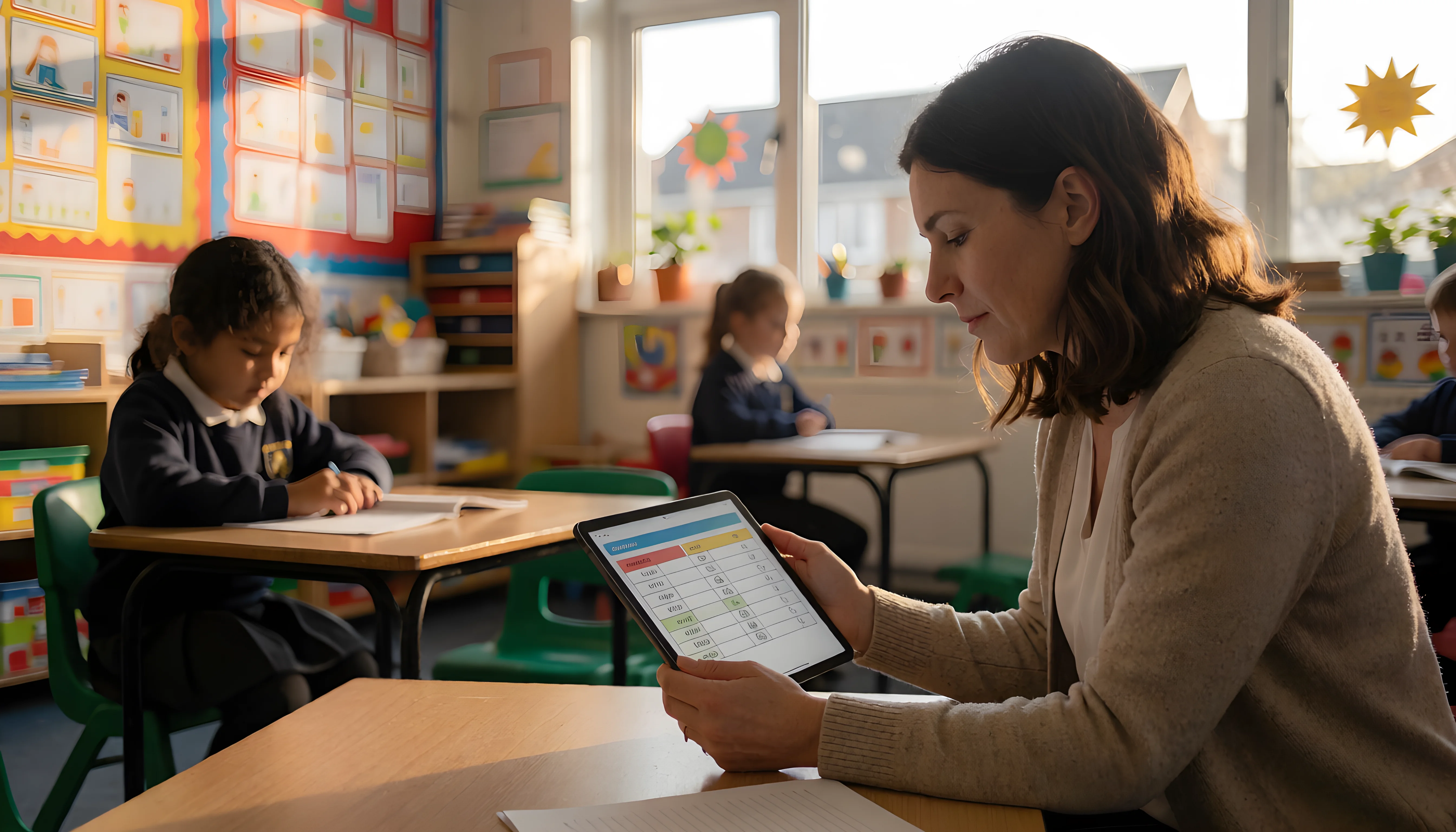
Recognising Warning Signs: Digital Behaviour Tracking
Every teacher knows the feeling. A child who used to bounce through the door starts arriving late and quiet. A pupil who always had their hand up now sits at the back with their hood half up. A reception child who settled beautifully in September begins crying at drop-off again in February. Something has shifted — but you cannot quite say when it started, or whether this is one difficult fortnight or the beginning of something that needs a proper conversation with a parent.
This is the hardest part of pastoral work in a primary school, and it is rarely about effort or care. The warning signs are almost never dramatic. They are small, slow, and spread across different people: the teaching assistant who noticed an untouched lunch, the office staff member logging a third late arrival, the class teacher who sent a behaviour note home six weeks ago and has taught four hundred lessons since. The information exists. It just is not in the same place at the same time.
Why paper trails hide the pattern
Most schools already collect far more behavioural information than they realise. The trouble is where it lives: an incident slip in a tray, a line in someone's planner, a message in a staffroom conversation, a spreadsheet that only one person updates. Each record is perfectly sensible on its own. Together, they are almost unreadable.
The consequence shows up at exactly the wrong moment. When a concern is finally raised formally, someone spends an afternoon reconstructing a timeline from memory, half-remembered dates and scraps of paper — and the resulting picture is thin precisely when it needs to be strong. Worse, the children most likely to slip through are the ones who never cross an obvious threshold. A pupil with one serious incident gets noticed. A pupil with eleven small, inconsistent, low-level signals across two terms often does not.
What digital behaviour tracking actually means
It is worth saying clearly what this is not. Digital behaviour tracking is not surveillance, and it is not about reducing a child to a score or a colour. It is about making small moments quick enough to capture that staff actually capture them — and then making them readable as a group rather than as isolated events.
In practice, good school admin software does three things. It lowers the cost of logging something to a few seconds, so a busy Year 3 teacher does it on the spot instead of meaning to do it at four o'clock. It keeps everything about one child in one chronological place. And it surfaces trends that no single member of staff could reasonably hold in their head.
A single late mark is admin. Three late marks, a reward streak that quietly stopped, and a child who has gone silent in group work is a story — and stories are what safeguarding leads can act on.
That shift, from incidents to patterns, is the whole point. It changes the question from was this serious enough to report? to what has been happening to this child over the last six weeks?
Joining the dots: attendance, behaviour and observations
Attendance is one of the most reliable early indicators schools have, and it is frequently the first thing to change. A digital register taken on any device, combined with attendance analytics by class, year group or individual pupil, turns scattered marks into a visible trend line. Automated absence notifications close the loop with families the same morning rather than days later, and when parents report absences through an app, the reasons they give become part of the record too.
Classroom observations add the texture that attendance data cannot. Voice-recorded observations are particularly effective here, because a thirty-second note dictated between activities costs a teacher almost nothing. Over a term, those transcribed micro-observations build a genuinely longitudinal picture of a child — not just what they achieved, but how they were. AI-powered progress analysis can then read across the accumulated notes and flag shifts in engagement, confidence or peer interaction that a human reader might only notice in hindsight.
Punctuality and absence patterns, especially clusters around particular days.
Changes in engagement, participation or friendship groups.
Reward and house point activity that drops off sharply.
Appetite, tiredness, toileting changes and shifts in nursery daily routines.
Uniform, equipment or homework completion becoming inconsistent.
Parental contact that suddenly becomes harder to make.
None of these indicators means anything in isolation, and that is exactly why they need to sit side by side. The value is in the overlap.
Rewards data tells a story too
Schools often think of behaviour tracking as logging what went wrong. In reality, the positive record is just as diagnostic. A digital rewards system that awards points for effort and achievement produces a continuous baseline for each child, and baselines make deviations obvious. A pupil who earned points most weeks since September and has earned none since half term has told you something — without a single incident report being written.
Last term we picked up on a Year 4 pupil nearly six weeks earlier than we would have before, and that conversation with mum changed the whole outcome.
Deputy Head, two-form entry primary school, West Yorkshire
From concern to safeguarding record
There is an important line between pastoral monitoring and a formal safeguarding concern, and your systems should respect it. Safeguarding concern logging needs detailed notes, actions taken, staff involved and a secure audit trail — with access restricted to designated safeguarding leads and every view logged. Concern history and tracking then allows a DSL to see every previous entry for that child, including interventions that were tried and what followed.
This matters enormously at transition points and when families move between settings. A child's record that reads as a coherent history, rather than a folder of disconnected forms, is far more useful to the next person responsible for their welfare.
Bringing parents in before it escalates
The best outcome of spotting a pattern early is a conversation, not a referral. Strong school communication tools make that conversation easier to start: direct messaging between teacher and parent, photos and observations shared as context, and push notifications so nothing sits unread for a week. For families with English as an additional language, automatic message translation removes a barrier that frequently delays exactly these discussions. Family group management means both parents or carers receive the same information, which is essential in separated or shared parenting arrangements.
This is where behaviour tracking stops being an administrative exercise and becomes genuine parent engagement. Parents very often hold the missing piece — a bereavement, a house move, a new sibling, a change in sleep. They simply need to be asked at the right moment.
Keeping it sustainable for staff
Any system that adds half an hour to a teacher's day will be abandoned by November, however well designed. The honest test of whether a tracking approach will survive is whether it reduces teacher workload overall. Thirty-second voice notes replace written logs. Observations already captured feed into end-of-term reports and parents' evening preparation instead of being rewritten. AI-generated meeting summaries capture agreed actions so staff are not typing up notes at nine in the evening.
Agree a short list of what everyone logs, make sure support staff and keyworkers are included rather than reporting verbally, and review patterns at a fixed point each half term. The discipline of a regular read-through matters more than the volume of data collected.
The direction of travel
Much of the edtech 2025 conversation has focused on lesson planning and marking, and understandably so. But the quieter, more significant shift is in pastoral intelligence: schools moving from reactive incident management to recognising early, patterned change in a child's wellbeing. With a GDPR-compliant platform, proportionate access controls and parents treated as partners, that shift improves outcomes without turning classrooms into monitoring stations.
Parent Portal brings attendance, behaviour, rewards, observations, safeguarding records and parent communication into a single platform built for UK primary schools, nurseries and early years settings — so the pattern is visible while there is still time to act on it. Explore how it works at parentportal.com.
Comments