
How Micro Observations Strengthen Parent-Teacher Relationships
Ask almost any parent what they want from their child's school and the answer is rarely a glossy report or a polished newsletter. It is something far simpler: they want to know their child is known. Not tracked, not graded, not benchmarked against the national average, but genuinely noticed as an individual by the adults who spend six hours a day with them.
That is the gap micro observations fill. And for schools investing in parent engagement and better school communication tools, it is one of the highest-impact changes you can make this academic year.
What Exactly Is a Micro Observation?
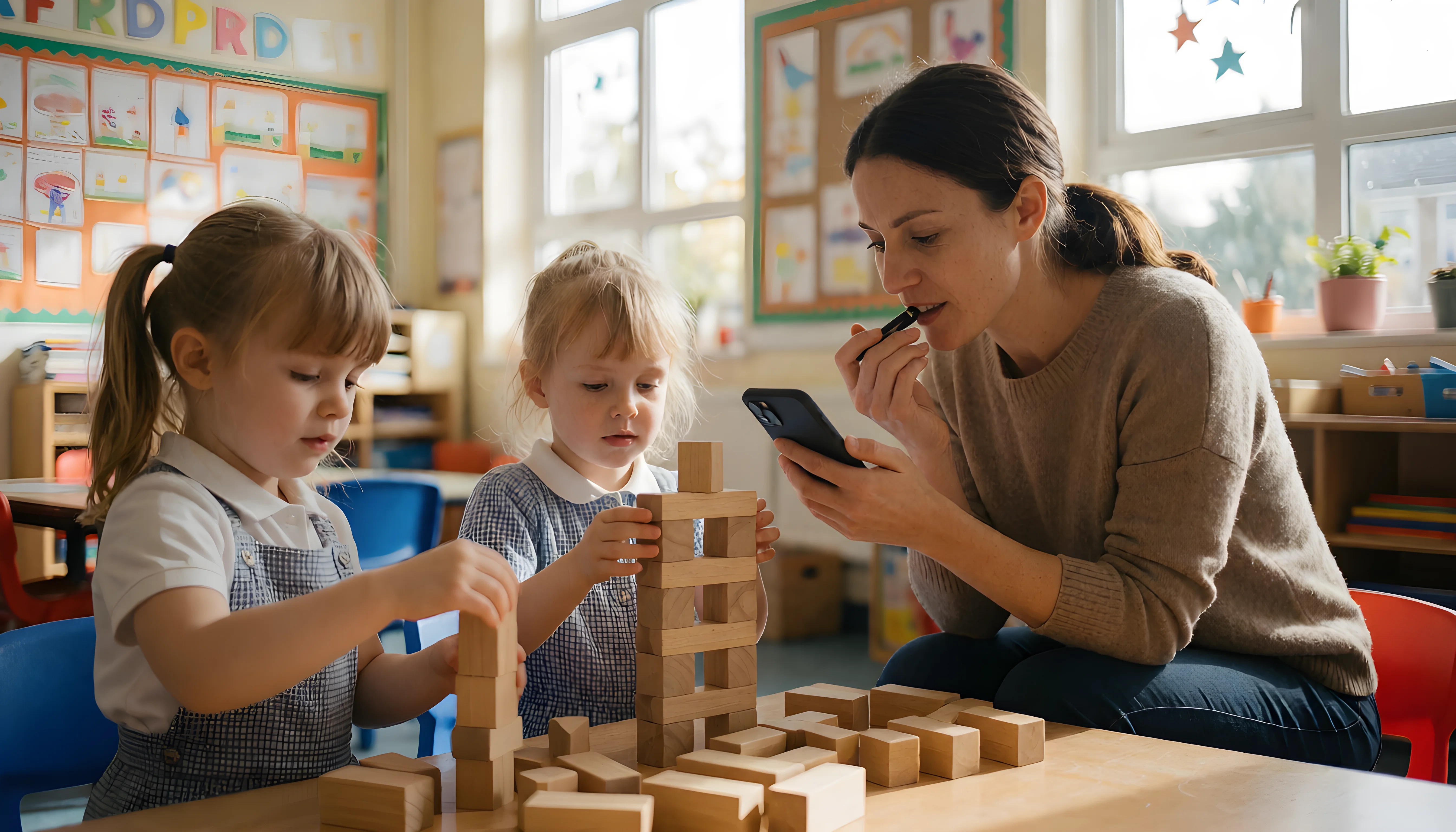
A micro observation is a small, specific, in-the-moment capture of a child's learning. It might be a thirty-second voice note recorded while a teacher is still crouched beside the sand tray. It might be a photograph of a tower that finally stayed standing on the fifth attempt, or a short video of a reluctant reader sounding out a tricky word unaided for the first time.
What makes it a micro observation is the scale. It is not a formal written assessment, nor a three-paragraph summary composed after school. It takes under a minute, it happens while the learning is still happening, and it records what the child actually did and said rather than a generalised judgement about their ability.
Individually, these moments look almost trivial. Accumulated across a term, they become something no termly report can replicate: a longitudinal, evidence-based picture of a real child developing in real time.
Why Termly Reporting Leaves Parents Guessing
Traditional reporting cycles create an awkward rhythm. Parents hear almost nothing for ten weeks, then receive a dense document or a ten-minute consultation slot in which they are expected to absorb everything at once. When concerns do arise, they land without context, and the conversation starts cold.
Worse, the information itself is often compressed to the point of meaninglessness. "Working at the expected standard in writing" tells a parent nothing about their child. It does not tell them that their daughter now reaches for adjectives unprompted, or that their son writes beautifully when the topic is dinosaurs and freezes when it is a recount of the weekend.
Micro observations change the texture of that relationship entirely. Instead of a single high-stakes update, families receive a steady drip of small, specific, recognisable moments. Trust builds incrementally, in the gaps between the formal milestones.
Parents do not need more information about their child. They need better evidence that someone is paying attention.
The Workload Objection, And Why It Does Not Hold
The immediate reaction from most teachers and school leaders is entirely reasonable: this sounds like more work. Observation has historically meant paperwork, and paperwork in the early years has a long and painful reputation.
But the economics of observation have shifted. Voice-recorded observations are the clearest example. A teacher speaks for forty seconds, the recording is automatically transcribed, and the note exists permanently without a single keystroke. Compared with writing the same observation longhand at 5pm from a half-remembered moment, it is faster, more accurate and considerably less draining.
The compounding benefit arrives later. Those accumulated observations are the raw material for everything else: progress tracking, pre-meeting preparation, end-of-term report comments. When AI analysis sits on top of a term's worth of voice notes, it can surface patterns a busy teacher genuinely cannot hold in their head across thirty children, identifying strengths, areas for development and suggested next steps. Report writing stops being a blank-page exercise and becomes a matter of reviewing and refining evidence you already gathered. For schools serious about how to reduce teacher workload, that shift matters more than any single time-saving feature.
In Parent Portal, teachers can tag EYFS observations against Development Matters statements and Early Learning Goals, or link Key Stage observations to National Curriculum objectives.
Progress is then tracked automatically against age-related expectations, so the same thirty-second voice note serves the parent, the teacher and the moderation file at once.
This is the part school leaders tend to appreciate fastest. Observation stops being a parallel workstream competing with assessment and becomes the same piece of work serving three purposes simultaneously.
How Small Moments Transform Parents' Evenings
Micro observations do not replace consultations. They make them dramatically better.
A teacher walking into a parents' evening with a term of voice observations, photos, behaviour records and progress data in one place is not reconstructing a child from memory. They are curating. The conversation can begin at a much higher altitude, because the parent already recognises the child being described. There is no five minutes spent establishing basic credibility.
Parents arrive differently too. Families who have been receiving small updates all term come with informed, specific questions rather than anxious general ones. The meeting shifts from information transfer to genuine collaboration on next steps, which is what it was always supposed to be.
The thing we did not expect was the change in the parents.
By the spring consultations, families were walking in already knowing their child's strengths, and we spent the whole slot talking about what came next instead of catching them up.
— Deputy Head, two-form entry primary school, Greater Manchester
That pattern repeats across settings. When parents feel informed, they stop treating the school as something to be monitored and start behaving like partners.
Reaching the Families Who Usually Slip Through
There is an equity argument here that deserves more attention than it usually gets. The parents who already engage confidently with school tend to be the ones who are available at the gate, comfortable with written English, and able to attend evening appointments.
Micro observations are far more accessible. A photograph with a short caption crosses a language barrier in a way a written report does not. Automatic message translation and multi-language interfaces bring EAL families into the conversation properly. Separated parents with linked accounts both receive the same updates rather than relying on one adult to pass them on. Working parents see their child's day without needing to take an afternoon off.
For nursery and early years settings, keyworker observations extend this further still, with daily routines and learning moments shared as the day unfolds rather than summarised in a handover at 5:30pm.
Making It Work in Practice
Schools that succeed with micro observations tend to share a few habits. They set a realistic expectation rather than an aspirational one, usually a small number of observations per child per week rather than a quota nobody can sustain in November. They use an approval workflow so staff can capture freely and quality-check before anything reaches parents. And they resist the temptation to share only the triumphs, because a picture built exclusively from successes is one parents eventually stop believing.
Most importantly, they treat observation as noticing rather than reporting. The goal is not documentation volume. It is the accumulated, unmistakable evidence that a child is being seen.
The Bigger Picture for EdTech in 2025
The edtech 2025 conversation is dominated by efficiency, and understandably so. But the quiet story in school admin software is relational rather than operational. The platforms that will matter are the ones that make it easier for schools to do the fundamentally human things well, at a scale that was previously impossible without burning out staff.
Micro observations sit exactly at that intersection. Lower workload, better assessment evidence, stronger relationships, and parents who trust you because they have a term's worth of reasons to. That is not a feature. That is the whole job, made easier.
Comments