
The End of Book Bags: Digital Home-School Communication
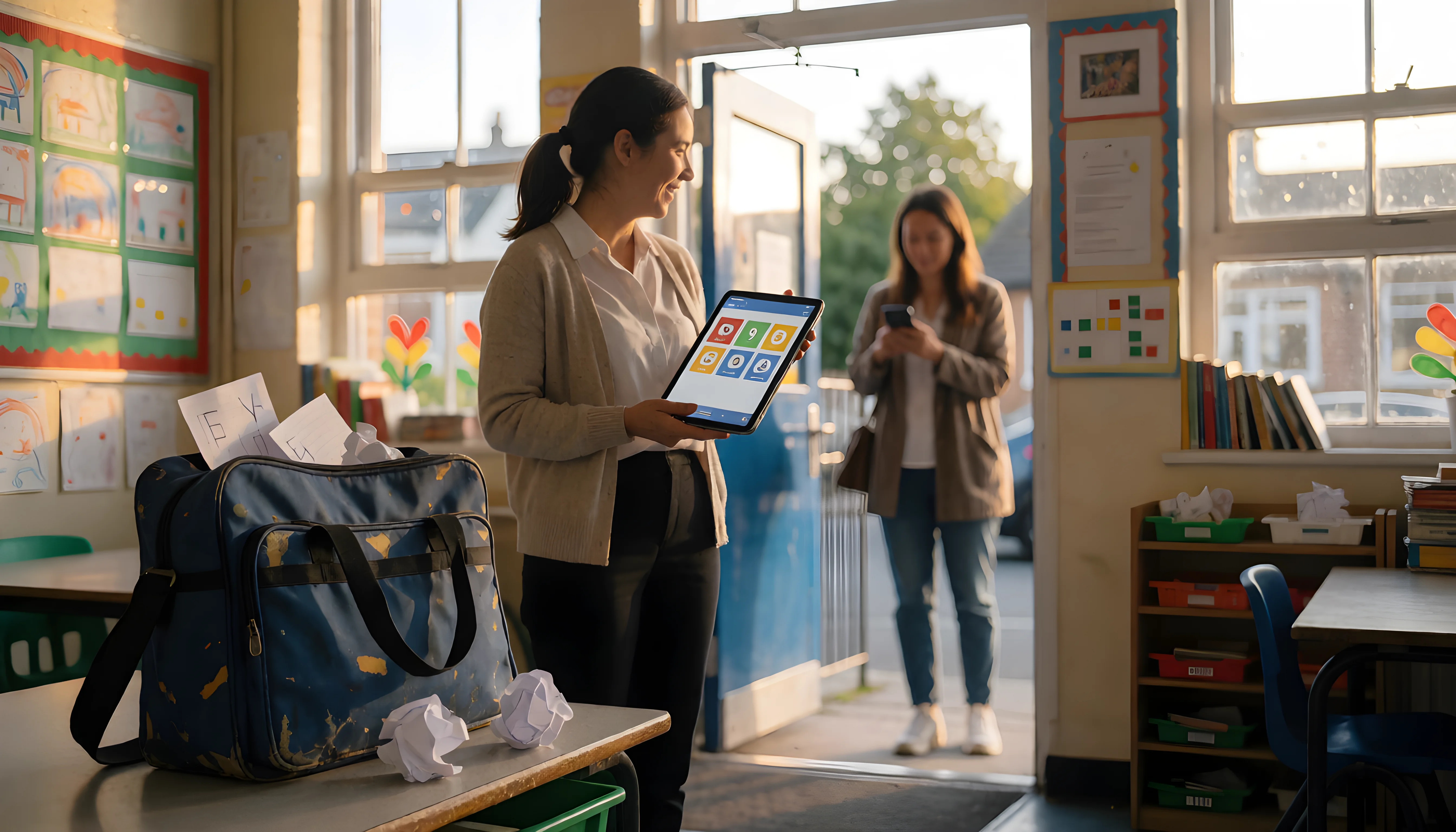
Every UK primary teacher knows the ritual. It's 3:10pm, the class is lining up, and you're pushing folded A5 letters into thirty book bags — trip consent forms, a reminder about non-uniform day, the reading record that needs signing, a note to one particular family that you really hope reaches them. By Monday, maybe eleven come back. Two are soggy. One has been coloured in.
The book bag has been the backbone of home-school communication for generations, and it has served us well enough. But it was always a workaround — a physical solution to an information problem — and in 2025 it's increasingly the weakest link in an otherwise well-run school.
Why the Paper Model Quietly Costs So Much
The true cost of paper communication is rarely counted, because it's spread so thinly across so many people. A letter home isn't one task. It's drafting, proofing, printing, collating, distributing, chasing, re-issuing for the children who lost theirs, and then manually tracking who has responded. Multiply that by trips, clubs, photo consents, flu jab forms, parents' evening slips and half-term reminders, and you have an administrative load that consumes hours of teaching and office time every single week.
Then there's the reliability problem. A letter that never leaves the book bag might as well never have been written. Schools often discover this at the worst moment — when a child turns up without a packed lunch on trip day, or when a parent says, entirely sincerely, that they never heard about the assembly. Nobody is at fault, and that's precisely the issue: the system itself leaks.
Paper also quietly excludes families. Parents working shifts, separated families where only one household receives the bag, and families with English as an additional language are all disadvantaged by a one-copy, one-direction, English-only piece of paper. Parent engagement isn't just about willingness — it's about access.
What Digital Home-School Communication Actually Looks Like
It's worth being clear about what we mean, because "going digital" has sometimes meant little more than emailing a PDF of the same letter. That's a format change, not a transformation.
Genuine digital home-school communication means messages arrive on the device a parent already checks dozens of times a day, with a push notification rather than a hope. It means a teacher can message one parent, a whole class or the entire school in seconds, attach a photo or a video, and know it has been delivered. It means term dates, trips, sports day and parents' evening all sit on one shared calendar with automatic reminders, rather than on a fridge magnet from September.
It also means two-way traffic. Parents report absences directly through the app, selecting a reason and expected return date, which lands in the office before the register is even taken. They book their own parents' evening slots from the available times. They complete permission forms and medical updates through custom forms, and the responses arrive as structured data rather than a shoebox of slips to transcribe.
The book bag was never really a communication system. It was a delivery mechanism we tolerated because nothing better existed.
Payments are the other half of the picture. Collecting dinner money, trip contributions and after-school club fees in cash envelopes is slow, awkward for families and risky for offices. Integrated payment processing lets parents pay in the app, lets admin see instantly who has paid, and lets the office send targeted reminders only to those who haven't — rather than another blanket letter to everyone.
Start with one high-friction process rather than digitising everything at once.
Most primary schools begin with absence reporting or trip consent forms — both are high-volume, easy to measure, and show a clear admin saving within the first half-term.
Once staff and parents trust the channel, messaging, payments and observations follow naturally.
From Broadcasting to Sharing Learning
The biggest shift isn't logistical — it's about what you can now share. Paper could only ever carry announcements. Digital channels can carry evidence of learning.
This is where many schools find the real value. Teachers record quick 30-60 second voice observations as learning happens, capturing the moment a child finally blends a tricky word or explains their reasoning in maths. Those notes are transcribed automatically, linked to Development Matters, Early Learning Goals or National Curriculum objectives, and — once approved by the teacher — shared with parents. Photos and short videos do the same job visually.
For EYFS and nursery settings, this is transformative. Keyworkers log daily routines, meals and naps alongside observations, so parents receive a picture of the day rather than a two-line verbal handover at the door. Over a year, those micro-observations build into a longitudinal learning profile that makes reports, transitions and consultations dramatically better evidenced.
Within a term of moving to Parent Portal, consent returns went from roughly 60% to over 95%, and our office team got back most of a day a week.
The unexpected win was the voice observations — parents genuinely look forward to them.
— Deputy Head, two-form entry primary, West Yorkshire
The Workload Argument School Leaders Care About
Any serious conversation about edtech in 2025 has to answer one question: does this add to teacher workload or remove it? Too many platforms add.
The test is whether the digital version of a task is genuinely faster than the paper one, not just more modern. Taking the register on a tablet should take less time than a paper register, not more. Writing a report comment should be faster when AI can draft an evidence-based first version from the term's accumulated observations, which the teacher then edits in their own voice. Setting homework should take seconds when differentiated tasks can be generated and assigned digitally, with submissions and feedback tracked in the same place.
Consolidation matters just as much. Schools frequently run a messaging app, a separate payments system, a booking tool for parents' evenings, a cloud drive and a safeguarding log — five logins, five suppliers, five sets of parent instructions. Bringing these into one piece of school admin software removes not only licence costs but the cognitive overhead of remembering where everything lives.
Doing It Properly: Practical Considerations
A few things separate smooth rollouts from painful ones. Set clear expectations about response times — digital messaging is instant, but teachers are not, and a published policy of "messages answered within two working days" protects staff from a 24/7 expectation. Decide who can message whom, and use class groups and announcements rather than opening every channel at once.
Consider your families honestly. Multi-language support and automatic translation genuinely widen participation for EAL households. Family group management matters enormously for separated parents, allowing both carers their own login and their own notifications rather than relying on one adult to forward everything.
And take data protection seriously. Any platform holding observations, photos, attendance and safeguarding records needs UK GDPR compliance at its core, proper data processing agreements, role-based access so safeguarding records sit only with designated leads, and an audit trail.
The Bag Can Stay — The System Can Go
Nobody is suggesting children stop carrying reading books home. But the book bag as a school communication tool has reached the end of its useful life. It's slow, lossy, unequal and expensive in exactly the resource schools have least of: staff time.
The schools getting this right in 2025 aren't the ones with the most technology. They're the ones who looked at every paper process, asked whether it still earned its place, and replaced the ones that didn't with something faster for staff and better for families. That's not a tech project — it's a workload and engagement project that happens to use technology.
If you'd like to see what that looks like in practice, Parent Portal brings messaging, observations, homework, attendance, payments and parents' evenings into one platform built specifically for UK primary and early years settings — with no setup fees and UK-based support who understand the curriculum you actually teach.
Comments