
How Voice Observations Support Target Setting in Reports
Ask a primary teacher what the hardest part of report writing is and very few will say the typing. The sentences about effort, enthusiasm and progress come fairly easily after a year with a child. The difficulty sits in the final line of every report: the target. That one sentence is supposed to tell a parent exactly what their child should work on next, why it matters, and how they can help. It is the part parents read twice. It is also, for most of us, the part written last, at nine o'clock at night, from memory.
Voice observations change that equation. Not by making report writing faster, although they do, but by making the targets genuinely better. When you have a year's worth of short, timestamped notes about how a child actually learns, target setting stops being an act of recall and becomes an act of reading the evidence you already gathered.
The Target-Setting Problem Nobody Talks About
Here is an uncomfortable truth about end-of-year reports. Most targets are written in the final fortnight of term, for thirty children, by one person who is also finishing assessments, preparing a transition meeting and rehearsing a leavers' assembly. Under those conditions, memory compresses. The vivid moments survive. The quiet, gradual shifts in a child's thinking do not.
The result is a target that sounds reasonable but says very little. To continue developing confidence in writing. To keep working on number bonds. To contribute more in class discussions. A parent reading that has no idea what to do on Tuesday evening. Worse, the receiving teacher in September has no idea what was actually observed. The target describes a general direction rather than a specific next step, because the detailed evidence that would have produced a specific next step was never recorded anywhere durable.
Why Thirty Seconds Beats Thirty Minutes
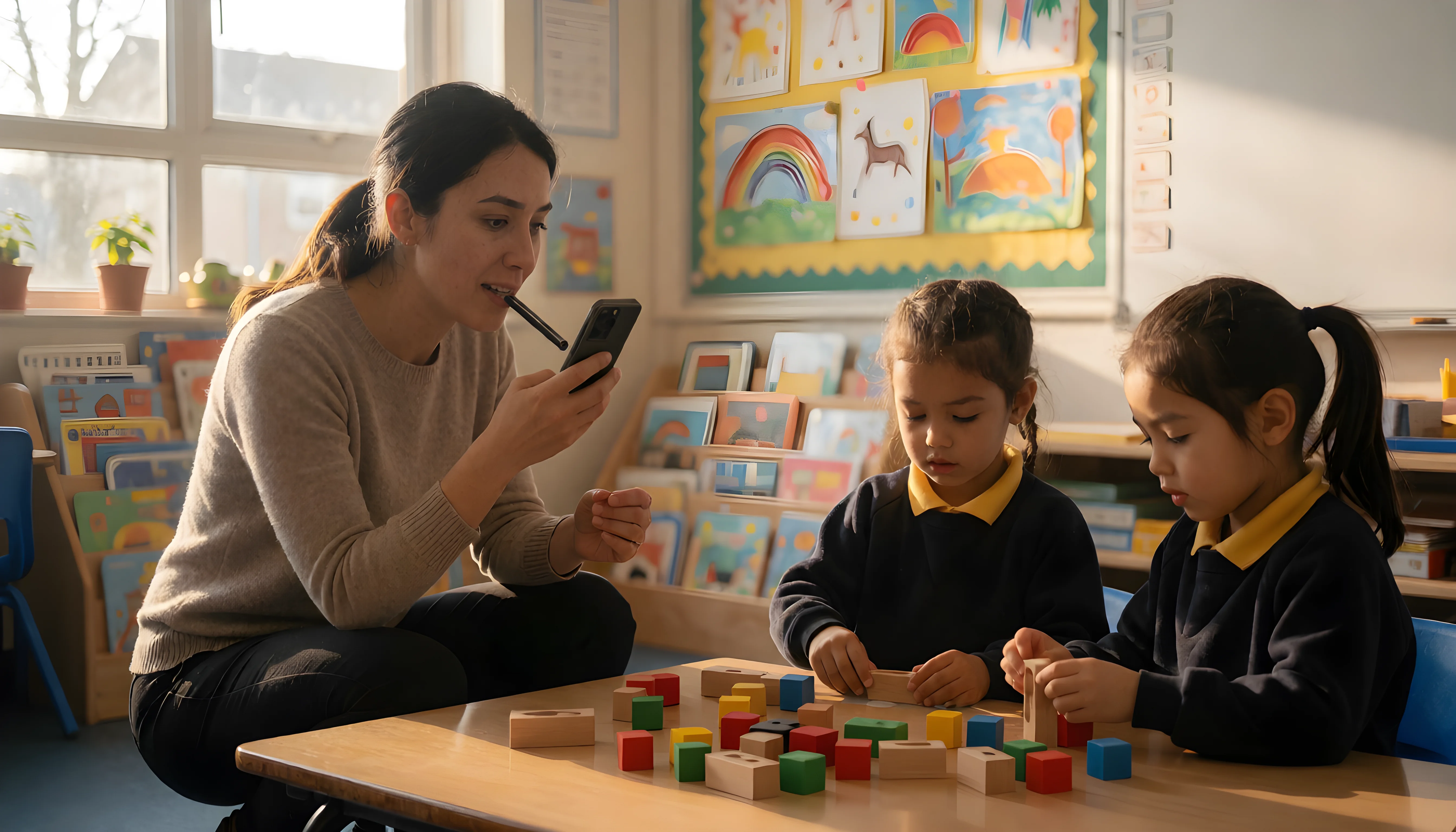
A voice observation is deliberately small. A teacher notices something worth keeping, taps record, and speaks for thirty to sixty seconds about what just happened. The recording is automatically transcribed, timestamped and attached to that child's learning profile. The whole interaction takes less time than finding a sticky note.
The value is in the fidelity. Written observations get summarised as they are written, because typing is slow and you are standing up. Speaking is fast enough that you keep the specifics: the exact phrasing a child used, the point at which they hesitated, the strategy they abandoned, the peer who unlocked it for them. Those specifics are precisely what a good target is built from.
Say the child's name and the context in the first five seconds.
Describe what the child did or said, using their own words where you can.
Note what support was or was not needed.
Finish with one sentence on what you think comes next.
Resist the urge to evaluate. Describe first, judge later, because a description stays useful for months while a judgement ages badly.
That final sentence is the one that pays off in June. A teacher who routinely records a possible next step is effectively drafting targets in small instalments across the entire year.
From Scattered Moments to a Clear Pattern
One observation is an anecdote. Forty observations are a picture. The real power of voice-recorded observations arrives once they accumulate, because patterns become visible that no single moment reveals.
Take a Year 2 child who struggles to get writing started. Three separate observations across a term show the same thing from different angles: she talks fluently about her ideas before writing, she stalls when asked to produce a plan on paper, and she writes at length when a partner has scribed her opening sentence. Individually, each note is minor. Together they point to a specific target about oral rehearsal and sentence starters, not a vague instruction to build writing confidence.
Platforms like Parent Portal go a step further by analysing accumulated observations with AI, surfacing strengths, emerging themes and suggested next steps for each child. The teacher remains the decision maker, but they start from a summary of the evidence rather than a blank box.
A good target is not a prediction about a child. It is the next logical step in a story you have already been writing all year.
That reframing matters for school leaders too. When targets grow out of recorded evidence, moderation conversations become concrete. A phase leader can ask to see the observations behind a target and have an actual answer, which is a very different quality assurance conversation from asking a teacher to justify a sentence they wrote from memory.
Targets That Come From Evidence, Not Guesswork
Compare two targets for the same child. The first: to improve her independent writing. The second: to use a spoken plan and a given sentence opener to begin a piece of writing without adult prompting, building towards planning independently by the end of the autumn term.
The second one is longer, and it is specific enough to be acted on by a parent, a teaching assistant and a September teacher. It is only writable because somebody recorded what actually happened in March, April and May. An AI report writing assistant can then draft the comment and target from that evidence base, producing something genuinely personalised to each child rather than a template with a name swapped in. The teacher edits, approves and moves on.
Keeping Targets Tied to the Curriculum
Targets drift when they float free of the curriculum. Linking observations to Development Matters statements, Early Learning Goals or National Curriculum objectives at the point of recording keeps everything anchored. Each voice note is tagged, progress is tracked against age-related expectations automatically, and by report season the target writes itself out of the gap between what a child has secured and what comes next in the sequence.
For EYFS and nursery teams, this is especially valuable. Early years practice is built on observation, but much of that observation has historically lived on paper, in folders, in handwriting nobody else can read. Voice observations make it searchable and shareable across keyworkers.
Bringing Parents Into the Target
There is a secondary benefit that improves parent engagement considerably. When observations have been shared with parents throughout the year, the report target is not a surprise. A parent who has heard a short voice note about their son persevering with a tricky calculation understands immediately why his target concerns strategy choice rather than speed.
That shared context transforms parents' evenings. Teachers walk in with a pre-meeting report pulling together observations, progress data and behaviour records. Parents walk in already informed. The conversation starts at the next step instead of the summary, and AI-generated meeting summaries capture the agreed actions so nobody leaves with a different memory of what was decided.
Last summer I opened each child's profile, read back through the observations I had recorded since September, and the targets were obvious. I had already spotted them, I just had not written them down.
Two parents told me it was the first report that sounded like it was actually about their child.
Year 1 teacher, two-form entry primary, Greater Manchester
That last point deserves emphasis. Parents can usually tell when a report is generic, and it quietly erodes confidence in the school. Evidence-based targets rebuild it.
The Workload Dividend
Nobody adopts a new observation habit for the love of admin, so it is worth being honest about the trade. Voice observations add a few minutes to the average teaching day and remove hours from report season, parents' evening preparation and transition handovers. For schools looking at school admin software and school communication tools in 2025 and beyond, that redistribution of effort is the whole point of edtech. The work moves from a crisis fortnight to a sustainable daily rhythm.
It also protects quality. An approval workflow means observations are reviewed before parents see them, so teachers can record freely and tidy up later rather than self-editing in the moment.
Making a Start This Term
You do not need a whole-school rollout to test this. Pick three children a day and record one observation each, which is a class of thirty covered in a fortnight. Keep them short. Always finish with a possible next step. By the end of a term you will have twenty to thirty notes per child, which is more than enough to write a target you can defend, explain and hand on with confidence.
Parent Portal brings voice observations, curriculum linking, AI progress analysis and report writing into one platform built for UK primary schools, nurseries and early years settings. If report season is the point in the year your team dreads most, the fix probably starts in October rather than June.
Comments