
Building a Narrative: Telling Each Child's Story Through Voice Notes
Ask an experienced early years practitioner what they know about a child in their class and you won't be handed a spreadsheet. You'll get a story. You'll hear about the week she refused to come inside from the mud kitchen, the morning he finally joined the carpet circle without being asked, the sudden obsession with dinosaurs that unlocked an interest in reading. Teachers hold these narratives in their heads, built from hundreds of tiny noticings, and they are easily the richest form of assessment any school possesses. The problem is that almost none of it ever gets written down.
Why Snapshot Assessment Flattens Children
Most formal assessment systems are built around moments: a half-termly judgement, a reading age, a tick against an Early Learning Goal. These are useful, but they describe a position rather than a journey. A child recorded as emerging in October and expected in February has clearly travelled somewhere, yet the record tells us nothing about how, or what moved them, or what might move them next.
That gap matters most for the children who need us to pay closest attention. A child with emerging speech and language needs, or one whose confidence fluctuates week to week, is badly served by a termly snapshot. What they need is a narrative — a continuous thread showing where progress is genuinely happening, even when it isn't yet showing up against age-related expectations. Building that thread used to mean an unsustainable amount of writing. It doesn't anymore.
Thirty Seconds Beats Thirty Minutes
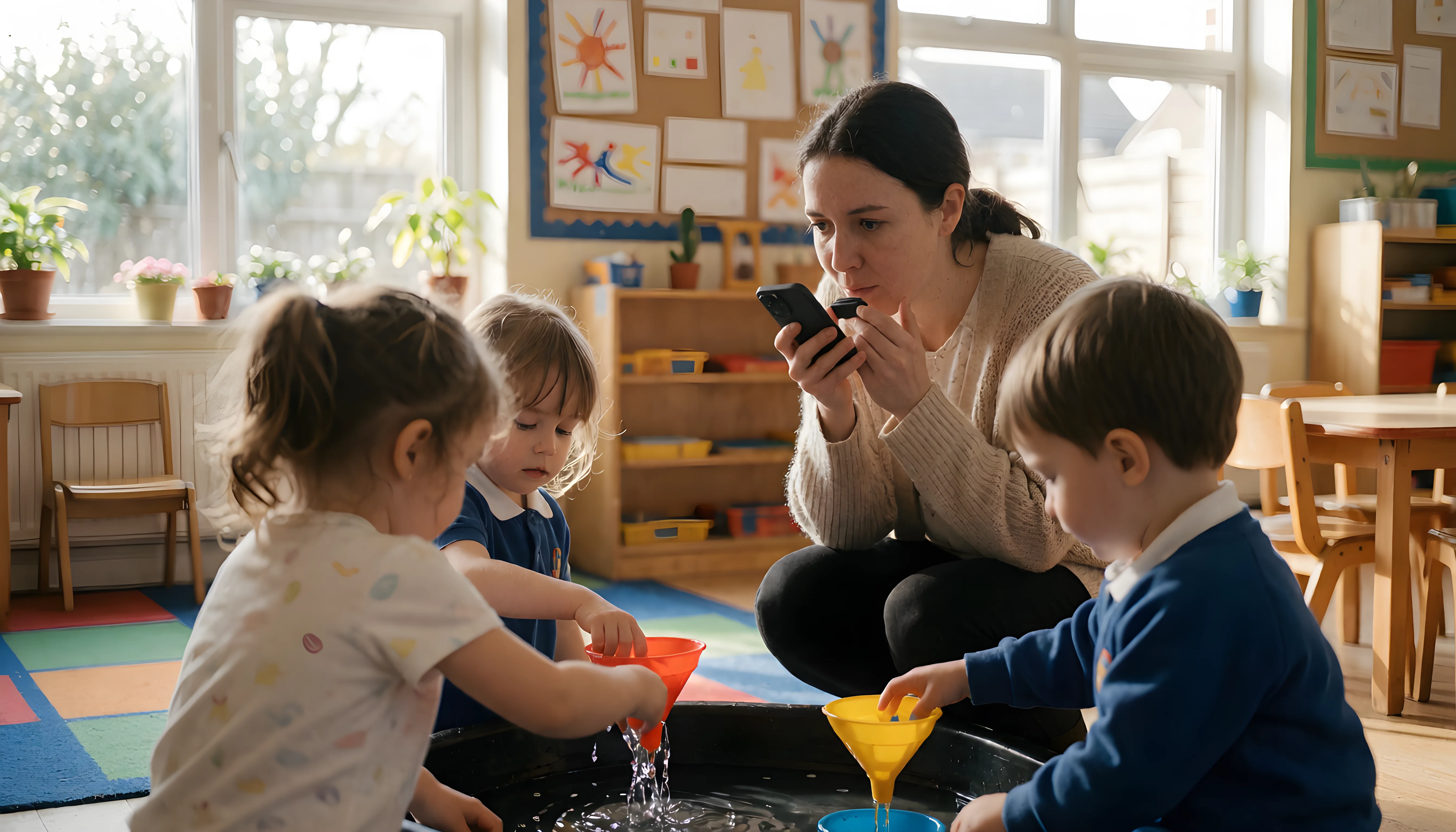
The practical breakthrough is embarrassingly simple: talking is roughly four times faster than typing, and it can happen while you're still in the room. A voice-recorded observation of thirty to sixty seconds — captured as the moment happens, in a teacher's own words, with the child's actual language quoted — takes less effort than remembering to write it up at 5pm and produces something considerably better.
Anyone who has tried to reconstruct a day's observations after the children have gone home knows exactly what gets lost. The specifics go first. You remember that Jacob did something impressive at the water tray; you've forgotten the sentence he used to explain it. Voice notes capture that language verbatim, while it's still fresh, and Parent Portal transcribes each recording automatically so it becomes searchable, taggable text without anyone typing a word.
A narrative isn't a longer record. It's a record that remembers what came before it.
The shift in practice is subtle but significant. Instead of sitting down to do observations as a separate administrative task, practitioners narrate their day as they teach. Three or four voice notes across a session is unremarkable. Over a half term that's forty or fifty genuine moments per child, each one timestamped and in context — the raw material of a real story rather than a compliance exercise.
From Fragments to a Thread
Individually, a voice note is just an anecdote. Accumulated, they become something far more powerful, and this is where the narrative approach earns its keep. Forty observations gathered over a term start to reveal patterns that no single moment could: that a child's best language consistently emerges during physical play rather than at the writing table, that collaborative work is where their confidence lives, that the dip in engagement every Thursday afternoon has a cause worth investigating.
Parent Portal's AI-powered progress analysis reads across that accumulated evidence and surfaces exactly these threads — strengths, areas for development, suggested next steps, and the learning preferences that keep showing up. It isn't making judgements on a teacher's behalf; it's doing the pattern-matching that no human has time to do across thirty children and hundreds of observations, then handing the insight back for professional interpretation. Teachers consistently describe it as the moment the data starts working for them instead of the other way round.
That means your narrative doubles as your evidence base — progress is tracked automatically against age-related expectations, so moderation, Ofsted conversations and transition documents draw on the same authentic record rather than a parallel paperwork exercise.
This is also where the narrative approach quietly solves a workload problem that has dogged primary and early years settings for years. Observation, assessment, reporting and parent communication have traditionally been four separate jobs built on four separate records. Build the narrative once, properly, and everything downstream feeds from it.
Letting Parents Read the Story Too
Parents receive remarkably little insight into their child's school day. A reading record, a termly report, ten minutes at parents' evening. For many families — particularly those with English as an additional language, or working patterns that make the playground conversation impossible — that's the entire window.
Sharing observations changes that completely. When a parent receives a short transcribed note describing how their daughter negotiated a turn-taking dispute at the sand tray, alongside a photo and the objective it links to, they aren't just being informed. They're being invited into the narrative. Parent Portal's observation approval workflow means staff review everything before it's shared, so quality and appropriateness stay firmly under school control, while automatic message translation makes the same story accessible to families in their home language.
Our staff are recording three times as much as they were writing, and for the first time our end-of-term reports read like they were written about actual children.
Parents mention the observations constantly — one dad told me it was the first year he'd felt like he knew what his son did all day.
— Deputy Head, two-form entry primary, West Midlands
Where the Narrative Pays You Back
The return on a well-built narrative shows up at precisely the points in the year that cost teachers the most time. Report season stops being a creative writing exercise performed from memory: Parent Portal's AI report writing assistant generates personalised comments drawn from the accumulated observation data, grounded in genuine evidence, which teachers then edit and approve. Parents' evenings change character too, because pre-meeting reports pull voice observations, progress data and behaviour records into one place, and AI-generated meeting summaries capture agreed actions afterwards.
For school leaders, the strategic value is consistency. When every classroom is building narratives the same way, you can see provision across the school — which year groups are capturing rich evidence, where observation practice needs support, how progress is tracking across cohorts. That makes the case for voice-led observation one of the more compelling school admin software decisions available to leadership teams this year.
Getting Started Without Overwhelming Staff
Schools that adopt this well tend to start small. Pick one year group or one key stage. Set a modest expectation — two or three voice notes per child per week, not a quota that breeds resentment. Model it in staff meetings by playing a good example and talking about what made it good: specific language, clear context, the child's own words. Resist the urge to standardise the voice of observations, because a teacher's natural commentary is exactly what makes the record feel human.
Then leave it alone for a term and look at what you have. Most settings find the same thing: a body of evidence richer than anything their old system produced, gathered in less time, and a set of children whose stories are finally written down somewhere other than a teacher's memory. That is what good parent engagement and credible assessment have in common — both depend on genuinely knowing the child, and both get easier the moment you start keeping the narrative.
Comments