
Building Baseline Data Through Consistent Voice Observations
Ask any Reception teacher what the first six weeks of the autumn term feel like and you will hear some version of the same answer: a blur. There are new routines to embed, thirty sets of names and faces to learn, settling-in conversations with nervous parents, and underneath all of it the quiet pressure of a question that shapes everything else — where is each of these children actually starting from?
Baseline data is supposed to answer that question. In practice, it often does not. Too many settings end up with a baseline that is really a snapshot: a fortnight of hurried assessment activities, a spreadsheet of educated guesses, and a set of judgements made before anyone knew the children well enough to make them. By the time the real picture emerges in late October, the baseline has already been submitted, and the gap between the data and the child becomes something staff quietly work around for the rest of the year.
There is a better way to build that picture, and it does not involve another assessment week. It involves capturing small moments, consistently, from the very first day — and the fastest way to do that is with your voice.
Why Written Observations Quietly Fail
Nobody sets out to keep poor records. The problem with written observations is structural, not attitudinal. Writing a meaningful observation takes two or three minutes, and those minutes do not exist in the middle of a session. So the moment gets mentally filed for later, and later becomes the end of the day, when the detail has already softened. What eventually gets typed up is a tidy, generalised sentence — enjoyed the water tray, played cooperatively — that tells a reader almost nothing about what the child actually did, said or understood.
The result is a baseline built on paraphrase rather than evidence. It also tends to be unevenly distributed. Research into early years record-keeping consistently finds that the children who generate the most written observations are the loudest and the most obviously struggling, while quietly competent children are under-recorded. If your baseline is assembled from whoever happened to catch your attention, your starting point is skewed before you have begun.
What Changes When You Speak Instead of Type
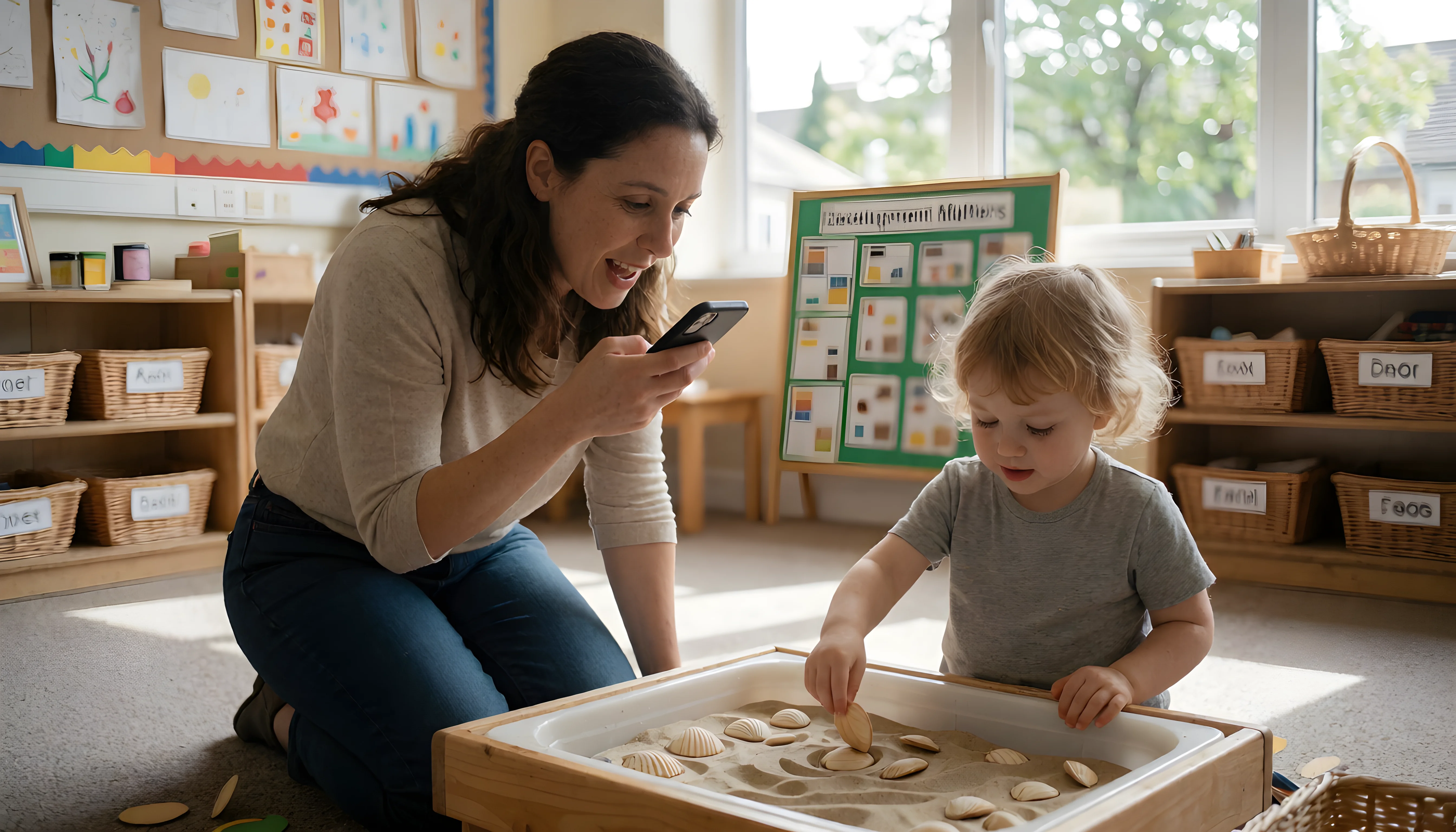
A voice observation takes thirty to sixty seconds. You can record one while kneeling beside a sand tray, standing at the edge of the playground, or walking between tables. Because the cost of capturing a moment drops so dramatically, the behaviour changes: staff record what they notice when they notice it, rather than deciding in advance whether a moment is worth the paperwork.
Spoken observations are also richer. When teachers talk rather than type, they naturally include the child's exact words, the context, what came immediately before, and their own in-the-moment interpretation. That verbatim detail is exactly what makes a baseline defensible later. There is a real difference between beginning to count and a recording in which a four-year-old counts seven shells aloud, loses track at eight, starts again, and gets there on the second attempt. The first is a judgement. The second is evidence.
Thirty children at four observations each sounds enormous — but at forty-five seconds per recording, that is roughly ninety minutes of total capture time spread across six weeks.
In Parent Portal, each recording is transcribed automatically, so the spoken moment becomes searchable written evidence without anyone typing it up.
That transcription step matters more than it first appears. A voice note sitting in a folder is a liability; a transcribed, tagged, timestamped observation attached to a named child is an asset. It can be searched, filtered, linked to curriculum objectives and pulled into a report nine months later.
Consistency Beats Volume Every Time
The most common mistake schools make when they adopt observation tools is chasing quantity. A thousand observations in September followed by silence in November produces a worse baseline than a steady trickle all year. Baseline data only becomes useful when it has something to be compared against, and comparison requires rhythm.
Practically, this means building capture into the timetable rather than hoping it happens. Some schools assign each member of staff a small group of focus children per day on a rolling rota, which guarantees that every child is observed regularly regardless of how loudly they ask for attention. Others anchor observations to specific sessions — one during child-initiated play, one during a structured activity — so the evidence base covers both independent and supported performance.
A baseline is not a judgement you make in September. It is a pattern you can only see once you have enough small moments to look back across.
Leaders have a role here too. If voice observations are presented as an additional expectation layered on top of existing paperwork, they will be resented and abandoned by half term. If they are presented as a replacement — the thing you do instead of writing up observations in the evening — uptake tends to be immediate and enthusiastic. Be explicit about what is being removed, not just what is being added.
Linking Moments to the Framework
Baseline data has to speak the language of the frameworks it will be judged against. A voice observation becomes far more powerful when it is tagged to Development Matters statements, Early Learning Goals, or National Curriculum objectives at the point of capture, while the context is still fresh.
Done consistently, this produces something genuinely valuable: a live map of coverage. You can see at a glance which areas of learning are well evidenced across the cohort and which have barely been touched, which children have a thin evidence base, and where age-related expectations are being met or missed. That is the difference between record-keeping and assessment.
Now every member of the team records short voice notes as they go, and by the end of September we have a picture of each child built from dozens of real moments rather than one sitting.
Our pupil progress meetings changed completely — we are discussing evidence instead of impressions.
— EYFS Lead, two-form entry primary school, Greater Manchester
Where the Baseline Pays You Back
The return on consistent observation arrives later in the year, and it arrives in several places at once. At autumn parents' evening, teachers walk into consultations with accumulated voice observations and progress data already summarised, rather than reconstructing a child's term from memory the night before. Conversations become specific, parents feel seen, and parent engagement improves for reasons that have nothing to do with newsletters.
At report season, the same evidence base does the heavy lifting. AI progress analysis can review months of accumulated observations for a single child and surface genuine patterns — a consistent strength in collaborative problem solving, a dip in independent writing stamina after Christmas, a clear preference for learning through movement — then draft evidence-based report comments the teacher refines rather than invents. This is where good school admin software earns its place: not by generating content from nothing, but by making the evidence staff already gathered usable.
It also matters for accountability. When an inspector, a SENCO or an incoming teacher asks how a judgement was reached, a longitudinal trail of dated, tagged, verbatim observations is a far stronger answer than a termly data drop.
Starting Small This Term
If you are introducing this to a team, resist the urge to roll it out everywhere at once. Pick one year group or one key stage, agree a modest target such as three observations per child per half term, and run it for six weeks. Review what the data actually shows at the end of that window, in a real pupil progress meeting, so staff see the payoff before they are asked to sustain the habit. Remove something from the existing workload in exchange. Then expand.
The schools getting the most from edtech in 2025 are rarely the ones with the longest feature list. They are the ones who found a way to capture what teachers already notice, consistently enough that it accumulates into something meaningful — and then let the technology do the sorting, tagging and summarising that no human should be doing at nine o'clock at night.
Parent Portal brings voice observations, curriculum tagging, progress analysis, parents' evenings and reporting into one platform built for UK primary schools, nurseries and early years settings. If building a stronger baseline is on your improvement plan this year, it starts with a thirty-second recording.
Comments