
Recording and Sharing Lessons with Absent Students via School Platforms
Every teacher knows the feeling. You spend twenty minutes carefully building towards the moment a tricky concept finally lands, the room clicks, hands shoot up, and then you glance down at the register and notice three empty chairs. Those children will walk back in on Thursday having missed the single lesson that made column subtraction make sense. For decades our answer has been a photocopied worksheet and a hopeful smile. In 2026, with attendance under more scrutiny than ever, schools have far better options available to them.
Recording and sharing lessons with absent pupils used to feel like something that belonged to secondary timetables and sixth-form revision sessions. But with rolling winter illness, medical appointments, anxiety-related absence, family circumstances and the occasional snow day, primary schools and early years settings are asking the same question their secondary colleagues asked years ago: how do we keep a child connected to their learning when they simply cannot be in the room? The encouraging news is that modern school communication tools make this much more achievable than most leaders expect, and it does not require a studio, a media technician, or an extra hour at the end of the day.
Why absence hits primary pupils hardest
In a secondary school, a missed lesson is a missed lesson. In a primary classroom, learning is cumulative in a much more fragile way. A child who misses three days of phonics in Reception does not simply miss three sessions; they miss the sequence that makes the next three weeks coherent. The same is true of early multiplication, handwriting formation, or a sustained writing unit built around a shared text. Gaps compound quietly, and by the time they surface in an assessment the child has often decided they are simply not good at that subject.
There is also a wellbeing dimension that school leaders recognise instantly. Children who are off for longer periods, whether through illness, hospital treatment or emotional difficulty, frequently describe returning as the hardest part. Being handed a stack of catch-up work on day one reinforces the sense of being behind. Receiving a short video from their teacher while they are still at home does the opposite. It says, quite simply, you are still part of this class.
What recording a lesson actually means in a primary classroom
Let us be realistic about this, because the phrase recording a lesson conjures images of cameras at the back of the room filming forty-five minutes of teaching. That is neither practical nor desirable in a primary setting, and it raises safeguarding questions that most schools will not want to answer. What works in practice is much smaller and much more human.
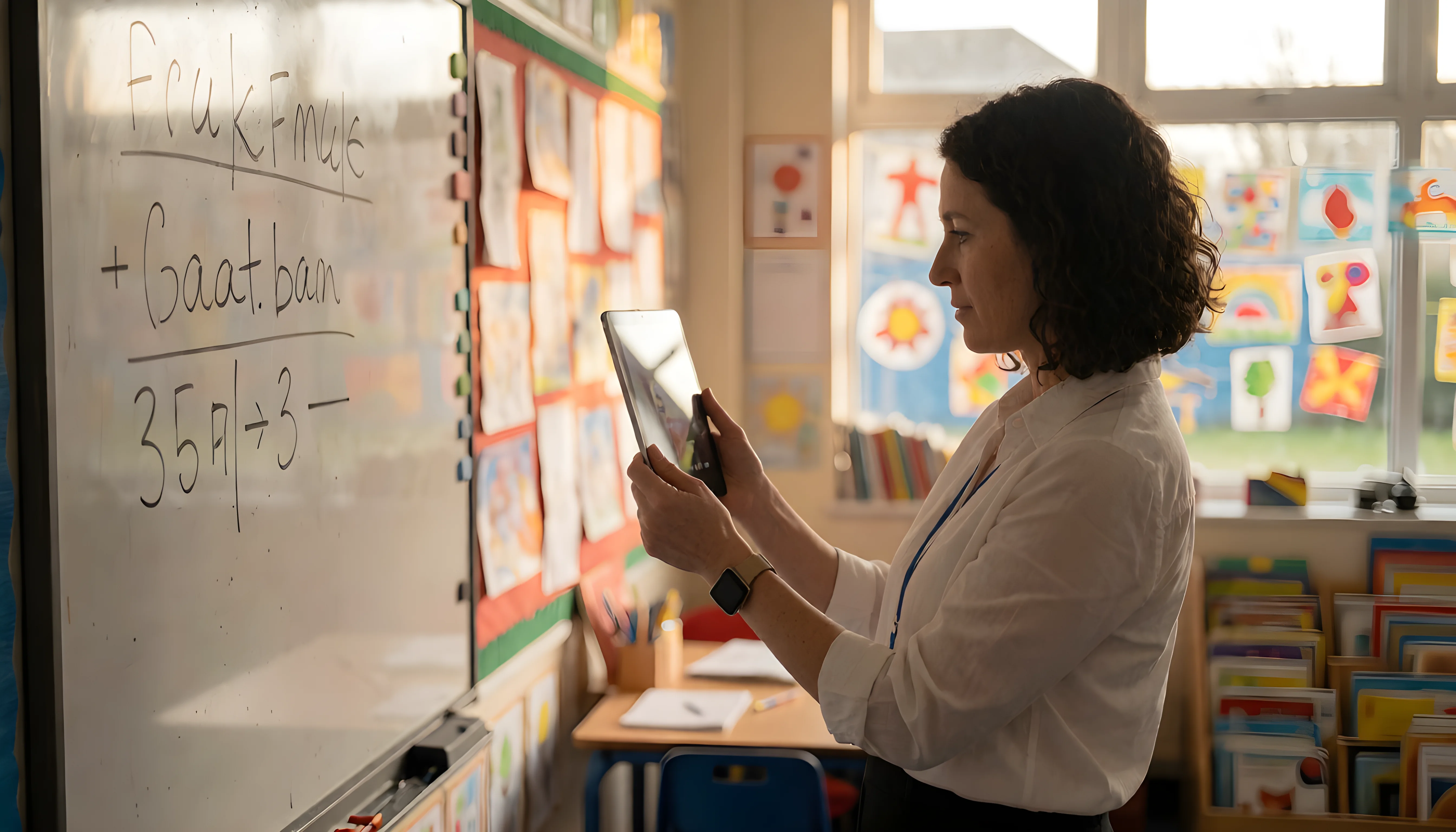
The most effective approach is the short, targeted capture. A ninety-second voice note explaining the method that was taught that morning. A photograph of the modelled example on the whiteboard, with a caption pointing out the step children found trickiest. A two-minute video of the teacher working through one question aloud. A set of slides from the lesson, shared digitally with a short written note. None of this requires editing, lighting or a second take, and all of it can be captured in the natural gaps of a school day.
Children who are absent rarely need to watch the whole session. They need the teaching input, the worked example, and a clear instruction about what to try next.
Aim for under three minutes. Anything longer is likely to be watched once, halfway, on a tablet in a living room.
This shift in mindset matters because it moves lesson sharing from a technical project into an everyday habit. Teachers already explain things out loud dozens of times a day. Capturing one of those explanations on a phone or tablet, through the same platform they already use for observations and homework, adds seconds rather than minutes.
Building a workflow that survives a busy week
Good intentions die on wet Wednesdays. Any system for sharing lessons with absent pupils has to be genuinely frictionless, or it will quietly stop happening by half term. The schools that make this work tend to build it directly into processes they already run rather than creating something new alongside them.
It starts with the register. When a parent reports an absence through the app and the digital register confirms it, the teacher already knows by half past nine exactly who is missing. From there, the teacher captures one short explanation per core lesson, attaches it to a homework task or a direct message, and sends it to the affected families only. The absent child receives the input, the task, and the resources in one place. Work comes back as a photo upload or a typed response, and feedback goes out the same way.
The goal was never to replicate the classroom at home. It was to make sure that no child returns from a week of illness feeling like the lesson happened without them.
Because everything sits inside one platform, the admin overhead largely disappears. There is no separate video hosting, no email chains with attachments too large to send, and no printed packs left in the office for a parent to collect. For school business managers and office staff, that last point alone is worth the change. Catch-up work stops being a reception desk job.
Keeping parents part of the process
There is an obvious secondary benefit here, and it is one that leaders should not undersell when they talk to governors. Sharing teaching input with absent children also shows parents exactly how things are taught in school. A parent who watches a ninety-second video of the written method their child is learning is far better equipped to help at the kitchen table than one working from a half-remembered method from their own schooling.
This is parent engagement in its most practical form. It is not a newsletter or a coffee morning; it is a parent and child sitting together with the actual teaching, delivered to a phone with a push notification. For families with English as an additional language, automatic message translation makes that content accessible in a way a paper worksheet never could.
The difference is most obvious with our longer-term absences. One of our Year 4 children was off for five weeks and came back able to join straight in with the maths unit.
Parents mention it constantly at consultations. They feel included rather than informed.
It is worth being honest with staff about expectations when you introduce this. Not every lesson needs capturing, and no teacher should be recording during a PE session or a messy play activity in nursery. Clear guidance about what is captured, by whom and how often prevents the initiative from drifting into unmanageable territory.
Safeguarding, consent and the questions governors will ask
Any conversation about recording in schools has to address safeguarding properly, and this is where using a dedicated school platform matters enormously compared with consumer messaging apps or public video sites. The key principles are straightforward. Recordings should capture the teacher and the teaching, not the class. Where other children are visible or audible, the recording should not be shared beyond that group. Everything should be stored within the school's own controlled environment, shared only with named recipients, and subject to an approval step before a parent sees it.
A platform built for UK schools handles much of this by design. Content is stored in GDPR-compliant cloud storage with controlled access, sharing is restricted to the correct family accounts, approval workflows let a teacher or leader review material before release, and access is logged. Compare that with a well-meaning teacher sending a video from a personal phone via a messaging app, which is how a surprising number of schools currently manage this, and the governance case makes itself.
Does it actually reduce teacher workload?
This is the fair question, and the honest answer is that it depends entirely on implementation. Done badly, lesson recording becomes another expectation stacked on an already impossible day. Done well, it genuinely does reduce teacher workload, because it replaces something that was already happening inefficiently.
Think about the current cost of absence. A teacher prints or photocopies catch-up materials, writes a note explaining what was missed, often repeats that explanation one-to-one on the child's return, and sometimes delivers the same conversation again at the classroom door to a parent. A single ninety-second recording, shared once, absorbs most of that. Add AI-generated differentiated tasks to accompany it, so the catch-up work is produced in seconds rather than cobbled together at four o'clock, and the time saved outweighs the time spent.
There is a longer-term gain too. Explanations recorded this year do not evaporate. A clear video explaining fraction equivalence is just as useful next February, and just as useful for a child who was present but did not quite follow it. Over two or three years, departments build a quietly valuable bank of teaching input that supports absent pupils, revision, and intervention alike.
Where to start
Begin narrowly. Pick one year group and one subject, usually maths, and ask those teachers to capture a short explanation only for children absent more than two consecutive days. Give them a three-minute ceiling and explicit permission for recordings to be imperfect. Review it after six weeks with the staff involved, not with a survey, and ask what felt sustainable.
The schools getting the most from edtech 2026 are rarely the ones with the most ambitious plans. They are the ones who identified a small, persistent problem and solved it properly using the school admin software they already had in place. Absence will always happen. Children falling behind because of it does not have to.
Parent Portal brings lesson sharing, homework, observations, attendance and parent messaging into one platform built for UK primary schools, nurseries and early years settings. If you would like to see how it works in practice, you can explore the platform at parentportal.com.
Comments