
Parent Reading Volunteers: Digital Coordination and Safeguarding
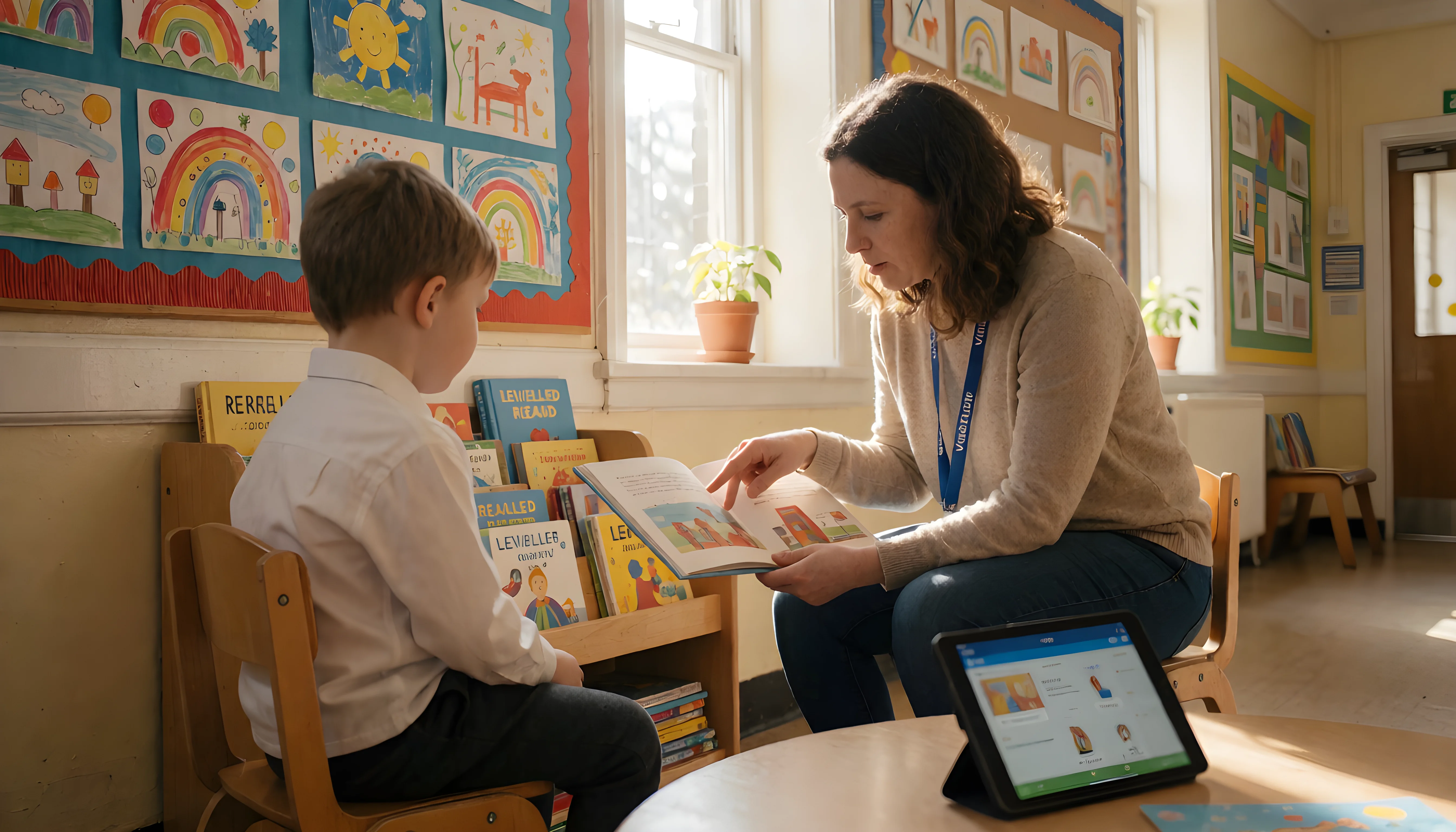
Walk into almost any UK primary school at half past nine on a Tuesday and you will find them: a parent perched on a too-small chair in the corridor, following a finger along a line of print with a Year 2 child. No fanfare, no budget line, no heading of their own in the inspection framework. Just ten quiet minutes of one-to-one reading that, repeated every week across a school year, can do more for a child's fluency and confidence than almost anything else a school can offer for free.
Parent reading volunteers are one of the best-value interventions in primary education. They are also, for whoever ends up organising them, one of the most quietly exhausting. The reading itself is the easy part. It is the rota, the reminders, the DBS paperwork, the induction, the 8:50am message saying sorry, can't make it today, and the awkward question of who actually knows what happened in those ten minutes that turns a lovely idea into a job nobody volunteers for twice.
Why reading volunteers are worth the admin
The case for one-to-one reading is not controversial. Children who read aloud regularly to an attentive adult build decoding accuracy, expression and stamina in ways that whole-class teaching simply cannot replicate. For children who do not read at home — and in many schools that is a significant minority — a volunteer reader may be the only adult who hears them read a whole book, cover to cover, at their own pace, without a queue of twenty-nine other children waiting.
There is a second benefit school leaders tend to underrate. A parent who spends twenty minutes a week inside the building understands the school differently. They see the reading scheme, the behaviour expectations, the sheer pace of a primary classroom. Parent engagement stops being a newsletter and becomes a relationship. Volunteers become advocates at the school gate, and a well-informed advocate is worth more than any amount of marketing.
The hidden cost of the paper rota
Here is the version most schools will recognise. A laminated sign-up sheet appears in the office. Names go on in biro. Someone photocopies it and pins a copy to the staffroom wall. A class teacher writes their own version in a planner. A volunteer swaps a Wednesday for a Thursday and tells the office, who tell one teacher but not the other. Half the slots are double-booked by October, three volunteers have quietly stopped coming, and nobody can say with confidence which of them completed induction.
Then add the questions that matter more. Who holds the DBS certificate numbers? Who confirmed the volunteer policy was read and understood? If a concern were raised tomorrow about a volunteer, could you produce a record of every session they attended and which children they read with? For most schools the honest answer is a drawer, an inbox and somebody's memory.
A volunteer programme you cannot audit is not really a programme. It is a group of adults in your building whose whereabouts you are hoping to remember.
That is the point at which coordination stops being an efficiency issue and becomes a safeguarding one. The administrative mess is a risk wearing the costume of a sign-up sheet.
Safeguarding comes first, not last
Before any digital system, the policy has to be right. Keeping Children Safe in Education is clear that schools must carry out appropriate checks on volunteers, and that the level of check depends on whether the volunteer is engaged in regulated activity — broadly, whether they work unsupervised with children on a regular basis. A parent reading in a shared space with staff nearby may be treated differently from one taking children to a separate room. That judgement belongs to the school, must be recorded in a written risk assessment, and should never be made informally at the office window.
Whatever you decide, the practical essentials are the same: a clear volunteer policy and code of conduct, an identity check, a documented risk assessment, induction covering safeguarding and how to report a concern, visible identification on site, a reliable signing-in process, and a named member of staff accountable for the programme. Every volunteer should be able to name the designated safeguarding lead and reach them within a minute.
Which check has this volunteer had, and why is that level appropriate for their role?
Where is the risk assessment for that role recorded?
Have they read and signed the volunteer code of conduct?
Who supervises them, and in which space will they be working?
Do they know how to report a safeguarding concern, and to whom?
If any answer is a shrug, the programme is not ready to start.
None of this is intended to put willing parents off, and in practice it rarely does. Volunteers who are inducted properly feel trusted rather than vetted. What puts people off is vagueness: being told to turn up at some point, finding nobody expecting them, and leaving unsure whether they helped.
Digital coordination: one rota, one source of truth
This is where good school communication tools earn their keep. Instead of a sheet in the office, volunteer recruitment becomes a custom form sent to parents that captures availability, a declaration, consent and the information your single central record needs — collected once, stored securely, visible to the people who should see it and nobody else. The volunteer policy and code of conduct sit in the school's document drive, where you can see who has opened them.
The rota itself lives on the school calendar rather than in three incompatible planners. Volunteers see their own sessions, class teachers see who is coming to their room, and automated reminders go out the evening before — which alone removes a surprising share of no-shows. When somebody cannot make Thursday, a message in the app reaches the right teacher and the office at the same time, instead of reaching one of them and not the other. Push notifications fill a gap at short notice far faster than a phone tree ever did.
For school admin software to genuinely reduce teacher workload here, the test is simple: does the class teacher have to chase anything? If the answer is no — if the rota, the reminder, the swap and the record all happen without a teacher touching them — the system is doing its job.
Capturing what happened in those ten minutes
The most common weakness in volunteer reading is that the learning disappears. A child reads beautifully, stumbles on a particular digraph, finally finishes a chapter book they have been fighting for weeks — and none of it reaches the teacher, so none of it reaches planning or the end-of-year report.
Fix that with a short structured note at the end of each session: book, pages, how it went, anything to flag. Volunteers should never have access to pupil records or assessment data, but they can absolutely pass on a few sentences. The class teacher then turns the significant moments into a proper record — a thirty-second voice observation while the memory is fresh, transcribed automatically and linked to reading objectives or Early Learning Goals. Over a term those micro-observations accumulate into evidence of real progress, and AI progress analysis can surface the pattern a busy teacher might miss: that this child's fluency climbs sharply with non-fiction, or that comprehension lags well behind decoding.
Now sign-up, the policy, the DBS record and the rota all sit in one place, and reminders go out without me lifting a finger.
The biggest change is that what the volunteers notice actually reaches the class teacher — it goes straight into the child's reading record instead of evaporating in the corridor.
Deputy Head, two-form entry primary, Yorkshire
Approval workflows matter at this stage too. Observations are reviewed by a teacher before anything is shared with families, so quality and tone stay under professional control.
Closing the loop with families
The parents whose children are being read with deserve to know it is happening. A short note or a photo of a finished book, shared through the app, tells a family their child is being noticed — and it often prompts more reading at home, which is the whole point. For families with English as an additional language, automatic message translation means that encouragement lands in a language they read comfortably.
A small programme, properly run
Much of the edtech 2025 conversation has been about AI lesson planning, automated reports and generated resources, and those tools are genuinely useful. But the unglamorous wins are often bigger. A reading volunteer programme costs nothing but coordination, and coordination is exactly what software is good at.
Start modestly. Recruit six volunteers properly rather than twenty badly. Get the risk assessment and induction right first, put the rota and the records somewhere everyone can see, and build a simple habit of feeding observations back to the class teacher. Do that, and within a term you have a safeguarded, auditable programme that gives struggling readers the one thing they need most — an adult with ten unhurried minutes and genuine interest — without adding one more clipboard to anybody's desk.
Comments