
How Micro Observations Replace Generic Parent Feedback
The End of "They're Doing Fine"
We’ve all been there. It’s parents' evening, and a queue of anxious faces waits outside the door. You have ten minutes to summarise an entire term's worth of learning, behaviour, and social development for a child. You consult your notes, but they often boil down to broad strokes. So, the familiar phrases emerge: "He’s a pleasure to have in class." "She’s doing fine, meeting expectations." "We’re working on his concentration." While well-intentioned, this feedback is generic. It gives parents a vague sense of comfort but lacks the specific, actionable insight they crave. It doesn’t capture the 'aha!' moment when a tricky maths concept finally clicked, the kindness shown to a friend in the playground, or the sudden burst of confidence in reading aloud. But what if we could replace these broad summaries with a continuous, vivid stream of these exact moments? This is the power of micro-observations, a fundamental shift in how we approach parent communication and student progress tracking.
The Problem with Point-in-Time Feedback
Traditional methods of parent feedback, like termly reports and parents' evenings, are snapshots in time. They represent a huge amount of work for teachers, who must synthesise weeks of information into a few concise paragraphs or a ten-minute conversation. This process is often stressful and relies heavily on memory or fragmented notes. The result is that the rich, nuanced story of a child’s progress gets flattened into generalisations. Parents leave with a static picture, unaware of the day-to-day journey of small wins, challenges, and breakthroughs. They hear the final grade but miss the process. This model places immense pressure on teachers and leaves parents feeling disconnected from the reality of their child's school life. It creates a system where parent engagement is an event, not an ongoing dialogue. It’s a system overdue for an upgrade, one that leverages modern school communication tools to build a more dynamic and authentic connection.
The small, everyday moments of discovery are where true learning happens. Capturing them is not just about recording progress; it’s about celebrating the journey.
This philosophy is at the heart of a new approach to feedback. Instead of summarising learning long after it has happened, we capture it as it unfolds. This is where micro-observations come in, transforming parent feedback from a monologue into a living story. It's a paradigm shift made possible by integrated platforms like Parent Portal, which put powerful observation tools directly into the hands of teachers, right in the classroom.
From Vague Comments to Vivid Evidence
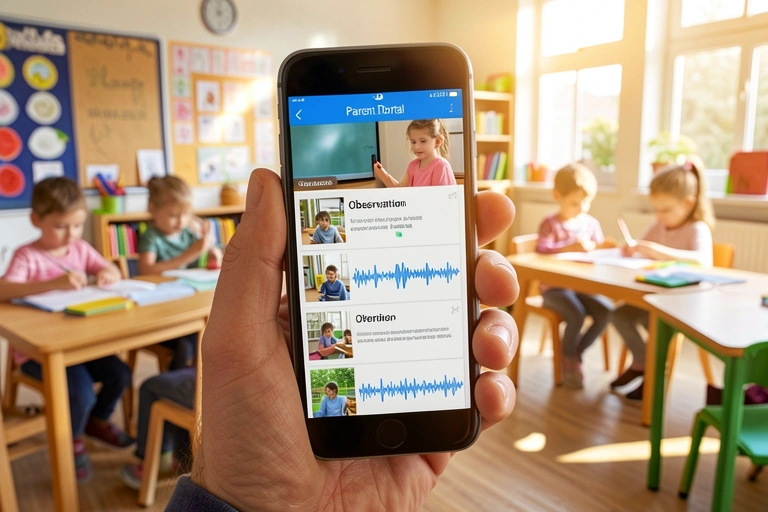
Imagine this scenario. In a traditional parents' evening, you might tell a parent, "Sophie is getting better at using descriptive language in her writing." The parent nods, pleased, but has no real context for this statement. Now, imagine a different approach. Throughout the term, you’ve been using Parent Portal to capture micro-observations. One afternoon, you record a quick 30-second voice note of Sophie proudly reading a sentence she wrote: "The colossal, sparkly dragon soared through the midnight sky." Another day, you snap a photo of a mind map she created for her story, full of exciting adjectives. These observations, shared securely through the app, land directly with her parents in near real-time. They don't just hear that she's improving; they see and hear the evidence. They witness her pride and progress. This is the difference between reporting on learning and sharing the learning experience. It turns abstract feedback into concrete, celebratory moments that strengthen the home-school partnership and give parents a genuine window into their child's world.
Our platform is designed to make capturing these moments effortless, reducing teacher workload, not adding to it.
Voice-Recorded Observations: Use your phone to record a quick 30-60 second voice note. Our AI automatically transcribes it, saving you from typing.
Photo & Video Moments: A picture is worth a thousand words. Snap a photo of a student's work or a short video of a group activity and share it securely.
Curriculum Tagging: With a few taps, link any observation directly to EYFS or National Curriculum objectives. This automatically builds an evidence base for progress tracking.
Secure Sharing with Approvals: Observations can be reviewed and approved before being shared, ensuring every communication is professional and appropriate.
This process enriches the daily communication between school and home. It provides parents with the context they need to support learning, sparking conversations at the dinner table that go beyond "How was school today?" When a parent sees their child has been learning about fractions using pizza slices in the app, they can reinforce that concept at home in a fun and relevant way. This specific, ongoing feedback loop is the cornerstone of true parent engagement.
The Cumulative Power of Continuous Feedback
A single micro-observation is powerful. But the cumulative effect of hundreds of these small data points is transformative. Over a term, Parent Portal aggregates every voice note, photo, and tagged objective into a comprehensive learning profile for each child. This is where the system’s intelligence comes into play. Our AI-powered progress analysis sifts through this rich data to identify patterns, highlight strengths, and even suggest areas for development. It moves beyond simply collecting moments to generating deep insights. For school leaders and teachers, this is a revolutionary step towards reducing teacher workload. The frantic pre-parents' evening scramble to assemble evidence is eliminated. Instead, teachers walk into meetings equipped with a detailed, longitudinal record of each child’s journey, complete with evidence. The conversation can immediately move to a higher level, focusing on strategy and next steps, because the evidence has already been shared over time.
Furthermore, this bank of evidence directly fuels other time-consuming tasks. When it’s time for end-of-term reports, our AI Report Writing Assistant analyses the accumulated observations to help generate unique, personalised, and evidence-based comments for each child. It eliminates the struggle of finding fresh ways to describe progress and ensures every report is as unique as the student it’s about. This is what smart edtech in 2025 should look like: technology that works in the background to make a teacher’s job more manageable and more impactful.
The Future of Parent Communication is Specific
Moving away from generic feedback isn't just about adopting a new tool; it’s about embracing a new culture of communication. It’s a commitment to honouring the individual learning journey of every child and making parents true partners in that journey. Micro-observations provide the specificity, timeliness, and evidence that traditional methods lack. They transform parent communication from a periodic, formal event into a continuous, collaborative dialogue. By leveraging a comprehensive school admin software platform like Parent Portal, schools can empower teachers to do their best work without being buried in administrative tasks. They can provide parents with the window they’ve always wanted into their child’s education. The era of "they're doing fine" is over. The future is specific, it's evidence-based, and it celebrates every small step of progress along the way.
Comments