
How Auto-Generated Reports Save Hours of Teacher Time
The Annual Report Writing Marathon
For teachers across the country, the phrase "report writing season" often brings a familiar sense of dread. It signals the start of a marathon task that consumes evenings and weekends, fuelled by coffee and the pressure to do justice to every child in their class. The process is a monumental undertaking: recalling specific achievements, finding the right words to describe progress, and ensuring each comment is personal, constructive, and unique. This administrative burden is one of the most significant contributors to teacher workload, pulling focus away from lesson planning, classroom interaction, and vital professional development. It’s a recurring cycle of stress that leaves educators feeling drained and overworked. But what if there was a way to reclaim that time without sacrificing the quality or personalisation of school reports? What if technology could handle the heavy lifting, transforming the process from a burden into a meaningful reflection of a child's journey?
The Challenge with Traditional Reports
The traditional method of writing school reports is fundamentally inefficient. It relies on a teacher's memory, supplemented by fragmented notes, workbooks, and assessment data scattered across various systems. The challenge isn't a lack of information; it's the sheer effort required to collate, synthesise, and articulate it for dozens of individual students. Teachers strive to provide rich, evidence-based feedback, but the reality is often a frantic search for examples in the final weeks of term. This last-minute scramble can lead to generic statements and a feeling that the final report doesn't truly capture the child's full year of growth. Furthermore, the pressure to maintain a consistent and positive tone for every report is immense. It’s a high-stakes balancing act of providing honest feedback to parents while encouraging the student, and doing it 30 times over is an exhausting task.
It transforms report writing from a frantic scramble for evidence into a thoughtful review of a rich, pre-compiled narrative.
This is where the power of integrated school communication platforms comes into play. By shifting the focus from a single, end-of-term event to a process of continuous observation, we can build a more accurate, detailed, and holistic picture of each learner. This is the foundation upon which truly insightful and time-saving reports are built.
Building a Rich Picture, Moment by Moment
Effective report writing begins long before you open a blank document. It starts with capturing the small moments of learning that happen every single day. Parent Portal is designed to make this process seamless and unobtrusive, embedding it into the natural rhythm of the school day. Instead of relying on memory, teachers can use tools like Voice-Recorded Observations to capture a quick 30-second voice note about a child’s breakthrough in understanding a maths concept or their thoughtful contribution during a group discussion. These voice notes are automatically transcribed and saved to the child’s secure learning profile. Similarly, a quick snap from a tablet using Photo & Video Observations can document a child’s proud construction in the block area or a group's collaborative science experiment. Each of these observations can be tagged against specific curriculum objectives, whether from the EYFS Development Matters framework or the Key Stage National Curriculum. Over weeks and months, these micro-observations create a rich, longitudinal, and evidence-based tapestry of each child's progress, strengths, and areas for development. The report is no longer something you write; it's something that has been building all term.
1. Capture: Teachers use voice, photo, and text to record learning observations throughout the term.
2. Analyse: The AI system analyses this accumulated, curriculum-tagged evidence for each student.
3. Generate: At report time, the AI Report Writing Assistant generates unique, evidence-based draft comments.
4. Review & Refine: Teachers review, edit, and personalise the AI-generated drafts, adding their own professional insight.
5. Finalise: The finished, high-quality reports are shared with parents in a fraction of the usual time.
Introducing the AI Report Writing Assistant
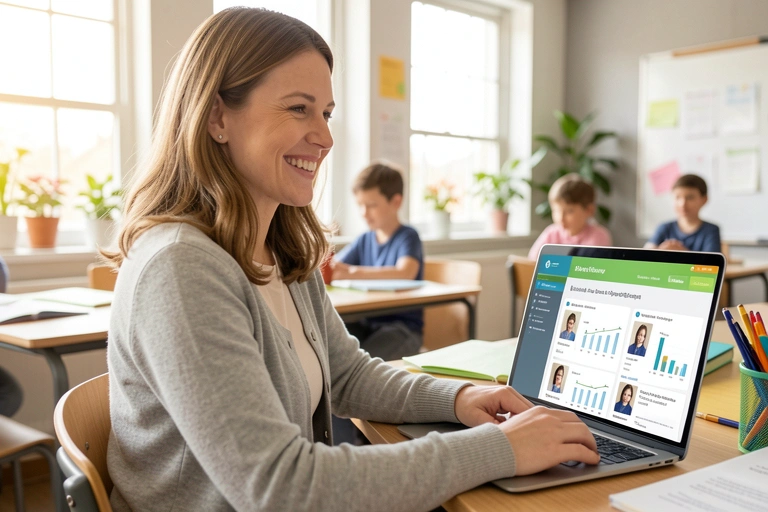
This is where the magic happens. With a rich repository of observational data collected throughout the term, Parent Portal's AI Report Writing Assistant steps in to do the heavy lifting. Instead of starting with a blank page, teachers start with a personalised, data-driven draft. The AI analyses all the voice notes, observation captions, and progress data for a student and generates a series of unique report comments. It identifies patterns, highlights key achievements, and summarises progress against learning objectives. The result is a comprehensive and surprisingly personal starting point. The AI is sophisticated enough to pick up on nuances from the teacher’s own voice notes, ensuring the tone is consistent. Crucially, this is not about replacing the teacher. The AI provides the first draft—the scaffolding—and the teacher provides the final professional polish. They can edit, rephrase, and add their own anecdotes, but they are refining a solid foundation rather than building from scratch. This partnership between human insight and artificial intelligence saves, on average, hours of work per class, allowing teachers to focus on what matters most: the substance of their feedback, not the syntax.
- C. Davies, Headteacher
The Wider Benefits: Beyond Report Cards
The benefits of this integrated system extend far beyond the end-of-term report. The same rich data that fuels the AI report writer also empowers teachers in their day-to-day work and in other key interactions. When preparing for Parents' Evenings, teachers no longer need to spend hours collating notes. A single click brings up a student's entire observation history, providing a comprehensive overview to guide the conversation. This ensures meetings are focused, productive, and evidence-based. This system also enhances parent engagement throughout the year. Sharing select observations with parents as they happen provides a window into the classroom, helping them feel more connected to their child's learning journey. When the final report arrives, it’s not a surprise; it's the culmination of a conversation that has been happening all year. This move towards continuous, transparent communication is a cornerstone of modern edtech, helping to build stronger home-school partnerships. By investing in tools that reduce administrative drag, schools can create a more sustainable and rewarding environment for their staff. As we look towards edtech 2025, it’s clear that AI-driven school admin software isn't just a futuristic concept; it's a practical solution to one of education's most persistent challenges.
Comments