
What Studies Show About AI in Education
The AI Revolution in Education: Beyond the Hype
The conversation around Artificial Intelligence in education has reached a fever pitch. From headlines promising to end teacher burnout to concerns about robot teachers, it can be difficult to separate the hype from the reality. As school leaders and educators, you’re tasked with making informed decisions that will genuinely benefit your students and staff. So, what does the evidence actually show? It’s time to look past the buzzwords and explore the growing body of research on AI's real-world impact on schools.
The integration of AI is no longer a futuristic concept; it’s a present-day reality that is redefining the landscape of EdTech in 2025 and beyond. Studies are beginning to paint a clear picture: when implemented thoughtfully, AI serves not as a replacement for teachers, but as a powerful co-pilot, capable of tackling some of the most persistent challenges in education, most notably teacher workload and the need for personalised learning.
Unlocking Time: What Research Says About AI and Teacher Workload
One of the most significant and well-documented benefits of AI in education is its ability to drastically reduce teacher workload. For years, educators have been buried under a mountain of administrative tasks that steal time away from what they do best: teaching. A major study from a leading university highlighted that teachers can spend upwards of 11 hours per week on non-teaching tasks like planning, marking, and administration. This is where AI is proving to be a game-changer.
AI-powered tools, like the AI Report Writing Assistant and AI Lesson Planner within platforms such as Parent Portal, are at the forefront of this shift. Research from organisations like the Education Endowment Foundation (EEF) is exploring how these tools can synthesise student data—from observations, assessments, and homework—to generate draft report comments and lesson structures. The findings consistently point towards significant time savings. Instead of starting with a blank page, teachers are given a detailed, evidence-based starting point that they can then refine with their own professional judgment and personal insights. This doesn’t just save time; it reduces cognitive load and allows educators to focus on the nuances of each child’s progress.
Furthermore, studies on automated feedback tools show promise in streamlining the marking process. AI can handle the initial pass on objective tasks like SPAG exercises or multiple-choice questions, giving instant feedback to students and freeing up teachers to provide more in-depth, qualitative feedback where it matters most.
AI is most effective when it complements, not supplants, the pedagogical expertise of teachers, acting as a tool to amplify their impact and reclaim their time for high-value interactions with students.
The cumulative effect of these time savings is profound. It leads to improved staff wellbeing, lower rates of burnout, and a renewed focus on instructional quality. By automating the mundane, we empower educators to concentrate on the human-centric aspects of teaching that AI can't replicate: building relationships, fostering curiosity, and inspiring a love of learning.
Personalising the Path: AI's Role in Differentiated Learning
Every teacher knows that a one-size-fits-all approach to learning is ineffective. However, catering to a classroom of 30 unique individuals, each with different strengths, weaknesses, and learning styles, is an immense challenge. Emerging studies are demonstrating AI's unique capability to make true personalisation scalable.
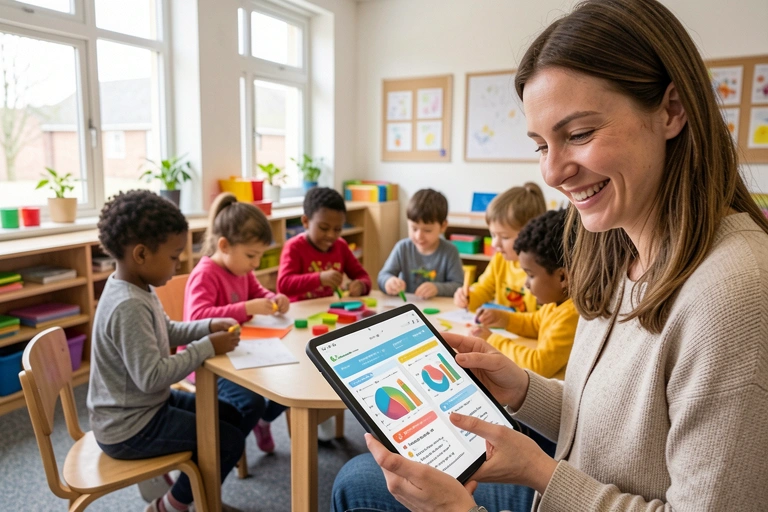
By analysing vast amounts of learning data, AI can identify patterns that would be invisible to the human eye. For instance, Parent Portal’s AI-Powered Progress Analysis tool can process thousands of micro-observations—voice notes, photos, and written records—to build a rich, longitudinal picture of a child’s development. It can flag when a student is falling behind a particular curriculum objective or highlight an emerging talent. Research into these adaptive learning systems shows that they can help create individualised learning pathways, suggesting specific resources, activities, or interventions tailored to each student’s needs. This moves beyond simple differentiation (e.g., three levels of worksheet) to genuine personalisation.
This data-driven approach not only supports students but also equips teachers with deeper insights. Instead of waiting for termly assessments, educators can get real-time, evidence-based suggestions for next steps. This proactive, rather than reactive, approach to teaching is a cornerstone of effective pedagogy, and studies confirm that AI is a powerful enabler of this shift.
Strengthening the Triangle: AI, Parent Engagement, and School Communication
Effective parent engagement is consistently linked to better student outcomes, but busy schedules and communication barriers can make it difficult to maintain strong school-home partnerships. Here again, research indicates that AI can serve as a vital bridge. Modern school communication tools are embedding AI to make information more accessible and meaningful for parents.
Consider the challenge of parents' evenings. AI can help by automatically generating summaries of discussion points and agreed actions, ensuring clarity and accountability. Platforms like Parent Portal go a step further by using AI to analyse a child's learning journey before the meeting, presenting teachers with a concise, evidence-backed summary from months of observations. This makes consultations more focused and productive.
Moreover, AI-powered translation features in messaging apps are breaking down language barriers, ensuring that EAL families are fully included in the school community. The ability to communicate seamlessly in a parent’s native language is a significant step towards equitable engagement. AI isn’t just making communication faster; it's making it more inclusive and impactful.
- Sarah Chen, Headteacher, Oakwood Primary
This testimonial reflects a common theme in recent case studies: school leaders are finding that strategic use of AI within their school admin software ecosystems frees up human resources for what truly matters.
The Future is Collaborative
The body of evidence is clear: AI is not a fleeting trend. When integrated into comprehensive platforms designed with pedagogical principles at their core, AI offers tangible solutions to long-standing educational challenges. Studies show it can reduce workload, enhance personalised learning, and improve parent engagement. However, the research also comes with a crucial caveat: technology is only as good as the people and processes that surround it. The most successful implementations are those where AI is seen as a supportive tool within a culture of professional collaboration and ethical oversight.
As we look toward EdTech 2025, the schools that thrive will be those that embrace AI not with blind optimism, but with critical, informed curiosity. By focusing on tools that are grounded in educational research and designed to support, not replace, the irreplaceable art of teaching, we can harness the power of AI to create a more efficient, equitable, and human-centred future for education.
Comments