
How to Handle Late Homework Submissions Fairly
The Challenge of the Missing Homework
Every teacher knows the feeling. The deadline has passed, and a handful of assignments are still missing. The challenge of late homework is as old as school itself, a persistent issue that sits at the complex intersection of accountability, fairness, and compassion. For many educators, it creates a significant administrative burden and a genuine pedagogical dilemma. How do we hold students responsible for deadlines without penalising those who may be struggling with circumstances beyond their control? Striking this balance is crucial for fostering a positive and productive learning environment.
The traditional approach often leans towards penalties—deducted marks, detention, or a blanket zero-grade policy. While these methods aim to teach responsibility, they can be a blunt instrument. They often fail to address the root cause of the late submission and can inadvertently punish the most vulnerable students, potentially damaging their relationship with learning. A fair system for handling late work requires a shift in perspective: from viewing it as a failure of compliance to seeing it as a signal that a student may need support.
Understanding the 'Why' Before the 'What'
Before deciding on a course of action, the first step should always be to understand why the homework is late. The reasons are rarely as simple as a student just 'not bothering'. Common underlying issues include a genuine misunderstanding of the task, feeling overwhelmed by the workload across different subjects, disorganisation and poor time-management skills, or a lack of necessary resources at home. More serious issues can also play a part, such as family instability, illness, or mental health challenges like anxiety.
Approaching a student with curiosity rather than accusation opens the door for an honest conversation. Creating a culture where students feel safe to admit they are struggling is paramount. When we investigate the 'why', we gather the information needed to respond effectively. A student who forgot the deadline needs a different intervention than a student who couldn't complete the work because they are acting as a young carer at home. Empathy is not about excusing the late work; it's about understanding its context to provide the right support.
The goal of homework isn't compliance; it's learning and reinforcement. A fair policy should always serve that primary purpose.
This is where effective communication channels become invaluable. When parents are connected to the school through a unified platform, it's easier to build a complete picture. A quick, private message to a parent can provide crucial context that a student may be hesitant to share, transforming a potential disciplinary issue into a supportive intervention.
Building a Fair, Flexible, and Transparent Homework Policy
A clear, school-wide policy on late submissions removes ambiguity for students, parents, and teachers. It ensures consistency and fairness, preventing a scenario where policies vary dramatically from one classroom to another. However, a robust policy isn't just a list of punishments; it's a supportive framework.
An effective policy should include:
1. Clear Expectations: Use a centralised system to communicate all homework tasks, instructions, resources, and deadlines. Tools like Parent Portal’s Homework Management feature ensure that assignments are never 'lost in the schoolbag'. When the task and deadline are visible to both parents and students in an app, accountability is shared.
2. Avenues for Help: The policy should explicitly state how and when students can ask for help or request an extension. Normalising the act of asking for support before the deadline is a powerful way to reduce late submissions.
3. A Spectrum of Consequences: Move away from the all-or-nothing zero-grade approach. Consider a tiered system, such as a small mark deduction for each day late, or requiring the student to complete the work in their own time for full credit. The focus should remain on completing the learning task.
4. Parent Partnership: The policy should be communicated clearly to parents at the start of the year. When parents have visibility of their child's homework status, as they do with Parent Portal’s Parent Homework Visibility feature, they can become proactive partners in ensuring work is completed on time.
With Parent Portal’s homework tracking, teachers can see a complete log of when an assignment was set, when it was viewed by the parent, and when it was submitted. This digital trail eliminates ambiguity and helps pinpoint where communication breakdowns might be occurring, making it easier to support both the student and their family.
By establishing this framework, you create a system that is understood by everyone. It promotes responsibility while building in the flexibility needed to handle individual circumstances with compassion. Technology is the key to making such a policy manageable, providing the transparency and communication tools necessary for it to succeed without adding to teacher workload.
Leveraging Technology to Reduce Workload and Improve Outcomes
The administrative side of managing homework—especially tracking submissions, chasing late work, and communicating with numerous parents—is a major contributor to teacher stress and workload. This is where modern school administration software provides a transformative solution. By digitising and centralising the entire homework process, schools can create a more efficient and effective system for everyone.
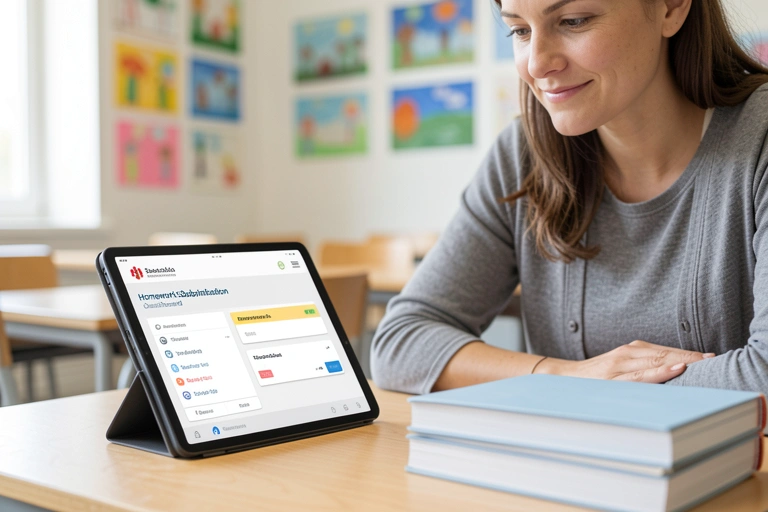
Imagine a dashboard where a teacher can see the status of every homework assignment for their class at a glance. They can instantly identify who has not submitted their work and send a pre-written, polite reminder to the student and their parents with a single click. This is the power of a platform like Parent Portal. The Homework Submission & Tracking feature automates what was once a painstaking manual process.
Furthermore, technology can help differentiate learning and make homework more engaging. Parent Portal’s AI-Generated Homework Tasks allow teachers to create age-appropriate activities tailored to different ability levels in seconds. This ensures that homework is always a meaningful learning opportunity, not just busywork, which in turn increases student motivation to complete it.
When feedback is also managed through the platform, the loop is closed. Teachers can provide written or audio feedback directly on the submitted work, and parents are notified to view it. This creates a continuous, visible dialogue around a child's learning. The time saved from manually chasing, recording, and reporting on homework can be reinvested into what matters most: planning high-quality lessons and providing individualised student support.
A Forward-Looking Approach to a Timeless Problem
Handling late homework fairly is about more than just a policy; it’s a reflection of a school’s culture. By prioritising understanding, promoting open communication, and using technology to create transparent and efficient systems, schools can move beyond a punitive model. An empathetic approach, supported by powerful school communication tools, not only helps students develop responsibility but also protects their wellbeing and preserves their love of learning.
As we look towards EdTech in 2025 and beyond, the focus is on creating integrated systems that reduce teacher workload and foster a stronger school community. By embracing platforms like Parent Portal, schools can transform the perennial problem of late homework into an opportunity for engagement, support, and partnership. The result is a fairer system for students, a lighter load for teachers, and a more connected and informed parent body—a true win-win for the entire school ecosystem.
Comments