
How Micro Observations Inform Teaching Strategies
The Challenge of the Modern Classroom
In the vibrant, bustling environment of a primary school classroom, a teacher’s attention is pulled in a dozen directions at once. Amidst the teaching, guiding, and managing, the ultimate goal remains constant: to understand and support the unique learning journey of every single child. But how can you truly grasp the nuances of 30 individual learning paths with limited time and resources? Traditional assessments offer periodic snapshots, but they often miss the rich, continuous story of a child's development—the small breakthroughs, the subtle struggles, and the sparks of curiosity that define their daily experience.
This is where the power of micro-observations comes in. Instead of relying solely on formal tests and summative assessments, what if we could capture learning as it happens, in small, manageable pieces? This approach is not about adding more to a teacher's already overflowing plate. On the contrary, when supported by the right technology, it can streamline processes, reduce teacher workload, and provide unparalleled insights that directly inform more effective and personalised teaching strategies.
Beyond the Formal Assessment: The Power of Micro Observations
So, what exactly are micro-observations? Think of them as small, high-frequency data points that capture authentic moments of learning. They are the quick notes, photos, or even short voice recordings that document a student’s progress, a question they asked, a concept they grasped, or a social skill they demonstrated. Unlike a formal assessment which measures an outcome, a micro-observation captures the process.
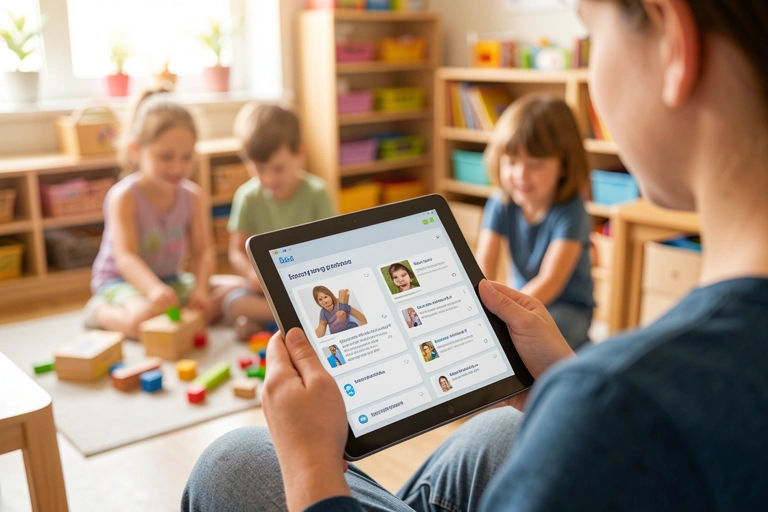
For instance, using a tool like Parent Portal, a teacher could record a 30-second voice note describing how a child successfully used phonics to decode a difficult word. They might snap a quick photo of a group of students collaborating effectively on a construction task, or a short video of a child explaining their mathematical reasoning. These aren't lengthy, time-consuming entries; they are swift, in-the-moment captures of learning in action. They provide qualitative, contextual evidence that a simple test score could never convey, building a foundation for truly responsive teaching.
True understanding of a child’s progress isn’t found in a single test score, but in the collection of countless small moments of effort, discovery, and connection.
By collecting these moments consistently, a teacher begins to weave together a detailed tapestry of each child's educational experience. It’s a shift from intermittent snapshots to a continuous, rolling video of their development.
Building a Mosaic of Learning, One Observation at a Time
Each micro-observation is a single tile in a larger mosaic. Individually, it offers a small insight. Collectively, these tiles form a comprehensive, longitudinal picture of a student's strengths, interests, and areas for development. This rich profile is far more dynamic and informative than a static data spreadsheet. It reveals patterns that might otherwise go unnoticed: perhaps a child thrives in collaborative settings, or consistently struggles with tasks requiring sustained independent focus. Maybe they show a surprising aptitude for spatial reasoning that only becomes apparent through observations of their play.
Platforms designed for modern education, like Parent Portal, allow teachers to tag these observations with specific curriculum objectives, such as EYFS Development Matters or Key Stage standards. This transforms anecdotal notes into structured, meaningful data. Over time, teachers can instantly see how a child is progressing against age-related expectations, not just based on a single piece of work, but on a wealth of evidence gathered over weeks and months. This detailed record becomes the cornerstone of effective planning and personalised intervention, making it one of the most powerful school communication tools available.
• Identify Gaps & Strengths: Pinpoint specific skills a child has mastered or is finding difficult in real-time.
• Enable Personalised Differentiation: Gain the insight needed to tailor tasks, resources, and support for individual learners.
• Inform Responsive Planning: Use recent observations to adjust upcoming lesson plans to better meet the class's needs.
• Track Real Progress: Monitor development against curriculum objectives with a rich, evidence-based timeline.
Translating Insights into Actionable Teaching Strategies
The true value of gathering this data lies in its application. A detailed student profile is only useful if it informs what happens next in the classroom. Micro-observations empower teachers to move from reactive to proactive teaching. When a teacher notices through several voice notes that a student is mispronouncing certain letter sounds, they can schedule a brief, targeted phonics intervention. If photo observations show another student is a natural leader in group activities, the teacher can create opportunities for them to develop those skills further.
This data-informed approach transforms differentiation from a complex ideal into a manageable practice. Instead of making broad assumptions about ability groups, a teacher can form fluid, dynamic groups based on real-time observational evidence for a specific skill. This ensures that every child receives the right level of support or challenge at the right time. It’s personalisation in its most authentic form, driven by a genuine understanding of the individual learner.
The AI Advantage: Uncovering Deeper Patterns and Saving Time
Manually sifting through hundreds of observations for 30 children to find patterns sounds daunting. This is where forward-thinking EdTech in 2025 and beyond provides a solution that helps reduce teacher workload. Parent Portal integrates AI-powered analysis that does the heavy lifting. The platform’s AI can analyse all accumulated observations—including transcribed voice notes—to automatically identify trends, highlight strengths, and suggest potential areas for development for each child.
This technology acts as a digital teaching assistant. It can summarise a child's progress in a particular area of the curriculum, saving teachers hours of manual data review. Furthermore, this AI extends to one of the most time-consuming tasks: report writing. The AI Report Writing Assistant can analyse a child’s entire observation history to generate unique, evidence-based, and personalised comments for end-of-term reports. The teacher remains in full control, editing and refining the comments, but the initial draft, grounded in months of real evidence, is created in seconds. This is a prime example of how smart school admin software can give time back to teachers to focus on what they do best: teaching.
– Headteacher, UK Primary School
Sharing the Journey: Engaging Parents with Meaningful Insights
The benefits of micro-observations extend beyond the classroom walls. Meaningful parent engagement is built on clear, consistent, and insightful communication. Sharing a photo of a child proudly holding up their artwork or a brief note about them helping a friend is infinitely more powerful than a generic end-of-day message. It gives parents a genuine window into their child's world at school.
With a secure platform, teachers can choose to share approved observations directly with parents. This creates a powerful home-school partnership where parents are not just passive recipients of information but active participants in their child's learning journey. They see the small wins and the moments of progress, helping them understand the learning process and providing opportunities to reinforce it at home. This shared understanding builds trust and ensures that everyone is working together to support the child.
The Future of Formative Assessment is Micro
The landscape of education is evolving. We are moving away from a reliance on high-stakes, periodic testing towards a more holistic, continuous, and child-centred model of assessment. Micro-observations are at the heart of this shift. They provide the rich, qualitative data needed to understand students deeply, teach them effectively, and engage their families meaningfully.
By leveraging dedicated school communication tools and intelligent school admin software, this powerful methodology becomes not just possible, but practical. It allows teachers to build a comprehensive understanding of every learner, inform their daily strategies with real evidence, and ultimately, reclaim their time to focus on fostering a love of learning. The future is not about more assessment; it's about smarter, more insightful assessment that truly serves the needs of every child.
Comments