
How Machine Learning Improves Voice Observation Analysis Over Time
The Challenge of Capturing Authentic Learning
In any bustling primary school or nursery, the most profound learning moments are often fleeting. They happen in a flash—a child suddenly articulating a complex idea during play, a group of students collaborating to solve a problem, or a quiet learner finding their voice in a small group discussion. For decades, teachers have tried to capture these moments with handwritten notes and formal observations. While valuable, these methods are time-consuming and often miss the spontaneity and richness of the original event. They can struggle to capture the tone, confidence, and nuanced language that reveal so much about a child's understanding. This is where modern school communication tools are changing the game, and it starts with the simple act of listening.
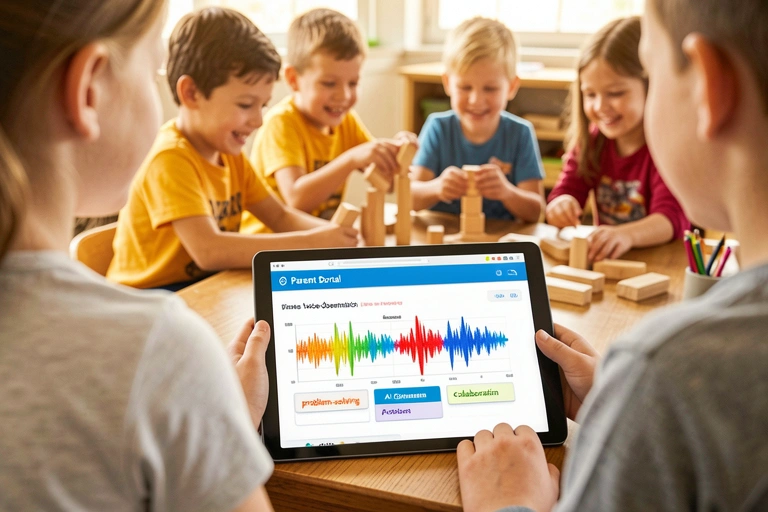
Imagine being able to capture that 30-second spark of genius without disrupting the flow of the lesson. Voice observations do just that. Using a platform like Parent Portal, a teacher can quickly record an audio snippet of a child's explanation or question. This isn't just about recording what was said; it's about capturing how it was said. This raw, authentic data is the seed from which a powerful understanding of student progress can grow, but the real magic lies in what happens next.
From Soundwave to Insight: The First Step of Analysis
Once a voice observation is recorded, the journey into meaningful analysis begins. The first stage is straightforward but technologically impressive: the audio is automatically transcribed into text. This immediately provides a searchable, written record of the learning moment. But transcription is only the beginning. This is where machine learning (ML) enters the classroom. The Parent Portal AI performs an initial analysis, scanning the transcribed text for keywords, concepts, and linguistic patterns. It cross-references this with the school's curriculum framework, whether it's EYFS, Development Matters, or the National Curriculum.
For example, a teacher records a child in the block area saying, “I made the tower taller by putting the wide blocks at the bottom so it’s more stable.” The AI doesn’t just transcribe this. It identifies keywords like “taller,” “wide,” and “stable.” It recognises this as language related to engineering, physics, and problem-solving. It might suggest tags for ‘Shape, Space and Measure’ (EYFS) or ‘Scientific Enquiry’ (KS1). This initial analysis already provides a huge head start, transforming a simple observation into structured, evidence-based data and helping to reduce teacher workload significantly.
The true partnership in modern EdTech isn't just between school and home, but between teacher and technology. When a teacher validates an AI's suggestion, the system learns from the expert, creating a cycle of continuous improvement that benefits everyone.
This initial step is impressive, but it's static. The system is applying a pre-programmed set of rules. The real power of machine learning, and what truly sets it apart, is its ability to evolve. It doesn't just analyse; it learns.
The "Learning" in Machine Learning: Getting Smarter Over Time
The term “machine learning” is key. Unlike traditional software, an ML model is designed to improve its performance on a task over time through experience. In the context of voice observations, this “experience” comes from two main sources: more data and human feedback.
First, consider the power of data. A single observation provides a snapshot. A hundred observations provide a gallery. A million observations, collected across thousands of classrooms, provide a universe of data. With every new voice note that is recorded and analysed, the AI model refines its understanding. It learns the subtle differences in how a four-year-old and a seven-year-old describe the same concept. It gets better at distinguishing between a guess and a reasoned conclusion based on sentence structure and vocabulary. It starts to identify patterns that a single human observer might miss, simply because it has a much larger dataset to draw from. This is how the system moves from simple keyword matching to understanding genuine context and intent.
Second, and most importantly, is the teacher feedback loop. After the AI suggests tags or summaries, the teacher reviews them. They can accept, reject, or modify the AI's suggestions. Every single one of these actions is a lesson for the AI. When a teacher corrects a tag, they are telling the model, “Your initial assumption was incorrect; this is a better fit.” The system logs this correction and adjusts its internal 'weightings' to make it more likely to get a similar case right in the future. This creates a powerful symbiosis: the teacher's professional judgement trains the AI to become a more effective teaching assistant.
AI-driven analysis can significantly reduce the time teachers spend on administrative tasks related to observation and assessment. On average, schools using integrated AI tools report a 40% reduction in time spent on report writing, freeing up teachers to focus on what they do best: teaching. This is a core component of using school admin software to actively reduce teacher workload.
This cumulative learning process means the AI's analysis becomes more nuanced, more accurate, and more helpful over time. The reports it generates become richer, and the insights it offers become more profound. It builds a longitudinal picture of each child's development, tracking not just what they know, but how their thinking and communication skills are evolving.
The Compounding Benefits for Teaching and School Leadership
As the voice observation analysis improves, its value multiplies across the school. For teachers, the AI graduates from being a simple scribe to a genuine, time-saving partner. The AI Report Writing Assistant in Parent Portal, for example, can draw on months of these increasingly accurate observations to draft personalised, evidence-based report comments for each child. This saves countless hours while producing a far more detailed and holistic summary than a teacher could write from memory alone.
For school leaders, this evolving intelligence provides an unparalleled view of teaching and learning across the institution. They can analyse trends not just within a class, but across year groups or even the entire school. Are there common misconceptions about a specific maths topic in Year 4? Is there a notable improvement in oracy skills following a new school-wide initiative? The aggregated, anonymised data from thousands of observations provides concrete evidence to inform school improvement strategies, professional development, and resource allocation. It transforms the school's communication tool into a powerful school administration and improvement engine.
This data-driven approach also strengthens parent engagement. When parents receive updates, they are not just generic photos. They are specific, analysed moments of learning, often accompanied by the child's own voice. They can see and hear their child's progress, leading to more meaningful conversations at home and at parents' evenings. The platform bridges the gap between classroom activity and parental understanding in a way that builds a true learning community.
Looking Ahead: The Future of AI in Education
The evolution of voice observation analysis through machine learning is a perfect example of how technology can augment, not replace, the art of teaching. It takes the administrative burden of evidence collection and turns it into an intelligent, responsive system that empowers educators. By learning from the expertise of teachers, the system grows into a smarter, more capable assistant, ultimately creating a more personalised and insightful educational journey for every child.
As we look towards EdTech 2025 and beyond, this symbiotic relationship between human intelligence and artificial intelligence will become the standard. The focus will continue to shift from simple digitisation to intelligent augmentation, using technology to unlock insights and free up human potential. The journey starts with a single voice, but through the power of machine learning, it echoes into a smarter future for the entire school community.
Comments