
The Role of Voice Notes in Formative Assessment
In the vibrant, fast-paced world of a primary school classroom, moments of genuine learning can be as fleeting as they are profound. A child suddenly grasps a tricky mathematical concept, a reluctant reader decodes a difficult word with newfound confidence, or a group of nursery children collaborate on a fantastical story. These are the golden nuggets of formative assessment—the real-time evidence that informs our next teaching steps. But how can we effectively capture these moments without disrupting the flow of learning or adding to our ever-growing administrative burden?
For years, the answer has been the trusty clipboard, the hurried scrawl on a post-it note, or a detailed entry in a notebook after the children have gone home. While valuable, these methods have their limits. The solution, increasingly, lies in a tool most of us carry in our pockets every day: the voice recorder. Using short voice notes as an observation tool is transforming formative assessment, making it more authentic, efficient, and insightful than ever before.
Beyond Clipboards and Post-it Notes
Traditional methods of recording formative assessment, while well-intentioned, often create more problems than they solve. The primary challenge is the trade-off between detail and time. Stopping to write a detailed note about a child's breakthrough can interrupt the learning momentum for the whole class. Consequently, teachers often resort to cryptic abbreviations or brief phrases that lose their meaning days later. We've all looked back at a note that says "Leo - good shape work" and wondered what specific insight we were trying to preserve.
This process also places a significant strain on educators, contributing to the pressure to constantly document everything. The administrative task of organising, transcribing, and connecting these scattered notes to curriculum objectives is a major factor that can reduce teacher workload when addressed effectively. Furthermore, written notes struggle to capture the nuances of a child's understanding. They can't record the tone of voice that reveals confidence, the hesitation that signals a misconception, or the enthusiastic chatter that shows deep engagement. We document the what, but we often lose the how and the why.
Capturing Learning in High Fidelity
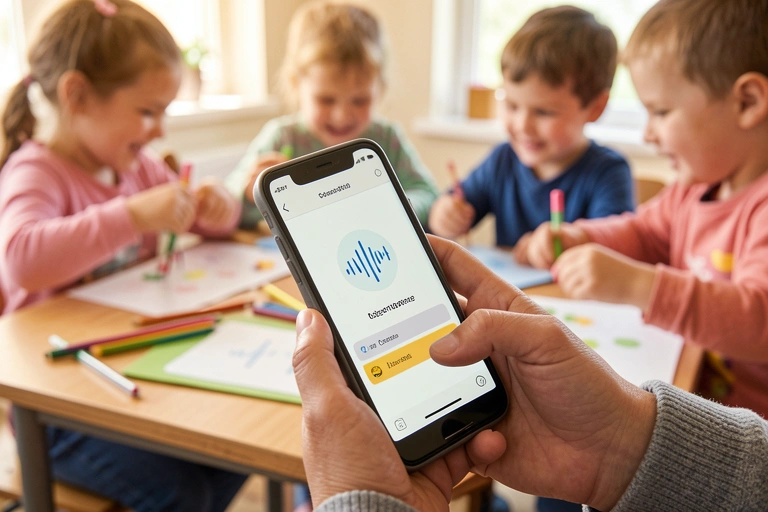
This is where voice notes change the game. By recording a quick 30 to 60-second audio observation, teachers can capture a learning moment in high fidelity. Instead of a second-hand summary, you have a primary source—the child's own voice, explaining their thinking in their own words. The benefits are immediate and substantial. Firstly, it's incredibly efficient. Speaking a 50-word observation is significantly faster than writing it, allowing teachers to gather more evidence with less disruption.
Secondly, it's authentic. A voice note preserves the exact language, vocabulary, and sentence structure a child uses. This is invaluable for tracking progress in oracy, EAL, and subject-specific terminology. You can hear the 'aha!' moment as it happens. Finally, it's discreet. Holding a phone and speaking quietly for a few seconds is far less intrusive than standing over a child with a clipboard and pen. This minimises the 'observer effect' and allows for a more natural and genuine snapshot of a child's ability.
From Theory to Practice: Voice Notes in Action
The practical applications for voice note observations span the entire curriculum. Imagine recording a Year 1 child as they read a page from their book, providing a clear benchmark of their fluency and expression that can be compared week on week. In a maths lesson, you could capture a student explaining why they chose a particular method to solve a problem, revealing their depth of reasoning in a way a ticked worksheet never could. In EYFS, a short recording of a child retelling a story or describing their junk model creation provides rich evidence of their narrative skills and imagination.
The goal of formative assessment is not to grade, but to grow. It is the compass that guides our teaching, and the truest readings come from the authentic, unfiltered voice of the learner.
These audio snapshots build a powerful, longitudinal picture of development. Over time, a collection of voice notes can show a child's journey from hesitant explanations to confident reasoning, from simple sentences to complex storytelling. It moves assessment from a series of isolated data points to a rich, evolving narrative of progress. This is the very essence of Assessment for Learning—using evidence to build a detailed understanding of a student's journey and guide them on their next steps.
- Record 30-60 second audio notes on any device.
- Automatically transcribe voice to text.
- Tag students and link observations to EYFS or National Curriculum objectives.
- Build a rich, searchable evidence bank for each child.
- Use AI to analyse progress and generate report card comments.
Of course, the power of this approach is fully unlocked when supported by the right technology. Random audio files saved on a device are no better than scattered post-it notes. This is where integrated school communication tools and platforms like Parent Portal become essential. By providing a structured system to capture, tag, transcribe, and analyse these observations, technology transforms a simple voice note into a powerful piece of pedagogical data.
Strengthening the Home-School Partnership Through Sound
One of the most exciting aspects of using voice notes is their potential to revolutionise parent engagement. A written report might state, "Jasmine is becoming more confident when sharing her ideas in science." While helpful, it lacks impact. Now, imagine being able to share a 20-second voice note with Jasmine's parents where she excitedly explains her prediction for an experiment. The parents don't just read about their child's confidence; they hear it. This creates a powerful, emotional connection to their child's learning that static text cannot replicate.
Sharing these moments provides parents with a unique window into the classroom. It helps them understand not just what their child is learning, but how they are learning. Platforms that facilitate this, with built-in approval workflows ensuring teachers control what is shared, are key to building this bridge. These audio observations can become fantastic talking points for parents' evenings, grounding the conversation in tangible evidence of progress and creating a more collaborative partnership between home and school.
This approach democratises assessment, making it more accessible and meaningful for parents. It helps them feel more involved and better equipped to support learning at home, creating a virtuous circle of engagement that ultimately benefits the child. The days of parents feeling disconnected from the daily life of the classroom are numbered, replaced by a new era of transparent, evidence-rich communication.
The Future of Assessment is Listening
As we look towards edtech 2025 and beyond, the focus is firmly on using technology to create more personalised, efficient, and human-centred learning environments. The integration of voice notes into formative assessment is a perfect example of this trend. It's not about replacing teachers with technology, but about augmenting their professional judgement with better tools. When combined with AI that can transcribe audio, identify key learning patterns, and even assist in writing report comments based on this evidence, the potential to reduce teacher workload is immense.
Platforms that combine these observation tools with wider school admin software features—from attendance and messaging to payments and parents' evening booking—create a unified ecosystem where data flows seamlessly. This integrated approach saves time, reduces administrative drag, and allows teachers to focus on what they do best: teaching. Embracing voice notes is more than just adopting a new tech gadget; it's a pedagogical shift. It's a commitment to listening more closely to our students, to valuing their voice, and to building a deeper, more authentic understanding of their learning journey. The future of assessment isn't just about seeing progress; it's about hearing it.
Comments