
The Accuracy Challenge: Understanding Voice Transcription Limits
The Rise of Voice in the Classroom
In our daily lives, we’ve become accustomed to talking to technology. We ask our phones for directions, tell our smart speakers to play a song, and dictate quick text messages on the go. This convenience, powered by sophisticated voice transcription, is rapidly moving from our homes into our professional lives. For educators, this isn't just a novelty; it's a potential solution to one of the most persistent challenges in the profession: time. The promise of EdTech is to streamline administrative tasks, and as one of the leading UK school communication tools, Parent Portal is at the forefront of this shift with features designed specifically to reduce teacher workload.
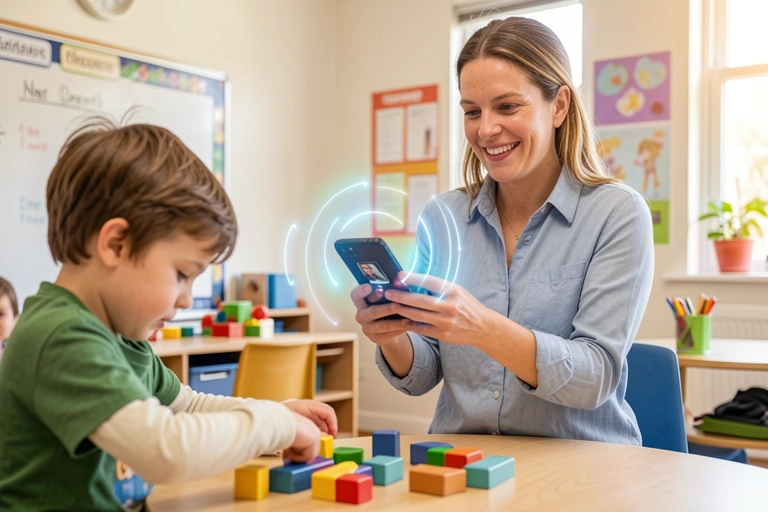
One of our most transformative features is voice-recorded observations. Instead of stopping to type out detailed notes about a learning moment, teachers can capture it with a quick 30-second voice note. These audio snippets are automatically transcribed, tagged to a student's profile, and can be shared with parents. It’s a powerful way to build a rich, longitudinal picture of a child’s progress. But as with any emerging technology, it’s crucial to have a transparent conversation about its capabilities and, just as importantly, its limitations.
Navigating the "Accuracy Challenge"
Let's be direct: no voice-to-text transcription service is 100% accurate, especially in the dynamic and often noisy environment of a primary school classroom. While the technology is incredibly advanced, it’s not magic. Understanding the factors that influence accuracy helps us use the tool more effectively and manage our expectations. A bustling classroom with 30 children is a world away from a quiet office where a single person dictates a memo. Background chatter, overlapping conversations, and sudden noises can all interfere with the clarity of the recording.
Furthermore, the beautiful diversity of regional accents across the UK can pose a challenge for any AI. While models are constantly learning, they can sometimes misinterpret words or phrases. The speed of speech is another factor; a teacher quickly capturing a fleeting moment might speak faster than usual, leading to potential errors. Finally, education has its own lexicon. Technical terms, phonetic sounds (like 'ch' or 'sh'), and unique name pronunciations can sometimes be mistranscribed. Recognising these variables isn't a criticism of the technology but an honest acknowledgment of the 'accuracy challenge' that all developers in this space are working to solve.
Even with minor imperfections, the speed and richness of a voice note far outweigh the time spent typing a perfect, but less immediate, observation.
The goal isn't flawless transcription on the first try. The goal is to capture the essence of a moment quickly and efficiently, providing a foundation that is significantly faster to work with than starting from scratch. By understanding these limitations, schools can implement voice tools as a powerful aid, not an infallible oracle. It’s a classic case of not letting the perfect be the enemy of the good, especially when it comes to boosting productivity and improving parent engagement.
While our system is designed for real-world classrooms, a few small adjustments can significantly improve accuracy:
• Speak closely to your device's microphone.
• Try to minimise immediate background noise where possible.
• Enunciate clearly, especially when using technical terms or names.
• A 30-second, focused observation is often more effective than a longer, rambling one.
Our Approach: Transparency and Teacher Control
At Parent Portal, we believe the best way to handle the limits of technology is to put control squarely in the hands of the professionals who use it. We've built our voice observation feature with safeguards that ensure accuracy and appropriateness, making it a reliable tool for school administration and communication. First and foremost, the original audio recording is always saved alongside the transcription. This is non-negotiable. If a transcript seems off, the teacher can listen to the original audio in a single tap. More importantly, it allows parents to hear the teacher's tone and, often, the child’s voice in the background, adding an emotional depth that plain text can never capture.
The second critical safeguard is our teacher approval workflow. No observation—transcribed or otherwise—is ever sent to a parent without a teacher reviewing and approving it first. This simple step is vital. It gives teachers a moment to quickly scan the text, make any minor edits if needed (like correcting a name or a specific term), and confirm they are happy with it. This human-in-the-loop system combines the speed of AI with the professional judgment of an educator, creating a workflow that is both efficient and trustworthy. This commitment to teacher oversight is central to our design philosophy and a key reason why our platform excels as a comprehensive school admin software solution.
- Sarah, Year 2 Teacher
Why Imperfect Transcription Still Transforms Practice
So, if it’s not always perfect, is it still worth it? The answer from our partner schools has been a resounding yes. The primary benefit is a dramatic reduction in teacher workload. Capturing a voice note takes seconds, while typing a detailed observation can take several minutes. Even if a teacher spends 10-15 seconds editing the transcript, the time saved across dozens of observations each week is substantial. This reclaimed time can be reinvested into what matters most: teaching and interacting with children.
Furthermore, the sheer volume and quality of data captured are far greater. Teachers can record more observations, creating a richer evidence base for assessments, parents' evenings, and end-of-term reports. Our AI-powered progress analysis can then identify patterns from this data, offering insights that might have been missed. For parents, receiving a voice note is a powerful tool for engagement. It’s personal, immediate, and offers a real window into their child's day. This is how modern parent engagement strategies come to life, strengthening the home-school partnership in a way that newsletters and static updates alone cannot.
The Future of Voice and EdTech 2025
The field of AI and voice recognition is one of the fastest-developing areas in technology. The models that power these systems are becoming more accurate, nuanced, and capable every single day. As we look towards EdTech 2025, we anticipate that transcription accuracy will continue to improve, better understanding different accents, contexts, and subject-specific language. At Parent Portal, we are committed to continuously updating and refining our platform to incorporate these advancements, ensuring our schools always have access to the best-in-class tools.
However, our guiding principle will remain the same: technology should serve the teacher, not the other way around. The future isn't about replacing professional expertise with automated systems. It's about augmenting that expertise, freeing educators from mundane tasks to focus on the human connections that lie at the heart of great teaching. Voice transcription is a powerful step on that journey, and we're excited to continue pioneering its responsible and effective use in UK schools.
Comments