
From Text to Speech: Making Learning Materials More Accessible
The Unspoken Barrier in Every Classroom
Walk into any primary school classroom in the UK, and you'll find a vibrant, diverse group of young learners. Each child brings a unique set of abilities, experiences, and challenges. As educators, our goal is to create an environment where every single one of them can thrive. Yet, quietly and often invisibly, a significant barrier persists: the printed word. For many children, a page of text isn't a gateway to knowledge; it's a locked door. Students with dyslexia, those with visual impairments, children for whom English is an additional language (EAL), and even those who are simply auditory learners can find text-heavy resources challenging and demoralising. This is the accessibility gap, and closing it is one of the most critical challenges in modern education. It’s not just about compliance; it's about equity. It’s about ensuring that a child's ability to learn isn't limited by their ability to read.
Unlocking Learning with Text-to-Speech
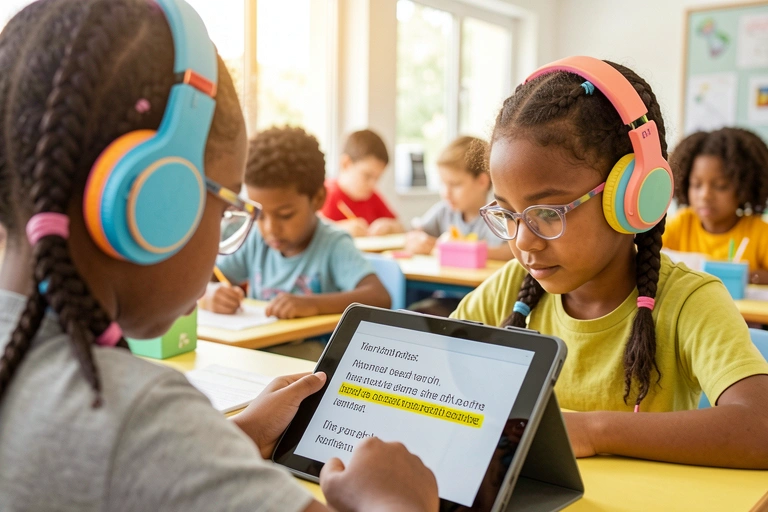
Imagine if that locked door could be opened with the press of a button. That's the promise of text-to-speech (TTS) technology. At its core, TTS is simple: it's software that reads digital text aloud. But modern TTS is far more than a robotic voice. Today's tools offer natural-sounding voices, the ability to highlight words as they are spoken, and customisable reading speeds. This simple transformation from text to audio has profound implications for learning. For a student with dyslexia, it separates the mechanical act of decoding from the cognitive act of comprehension. For an EAL student, it provides a clear model of pronunciation. For an auditory learner, it presents information in their preferred modality. By providing an alternative way to access information, TTS empowers students to become more independent, confident learners. It levels the playing field, allowing children to engage with grade-level content and focus on what truly matters: understanding and learning.
The power of the Web is in its universality. Access by everyone regardless of disability is an essential aspect.
The words of Tim Berners-Lee, the inventor of the World Wide Web, serve as a powerful reminder of our collective responsibility. In education, this principle is even more profound. When we make learning materials accessible, we're not just helping a few students; we are creating a more robust and flexible learning environment that benefits everyone. The independence a child gains from being able to have a text read to them, rather than relying on a teaching assistant or peer, is immeasurable. It fosters self-esteem and a positive association with learning, which can have a lasting impact on their entire academic journey.
Practical Applications in the Modern Classroom
The theory is compelling, but how does TTS translate into daily practice? The good news is that implementation can be straightforward and incredibly effective. Consider reading comprehension tasks. Instead of some students struggling with the text itself, all students can listen to the passage, following along with the highlighted words. This ensures that the assessment is truly about their comprehension, not their decoding ability. Homework is another key area. When instructions are provided as text, misinterpretations can happen. With TTS, students and parents can hear the instructions read aloud, ensuring clarity and reducing anxiety. Furthermore, TTS is a brilliant tool for the writing process. By having their own work read back to them, students can hear awkward phrasing, grammatical errors, and typos they might otherwise miss, turning them into more effective editors of their own work. This auditory feedback loop is a powerful way to improve writing skills for learners of all abilities.
Explore the 'Accessibility' settings on your school's tablets, Chromebooks, and PCs to unlock powerful tools that can read web pages, documents, and other text aloud for students at no extra cost.
The potential doesn't stop there. For subjects rich in new vocabulary, like science or history, TTS helps with both recognition and pronunciation. It can be used to create audio versions of class novels, research materials, and even exam questions, where permitted. By integrating TTS into your teaching toolkit, you move from a one-size-fits-all model to a more flexible, differentiated approach that caters to the individual needs of your students without singling anyone out.
Beyond TTS: A Holistic Vision for Accessibility
While text-to-speech is a game-changing tool, it's one part of a larger, more holistic approach to accessibility. True inclusivity involves communicating and sharing progress in ways that are accessible to everyone in the school community, including parents. This is where modern school communication platforms come into their own. For example, the ability for a teacher to record a 30-second voice-recorded observation of a child mastering a new skill is a powerful form of accessible evidence. It captures the moment authentically and can be shared with parents, providing a rich, qualitative insight that a written note might miss. This shift from purely text-based records to a mix of media creates a much fuller, more human picture of a child's development. This is accessibility in action, extending beyond the student to embrace the entire family. When a platform offers automatic translation for messages and announcements, it breaks down language barriers, ensuring EAL parents are fully included in the school community and their child's education.
This multi-modal approach is the future of school communication and progress tracking. It acknowledges that just as children have diverse learning styles, parents have diverse communication preferences and needs. By offering information through text, photos, video, and audio, schools can create a truly inclusive communication strategy that strengthens the home-school partnership and boosts parent engagement across the board.
Reducing Workload with Integrated AI Tools
A common concern among educators is that implementing new technology, even for a worthy cause like accessibility, will simply add to their already overwhelming workload. This is a valid fear. The key is not to add more tools, but to use a smarter, integrated one. A comprehensive school admin software solution like Parent Portal is designed to reduce teacher workload by building these capabilities directly into the platform you use every day. Imagine needing to explain a complex scientific concept. Instead of writing out a simplified explanation, the AI Concept Explainer can do it for you in seconds, generating child-friendly text that can then be read aloud. Need a differentiated reading comprehension task? The Comprehension Generator can create it. This synergy between AI-powered teaching assistants and built-in accessibility features is what makes modern EdTech so powerful. It automates the time-consuming aspects of differentiation and content creation, freeing up teachers to focus on what they do best: teaching. When your communication tool, observation tracker, and teaching assistant are all one and the same, accessibility ceases to be an extra task and becomes a seamless part of your workflow. This is how we can realistically and sustainably build the inclusive classrooms we envision for EdTech 2025 and beyond.
Building the Inclusive Classroom of the Future, Today
Creating a truly accessible learning environment is no longer a distant dream; it's an achievable reality. By embracing technologies like text-to-speech and leveraging the power of integrated school platforms, we can systematically dismantle the barriers that hold some children back. This isn't about technology for technology's sake. It's about using smart tools to foster independence, build confidence, and unlock the potential within every child. It’s about saving valuable teacher time and directing it towards high-impact interactions. As we move forward, let's commit to building schools where every student has the tools they need to access information, and every teacher has the support they need to make it happen. The inclusive classroom of the future starts with the choices we make today.
Comments