
How School Leaders Can Monitor Teaching Quality
The Modern Leader's Dilemma: Monitoring Quality Without Compromise
For any school leader, ensuring high-quality teaching and learning across every classroom is the cornerstone of their mission. It’s a profound responsibility that directly shapes student outcomes and the school's reputation. Yet, the traditional methods of monitoring teaching have often been a source of significant tension. The high-stakes, graded lesson observation, once a staple of school improvement, frequently creates a culture of anxiety and performance, rather than one of authentic, reflective practice. Teachers feel the pressure to deliver a perfect, one-off showcase, while leaders are left with a snapshot that may not truly represent the day-to-day reality of the classroom. This old model is not just stressful; it's inefficient and often ineffective. It adds to the already immense teacher workload and can stifle the very creativity and risk-taking that defines outstanding teaching. The challenge for today's school leader is clear: how can you maintain a clear and accurate view of teaching quality, support your staff effectively, and foster a positive professional culture all at once? The answer lies in shifting the focus from 'judging' to 'understanding' and leveraging modern technology to make this possible.
Beyond the Graded Lesson Observation
The concept of a single, high-pressure observation as the primary measure of a teacher's competence is rapidly becoming outdated. Educational leaders now recognise that this approach is fraught with limitations. A teacher’s true impact is not demonstrated in a single 60-minute slot under scrutiny; it’s revealed over time, in the small interactions, the gradual breakthroughs, and the consistent nurturing of a positive learning environment. Relying on isolated observations can lead to skewed perceptions, rewarding polished performers rather than celebrating the messy, authentic, and often non-linear process of genuine learning. Furthermore, the administrative burden associated with formal observations is substantial. Scheduling, pre-meetings, recording evidence, writing up detailed feedback, and objective setting all consume valuable time for both teachers and leaders – time that could be better spent on direct instructional support or collaborative planning. To truly understand the quality of teaching, leaders need to move towards a more holistic, evidence-based model that gathers low-stakes data from multiple sources over an extended period.
The most effective professional development is ongoing, job-embedded, and collaborative, shifting the focus from teaching to learning itself.
This shift requires building a foundation of trust, where teachers feel safe to experiment, to reflect openly on their practice, and to seek support without fear of reprisal. It’s about transforming the process from a top-down evaluation into a collaborative journey of professional growth.
Fostering a Culture of Professional Growth
To truly monitor and enhance teaching quality, school leaders must first act as cultural architects, building an environment where continuous improvement is the norm. This means reframing the conversation around professional development. Instead of a deficit model focused on 'fixing' weaknesses, it becomes a coaching model focused on nurturing strengths and exploring new strategies. When teachers feel they are part of a supportive professional learning community, they are more likely to engage in meaningful self-reflection and peer collaboration. This is where gathering low-stakes evidence of practice becomes transformative. Imagine enabling a teacher to share a moment of success not for judgement, but for celebration and analysis. Or to capture a tricky concept they are trying to explain and discuss it with a mentor. This changes the dynamic entirely. It empowers teachers to own their professional development, using real classroom moments as the basis for growth. It’s in this culture of trust that technology can serve as a powerful ally, not as a tool for surveillance, but as a facilitator of meaningful professional dialogue.
This approach respects the complexity of teaching and provides a framework for improvement that is both more effective and more humane. It leverages technology to gather authentic insights that were previously invisible.
Using EdTech to See the Real Classroom
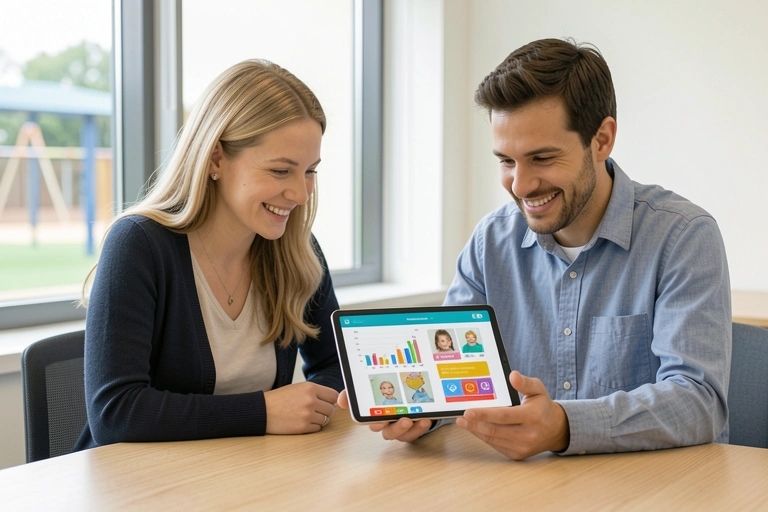
The true magic happens when you shift your evidence-gathering focus from teaching performance to student learning. A platform like Parent Portal offers a revolutionary way to do this. Instead of observing the teacher, you create a system where teachers capture evidence of learning as it happens. For instance, the Voice-Recorded Observations feature allows a teacher to quickly record a 30-second audio clip of a child explaining their reasoning in maths, or a group of children collaborating on a science experiment. These are not staged events; they are authentic, in-the-moment snapshots of learning. For a school leader, this collection of audio evidence, automatically transcribed by AI, provides an incredible window into the classroom. During a professional review meeting, a leader can ask, "Show me a moment this week where a child had a breakthrough." Reviewing this together provides a far more powerful and positive basis for discussion than a generic observation form. Similarly, Photo and Video Observations build a visual tapestry of the learning journey across a term. A leader can review the feed for a particular class and see the range of activities, the level of engagement, and the progression of skills over time. It gives an aggregate view of the learning culture in that room, moving beyond the individual to see the impact on the whole class.
This method respects teacher autonomy while giving leaders the rich, qualitative data they need. It transforms monitoring from an event into an ongoing, integrated process.
From Subjective Judgement to Evidence-Based Dialogue
Armed with this wealth of authentic learning evidence, professional conversations become more objective, focused, and productive. Parent Portal's integrated Appraisal System allows this evidence to be linked directly to professional goals. During a performance management meeting, a teacher and their line manager can review a portfolio of observations, progress data, and parent communications together. Instead of relying on memory or subjective impressions, they can set SMART objectives based on tangible evidence. The dialogue changes from "I think you should..." to "The evidence shows that students are really excelling in X, how can we apply those strategies to Y?" This data-driven approach is supercharged by AI-Powered Progress Analysis. The platform's AI can analyse thousands of observations tagged against curriculum objectives (from EYFS to KS2) and identify patterns. For a school leader, this is gold. The AI can highlight that, across Year 3, children are showing exceptional progress in creative writing but may need more support with specific maths concepts. This insight allows leaders to make strategic decisions about CPD, resource allocation, and curriculum adjustments based on school-wide trends, not guesswork. It depersonalises feedback and helps everyone focus on the ultimate goal: improving student learning.
Connecting Teaching Quality to Wider School Goals
Excellent teaching doesn't exist in a vacuum. Its impact reverberates throughout the school community, particularly in parent engagement and student wellbeing. A system that makes learning visible naturally strengthens the home-school connection. When teachers use Parent Portal to share those wonderful learning moments—a photo of a child proudly holding their artwork or a voice note of them reading a sentence for the first time—parents feel more connected and informed. This positive stream of communication is, in itself, an indicator of a high-quality learning environment. School leaders can see this positive engagement as a direct outcome of great teaching. Furthermore, features like the Digital Rewards System offer another lens through which to view classroom culture. Consistent and meaningful rewards for effort, kindness, and collaboration reflect a positive and well-managed classroom, giving leaders insight into the 'hidden curriculum' of social and emotional development. Crucially, this advanced approach to monitoring quality also helps reduce teacher workload. By using AI to transcribe voice notes, analyse progress, and even assist in generating end-of-term report comments based on the accumulated evidence, the system frees up teachers from administrative drudgery. This sends a powerful message that leadership values their time and wellbeing, which is fundamental to retaining great staff.
A Smarter Approach to School Improvement
Monitoring teaching quality in the 21st century requires a smarter, more sophisticated approach. It demands that we move on from outdated methods that cause stress and provide limited insight. The future of effective school leadership lies in building a culture of trust and embracing technology that provides a continuous, 360-degree view of learning. A comprehensive school admin software solution like Parent Portal provides the very infrastructure needed to turn this vision into a daily reality. By focusing on capturing authentic evidence of learning, facilitating data-driven professional dialogue, and connecting classroom practice to wider school goals, leaders can support their teachers, engage their parents, and, most importantly, drive meaningful and sustainable improvement for every child. This is not just about new tools; it's about a new philosophy of leadership—one that is supportive, evidence-based, and relentlessly focused on what truly matters.
Comments