
The Unexpected Benefits of Daily Voice Recording
Moving Beyond the Pen and Paper
Imagine the scene: the last student has gone home, the classroom is finally quiet, and you’re faced with a mountain of paperwork. Atop that pile sits a stack of observation notes you need to write up. You try to recall the specifics of a breakthrough moment a child had in maths, or the nuance of a conversation during free play. The details are fuzzy, lost in the whirlwind of a busy school day. For decades, written observations have been the standard, but they are often a time-consuming and imperfect summary of a dynamic process. They can feel like another administrative burden, capturing a fraction of the real story and adding to the ever-present challenge of teacher workload.
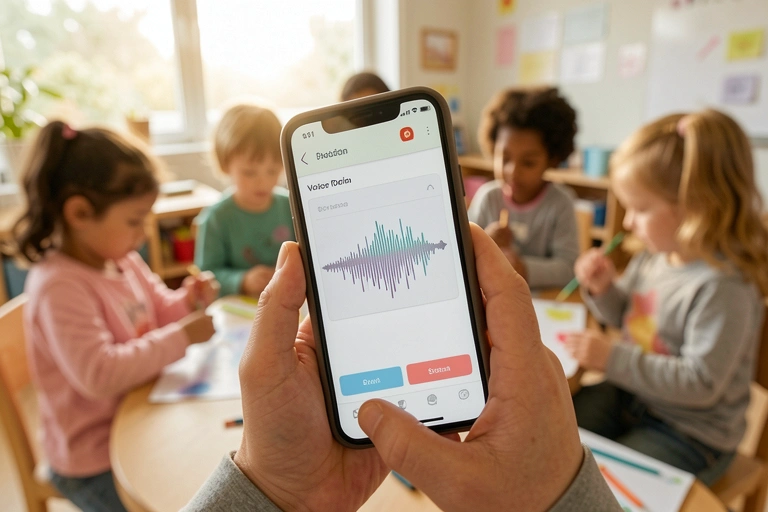
What if there was a way to capture these moments with perfect fidelity, in a fraction of the time? This is where the simple power of voice recording comes in. By swapping the pen for a microphone, teachers can capture rich, detailed, and authentic snapshots of learning as they happen. A quick 30-60 second voice note can preserve not just what a child said, but how they said it—their excitement, their hesitation, their dawning comprehension. This isn't about replacing skilled teacher assessment; it's about enhancing it with a tool that fits seamlessly into the flow of the classroom.
The Sound of Authentic Learning
So much of a child's development, particularly in the Early Years and Key Stage 1, is verbal. The most profound learning moments are often expressed through speech—explaining a concept to a friend, wrestling with a new word, or narrating an imaginative story. These are the moments that traditional, static forms of observation can miss. Daily voice recording allows educators to build a vibrant, audio-based portfolio of a child's journey.
Consider the difference between writing "Sophie used descriptive language in her story" and having a recording of Sophie excitedly saying, "And the gigantic, sparkly dragon flew over the wobbly, wobbly bridge!" The latter is not just evidence; it's a living piece of her learning journey. It captures her personality, her vocabulary, and her confidence in a way that written notes never could. Platforms like Parent Portal are making this process incredibly simple, allowing teachers to record quick voice observations on any device, tag the relevant children, and securely save it to their student profile in seconds.
It’s one thing to write that a child is growing in confidence, but it’s another for a parent to actually hear them explain their thinking on a project.
This approach transforms assessment from a retrospective task into a real-time celebration of progress. It frees teachers from their clipboards, allowing them to remain present and engaged with the children while still capturing the high-quality evidence needed to track development and inform planning. The focus shifts from paperwork to pedagogy, which is a win for both teachers and students.
Building Bridges: A New Era of Parent Engagement
Meaningful parent engagement is the holy grail for most schools. While newsletters and parents' evenings are important, they often provide a high-level overview. What parents truly crave is a window into their child's daily world at school. Sharing these voice notes—after a quick review and approval by the teacher—does just that, creating a powerful and emotional connection between home and school.
Imagine a parent receiving a notification during their workday. They open the app and get to hear their child, who is usually shy, confidently counting to twenty, or explaining the life cycle of a butterfly. This isn't a generic update; it's a personal, tangible piece of their child's progress. It opens up new avenues for conversation at home and gives parents the context they need to support learning. It's one of the most effective school communication tools available, fostering a true partnership in a child's education.
AI-Powered Insights: Turning Voice into Action
Herein lies the most unexpected benefit, and the part that truly tackles teacher workload. Capturing hundreds of voice notes sounds great, but it could easily become an unmanageable sea of data. This is where advanced school admin software shows its true power. Modern platforms use AI to do the heavy lifting, turning these audio snippets into structured, actionable insights.
Automatic Transcription: Every voice note is automatically converted into text, making it searchable and easy to analyse.
Curriculum Tagging: Teachers can link observations to specific EYFS or National Curriculum objectives with a single tap.
AI Progress Analysis: The system analyses accumulated observations to spot patterns, highlight strengths, and identify potential areas for development.
AI Report Writing Assistant: Come report-writing time, the AI can generate personalised, evidence-based comments for each child based on their unique collection of voice observations.
This synergy between human observation and artificial intelligence is what makes the system so effective. The teacher's professional judgement is central—they capture the moment that matters. The AI then handles the administrative side: the transcription, the data organisation, and the initial analysis. This is a real solution to reduce teacher workload, not just move it around. It automates the monotonous tasks, freeing up teachers to focus on interpreting the data and planning their next steps.
A Smarter Way to Inform Teaching and Planning
The final, powerful piece of the puzzle is how this rich new data source feeds back into teaching and learning. The AI-powered analysis within platforms like Parent Portal can highlight trends that might not be immediately obvious. For example, it might identify a specific SPAG concept that an entire group is struggling with, or notice that a particular child thrives during collaborative, hands-on activities.
These insights allow teachers to be more responsive and targeted in their planning. They can create differentiated homework tasks, generate new activity ideas, or find child-friendly ways to explain complex concepts, often with the help of integrated AI teaching assistant tools. The accumulated observations also provide a robust evidence base for parents' evenings, with teachers able to draw on a rich history of a child's progress, complete with audio examples. It’s a complete, virtuous cycle: authentic observation leads to deeper insights, which leads to more effective teaching and better-informed parents. Looking ahead to edtech 2025, this integrated approach to observation, communication, and planning represents the future of effective school management.
The Future of Assessment is Listening
What starts as a simple, 60-second voice note blossoms into something far more profound. It becomes a tool for authentic assessment, a bridge for parent communication, a workload reduction strategy, and a powerful engine for data-informed instruction. By embracing daily voice recording, schools are not just adopting a new piece of technology; they are adopting a new philosophy. It is a philosophy that values the authentic voice of the child, empowers the professional judgement of the teacher, and builds a stronger, more connected school community. The benefits are not just unexpected—they are transformative.
Comments