
Science Homework: Digital Assignment and Submission Workflows
From Static Worksheets to Dynamic Discoveries
For many teachers, the phrase "science homework" conjures images of photocopied diagrams to label, definitions to memorise, and question sheets about reversible changes. While foundational knowledge is important, this traditional approach often misses the very essence of science: inquiry, experimentation, and discovery. The administrative burden alone—designing, printing, distributing, collecting, and marking paper-based tasks—can be overwhelming. What if we could transform this process? What if homework could genuinely extend the curiosity sparked in the classroom, empowering students to become scientists in their own homes?
Digital assignment and submission workflows offer a powerful solution. By leveraging technology, schools can move beyond the limitations of paper and create a more dynamic, engaging, and efficient homework ecosystem. This isn't just about replacing a worksheet with a PDF; it's about fundamentally rethinking how we assign, collect, and give feedback on science tasks to reduce teacher workload and ignite a passion for learning.
The Challenges of Traditional Science Homework
The weekly cycle of science homework is a familiar strain on resources and time. Teachers spend hours sourcing materials, wrestling with the photocopier, and then chasing down forgotten or lost sheets. The marking pile that follows is often a sea of similar-looking papers, making it difficult to provide personalised, impactful feedback. For students, a worksheet on ecosystems can feel disconnected from the real, living world outside their window. For parents, deciphering task requirements and helping their child can be a struggle, often resulting in a completed task that doesn't truly reflect the student's understanding.
Furthermore, practical science is notoriously difficult to assign as homework. How can you ask a child to demonstrate their understanding of forces or chemical reactions on a piece of A4 paper? The result is that homework often becomes a theoretical, passive activity, robbing students of the chance to learn by doing. This disconnect between classroom experiments and homework theory creates a missed opportunity for reinforcing key scientific skills and concepts.
Designing Engaging Digital Science Assignments
A modern school communication platform like Parent Portal revolutionises how science homework is created and assigned. Instead of a one-size-fits-all worksheet, teachers can build rich, multi-layered tasks directly within the system. An assignment can include clear instructions, deadlines, and a wealth of attached digital resources—a link to a National Geographic video about ocean currents, a virtual-lab simulation, or an interactive diagram.
This is where smart tools become a teacher's best friend. Parent Portal’s AI-Generated Homework Tasks can act as a tireless assistant. A teacher can input a topic like "Living Things and Their Habitats" for Year 4 and instantly receive differentiated activities. One group might get a task to identify and photograph five different types of plants in their garden, while another receives a research prompt about the lifecycle of a butterfly, complete with suggested keywords for searching. This level of differentiation, which would take hours to plan manually, can be achieved in seconds, ensuring every child is appropriately challenged.
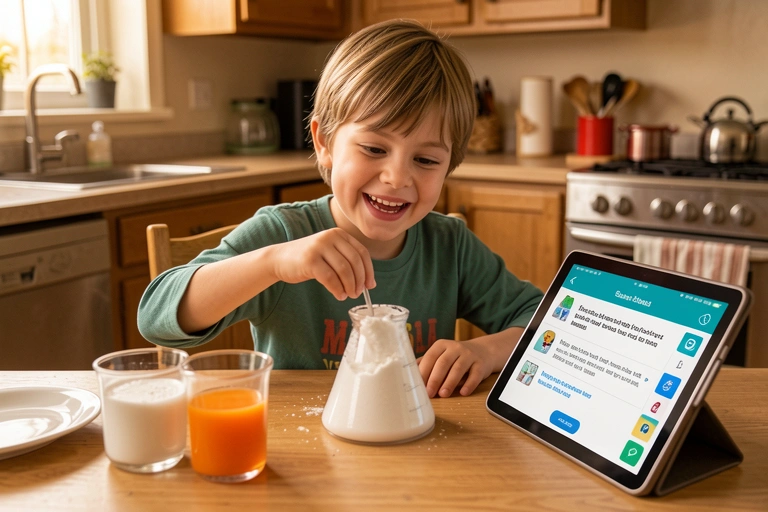
When a child brings their home experiment to life through video, homework ceases to be a chore and becomes an act of scientific discovery, fuelling richer conversations back in the classroom.
The ability to tailor tasks is crucial. Using an Activity Ideas Generator, a teacher can find inspiration for hands-on investigations that use common household items, making practical science accessible to everyone. This shift from passive consumption of information to active investigation is the cornerstone of a successful science curriculum.
A Submission Process Fit for Scientific Inquiry
The real magic happens when it's time for students to submit their work. Digital workflows break down the barriers of paper, allowing for evidence of learning in its most authentic form. A task asking students to investigate friction doesn't have to end with a written paragraph. Instead, a student can submit a 30-second video of them testing which surface creates the most friction for a toy car, explaining their findings as they go. A task about separating mixtures could be evidenced with a series of photos showing the process step-by-step, with captions added by the student.
This multimedia approach is perfectly suited to science. It allows students to show what they know, not just write it. Parent Portal's homework submission feature enables students to upload photos, videos, and files directly from a tablet or computer. This doesn't just make homework more engaging; it also develops crucial communication and digital literacy skills. The teacher's dashboard provides a clear, real-time overview of who has submitted their work, ending the need for manual tracking and lost-paper admin forever.
- Sarah Jones, Head of Science, Oakwood Primary
This process also closes the loop for parents. With Parent Homework Visibility, they can see the exact task, their child's submitted video or photos, and the teacher's subsequent feedback, all in one place. It provides a clear window into their child's learning, empowering them to have more meaningful conversations about school.
Making Feedback Meaningful and Efficient
Feedback is where learning is consolidated. However, providing detailed, constructive comments on 30 different pieces of work is one of the most time-consuming parts of a teacher's job. Digital platforms streamline this significantly. Teachers can type feedback directly onto a submission, which is instantly shared with the student and their parents. This immediacy makes the feedback far more impactful than a comment on a piece of paper returned days later.
This is another area where AI can dramatically reduce workload. The AI Feedback Generator can analyse a student's submitted text, identify strengths, and suggest areas for improvement. For example, if a student writes a summary of an experiment, the AI can help the teacher generate feedback that praises their clear hypothesis while gently prompting them to include more detail in their conclusion. The teacher remains in full control, editing and approving the AI-generated comments to ensure a personal touch. This saves valuable time that can be reinvested into planning and teaching.
AI Homework Generator: Instantly create differentiated tasks, experiments, and research questions.
Concept Explainer: Break down complex topics like photosynthesis or electrical circuits into simple, child-friendly language.
Comprehension Generator: Create reading tasks based on scientific articles with targeted questions.
Feedback Generator: Provide specific, constructive feedback on submitted work in a fraction of the time.
By combining teacher expertise with AI efficiency, schools can deliver a higher quality of feedback without adding to teacher burnout. Every piece of work gets the attention it deserves, and every child receives targeted guidance on their next steps. This powerful feedback loop, visible to parents, reinforces the partnership between home and school.
Connecting Homework to the Broader Learning Journey
Ultimately, a digital workflow ensures that homework is not an isolated task but an integral part of each child's learning journey. Each video, photo, and written submission becomes a piece of evidence that builds a rich, longitudinal picture of a student's progress. Within Parent Portal, this evidence feeds directly into a child's Student Learning Profile.
When it comes to assessment or parents' evening, a teacher no longer has to rely on memory or a single test score. They can pull up a portfolio of a child's work, showing their development in scientific inquiry over time. They can share the video of the toy car experiment from October and compare it with a detailed investigation write-up from February. This evidence-based approach makes conversations with parents more concrete and meaningful, highlighting growth and identifying specific areas for support. It transforms homework from a simple measure of completion into a vital tool for understanding and nurturing each child's potential as a scientist, innovator, and critical thinker.
Comments