
Voice Biometrics: Could AI Identify Individual Student Speech?
The Sound of Learning: A New Frontier
Step into any vibrant primary classroom, and you're met with a symphony of sound. It’s the sound of learning: the excited chatter of a group project, a thoughtful question posed to a partner, the quiet whisper of a child figuring something out. For teachers, this sound is both music and a monumental challenge. Amidst the productive noise, how can you possibly capture every individual contribution, every fleeting moment of insight or confusion? Educators are masters of observation, but even the most attentive teacher can't be everywhere at once. This is where the future of educational technology, or EdTech, is heading. We're on the cusp of a significant leap forward, moving beyond simple transcription to a world where AI can not only understand what is said, but who is saying it. This is the world of voice biometrics, and it holds the potential to transform how we assess learning, engage parents, and support every child.
What Exactly is Voice Biometrics?
The term might sound like something from a science fiction film, but the concept is already part of our daily lives. If you've ever used your voice to unlock your phone or authorise a bank transaction, you've used voice biometrics. In simple terms, it's a technology that uses the unique characteristics of a person's voice as a digital identifier. Much like a fingerprint, each person's voice has a unique 'voiceprint' determined by both their physical vocal tract and their learned speaking patterns – their pitch, cadence, and tone. It’s far more sophisticated than standard speech-to-text software, which only cares about the words spoken. Voice biometrics answers a different, more powerful question: who is the speaker? By applying this technology to the classroom, we can begin to untangle the complex audio tapestry of a learning environment, attributing speech to individual students with remarkable accuracy.
From Classroom Chatter to Individual Insights
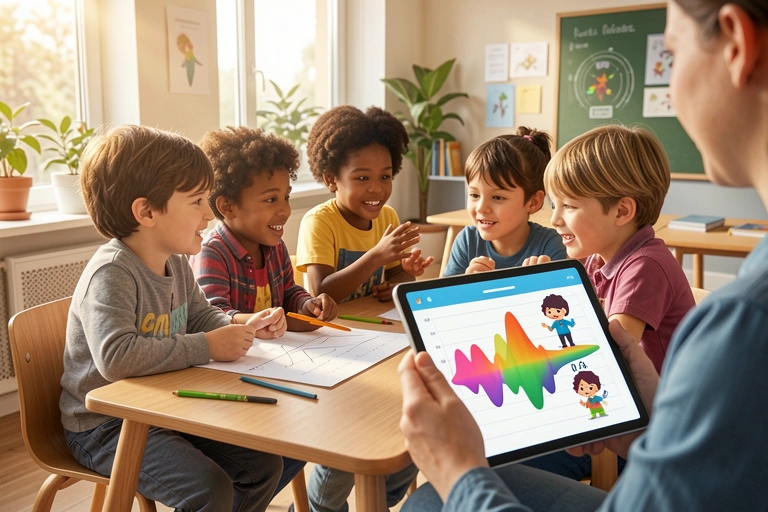
Picture a typical Year 2 group activity. Four children are building a model bridge out of straws and tape, discussing which shapes are strongest. One child suggests using triangles, another points out a potential weak spot, a third voices agreement, and the fourth quietly tests a join. A teacher might capture this learning moment with a quick voice note on their Parent Portal app. Currently, AI can transcribe that 60-second observation, providing a text record of the conversation. But what if it could go a step further? With voice biometrics, the system could automatically tag each part of the conversation to the specific child who spoke. Suddenly, the teacher has a rich, objective record: "Sophie suggested using triangles for strength. Tom pointed out the base was wobbly. Chloe agreed with Sophie's idea." This technology could shine a light on the quieter contributors, the children whose valuable input can get lost in the noise of more dominant personalities. It provides an unbiased log of collaboration, problem-solving, and subject-specific language use, all gathered authentically in the flow of learning.
Imagine an assessment system that truly hears every child, capturing their authentic voice in the flow of learning, not just in the silence of a test.
This automated attribution of speech doesn't just save time; it creates an entirely new form of evidence. The accumulated data would build a formidable, longitudinal record of a child's oracy skills, their confidence, and their grasp of concepts expressed through speech. For EAL students, it could track their developing fluency and vocabulary in a low-stakes context. For shy children, it validates their contributions and ensures their progress is seen. It shifts the focus from sporadic, high-pressure assessment points to a continuous, authentic stream of evidence, reducing teacher workload and providing a far more holistic view of each student.
This deeper insight naturally extends to one of the most important aspects of schooling: the home-school connection. Tools designed to improve school communication are most effective when they deliver specific, meaningful information. Instead of a generic report comment like "Jasmine contributes well in group work," a teacher could share an AI-generated summary from Parent Portal that notes, "During science today, Jasmine explained to her group why their first tower design was unsteady and suggested a wider base, showing great problem-solving skills." This level of detail empowers parents, giving them a concrete window into their child’s school day and providing specific discussion points to use at home. It makes preparations for parents' evenings, whether virtual or in-person, incredibly efficient, as the teacher has a rich, evidence-based profile of each child's spoken contributions at their fingertips.
Navigating the Future: Ethics, Privacy, and Practicality
The potential is exciting, but any discussion of student data, especially biometric data, must be grounded in a serious consideration of ethics and privacy. The goal is not surveillance; it is support. Introducing a system like this requires a framework built on trust, transparency, and robust security. Issues like explicit parental consent, data encryption, and strict access controls are not just important—they are non-negotiable. Schools and EdTech providers must work together to ensure that this technology serves only to enhance educational outcomes and is protected by the highest standards of data security, fully compliant with UK GDPR. The technology itself must also be scrutinised for fairness and accuracy, ensuring AI models are trained on diverse datasets to prevent bias against different accents, dialects, or speech patterns.
- Explicit and granular parental consent.
- Secure, encrypted storage of voiceprint data.
- Clear policies on data usage and retention.
- Anonymisation of data for AI model training.
While this technology isn't a standard feature in school admin software today, the building blocks are already in place. Platforms like Parent Portal, with its voice-recorded observations and AI-powered analysis, are paving the way. As AI capabilities continue to accelerate towards 2025 and beyond, the integration of voice biometrics feels less like a question of 'if' and more like one of 'when'.
Hearing Every Voice: The Future of EdTech Today
The promise of voice biometrics in schools is profound. It offers a way to dramatically reduce teacher workload by automating a time-consuming aspect of observation and assessment. It provides deeper, more objective insights into student learning and collaboration, helping teachers to tailor their support more effectively. And it strengthens parent engagement by offering a clear, evidence-based window into their child's progress. By ensuring every voice is logged, valued, and understood, we can build a more equitable and insightful educational experience for every child. The symphony of the classroom is complex, but with the right tools, we are getting closer to hearing every single note. What could you learn if you could truly hear every student?
Comments