
Tracking Reading at Home: Homework and Parent Communication
Moving Beyond the Dog-Eared Reading Record
For decades, the humble reading record has been a staple of primary education. A folded piece of card, tucked inside a reading book, it’s a seemingly simple tool for a vital task: encouraging children to read at home. Yet, for all its good intentions, the traditional reading record often creates more problems than it solves. It gets lost, damaged, or simply forgotten at the bottom of a school bag. The information it contains can be minimal—a parent’s signature, a date, perhaps a hastily scribbled “read to page 10.” This leaves teachers with a significant administrative burden and very little meaningful insight.
The daily task of checking, chasing, and collating these paper slips consumes valuable time that could be spent on planning and teaching. More importantly, it creates a disconnect. Teachers can’t see the quality of the reading experience. Was the child engaged or reluctant? Did they struggle with certain words? Did they discuss the story with their parent? Likewise, parents may feel isolated, unsure of how to best support their child’s reading journey beyond simply signing the log. It’s a system that tracks compliance, not comprehension or connection. In an era of advanced digital tools, there is a more effective, engaging, and insightful way to bridge the gap between home and school reading.
Building a Digital Bridge: Homework and Communication in One
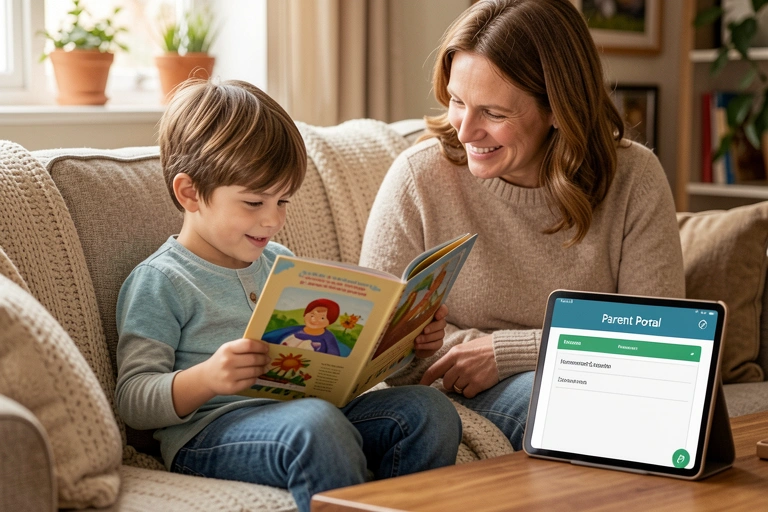
Imagine replacing that flimsy paper log with a dynamic, digital space that connects teachers, parents, and students in a collaborative reading partnership. This is precisely what a modern school communication platform like Parent Portal can achieve through its integrated homework management features. Instead of relying on a physical record, teachers can set a recurring digital homework task: “Read with an adult for 15 minutes every night.” This simple switch immediately solves the problems of lost and forgotten logs. But its real power lies in transforming how reading is reported and discussed.
Parents can easily mark the task as complete within the app. Crucially, they can also add comments, sharing context that a paper log could never capture. A parent might write, “Amelia absolutely loved this book and read an extra chapter!” or “Leo found the words with ‘igh’ tricky tonight, we practiced them a few times.” They can even upload a photo of a completed activity page or a short video of their child proudly reading a passage aloud. This transforms a passive administrative task into an active, rich dialogue about a child’s progress. It provides teachers with qualitative insights that are far more valuable than a tick in a box, helping them tailor their support in the classroom.
The goal is not just to know if a child has read, but how they read.
This digital approach fosters a culture of shared responsibility. Parents are no longer just supervisors; they become active contributors to their child’s learning portfolio. The homework tool becomes a two-way street, where insights from home directly inform practice at school, and vice-versa, creating a cohesive and supportive learning environment centred around the child.
Beyond 'Just Reading': Capturing Authentic Moments
While parent feedback is invaluable, teachers also need their own tools to capture and share learning evidence. Parent Portal’s observation features provide a powerful way to document a child's reading development in the classroom and share it with parents to guide home practice. These are not lengthy, formal assessments but quick, authentic snapshots of learning in action. During a guided reading session, a teacher might notice a child using a new decoding strategy successfully. Instead of just making a mental note, they can record a 30-second voice-recorded observation on their device.
They can capture the child’s voice as they read, adding a brief comment like, “Fantastic use of phonics to sound out ‘magnificent’,” and link it directly to the child's profile. Later, this observation can be shared securely with the parent. Hearing their own child’s success is incredibly powerful for parents and gives them a concrete example of progress. It also provides a model. When a teacher shares an observation of a child self-correcting, they can send a message encouraging the parent to praise that same behaviour at home. This creates consistency and reinforces learning strategies across both environments, making home reading time more effective and less stressful.
These photo, video, and audio observations, linked to EYFS or National Curriculum objectives, build a rich, longitudinal picture of each child’s reading journey. It’s a holistic view that combines formal and informal evidence, painting a story of growth that a simple reading level could never tell.
From Data Points to Development: Tracking Progress Meaningfully
The true advantage of a digital system is its ability to consolidate multiple sources of information into a single, coherent narrative of student progress. With Parent Portal, a child's reading homework submissions, parent comments, and teacher observations all feed into one unified student profile. This eliminates the need for teachers to cross-reference multiple documents or systems. At a glance, they can see a complete history of a child's reading journey.
This is where AI-Powered Progress Analysis comes in. The platform’s AI can analyse this wealth of accumulated data to identify patterns and trends that might otherwise go unnoticed. It can highlight if a child consistently receives parent comments about struggling with fluency, or if teacher observations show a marked improvement in comprehension after a classroom intervention. The system can generate automated summaries that highlight a child's strengths, pinpoint areas for development, and even suggest next steps. This data-driven insight is invaluable for planning differentiated instruction and preparing for consultations. Before a parents' evening, a teacher can review this entire reading history, armed with concrete examples and evidence to facilitate a productive, forward-looking conversation.
– Sarah, Year 2 Teacher
This approach moves beyond simply tracking books read. It tracks skills, confidence, and engagement over time, providing a far more authentic and useful measure of a child's development as a reader. It empowers teachers with the information they need to provide targeted support and helps ensure that no child’s struggles or successes go unnoticed.
Less Admin, More Impact: Streamlining Teacher Workload
One of the most significant barriers to effective teaching is the overwhelming weight of administrative tasks. A powerful school admin software and communication platform must do more than just add features; it must actively reduce teacher workload. By digitizing the home reading process, Parent Portal removes the daily grind of managing paper logs. There’s no more chasing forgotten records, no more deciphering illegible notes, and no more manually collating data. Reminders for homework can be automated, and submissions are tracked automatically.
The efficiency gains extend far beyond homework. The time saved is reinvested into high-impact activities. Teachers can use the AI teaching assistant tools to support their reading instruction. For example, they can use the AI Comprehension Generator to instantly create differentiated question sheets based on a child’s home reading book, saving hours of resource creation. When it’s time to write end-of-term reports, the AI Report Writing Assistant is a game-changer. It analyses all the accumulated observation data—the voice notes, parent comments, and progress tracking—to generate unique, evidence-based comments for each child's report. The teacher remains in full control, editing and personalising the comments, but the heavy lifting of summarising a term's worth of progress is done for them. This is a core principle of effective EdTech for 2025: using technology to handle the administrative load so that teachers can focus on the human element of their profession—teaching, mentoring, and inspiring.
The Next Chapter in Home Reading
Fostering a love of reading is one of the most important missions of any primary school. Achieving it requires more than just sending books home; it demands a strong, collaborative partnership between school and families. Traditional methods have placed barriers in the way of this partnership, creating administrative friction and limiting the flow of meaningful information. By embracing a comprehensive school communication tool, schools can tear down these barriers and write a new chapter in how they manage, monitor, and celebrate home reading.
Parent Portal provides the tools to create a seamless, insightful, and engaging process. It empowers parents to become active participants, gives teachers a holistic view of student progress, and significantly reduces workload through smart automation and AI. The result is a system where communication is effortless, insights are rich, and every child is better supported on their journey to becoming a confident, lifelong reader. It’s a smarter, more connected, and ultimately more human way to track reading at home.
Comments