
The Next Generation: Video Micro Observations and Beyond
In the ever-accelerating world of education, the pressure on teachers and school leaders to do more with less time is immense. We're constantly seeking tools that don't just add another layer of complexity but genuinely streamline our processes, enhance our teaching, and deepen our connection with parents. For years, technology has promised to reduce teacher workload, but often it has simply shifted it. Today, however, we stand at a fascinating intersection of communication, observation, and artificial intelligence that is finally delivering on that promise. At the forefront of this evolution is the rise of video micro-observations—a powerful method for capturing learning that is revolutionising assessment, parent engagement, and the very way we understand student progress.
Beyond the Clipboard: The Limits of Traditional Observation
For generations, the cornerstone of classroom observation has been the teacher with a clipboard, scribbling notes as they move between tables. While well-intentioned, this method is fraught with challenges. It’s time-consuming, often pulling the teacher away from active teaching. The notes themselves can be subjective and lack the rich context of the moment. Was the child collaborating? What was their body language? What was the 'aha' moment that led to the breakthrough? Written notes struggle to capture this nuance. Furthermore, transcribing these notes, linking them to curriculum objectives like Development Matters or National Curriculum standards, and then compiling them into a meaningful report is a monumental administrative task. It contributes significantly to teacher workload and often results in a static, two-dimensional picture of a child’s dynamic learning journey.
Capturing Learning in the Moment
The first significant leap forward was the move to digital and voice-recorded observations. Platforms like Parent Portal enabled teachers to capture quick 30-60 second voice notes throughout the day. This was a game-changer. Instead of pausing to write, a teacher could discreetly record their thoughts while a child was engrossed in an activity, capturing authentic learning as it happened. These “micro-observations” are less intrusive and, when accumulated over time, build a far richer and more accurate longitudinal record of a child's development. The automatic transcription of these voice notes made the data searchable and easier to manage, easing the administrative burden. It marked a critical shift from staged assessment to continuous, in-the-moment evidence gathering, but it was only the beginning of the story.
The Next Generation: Why Video Changes Everything
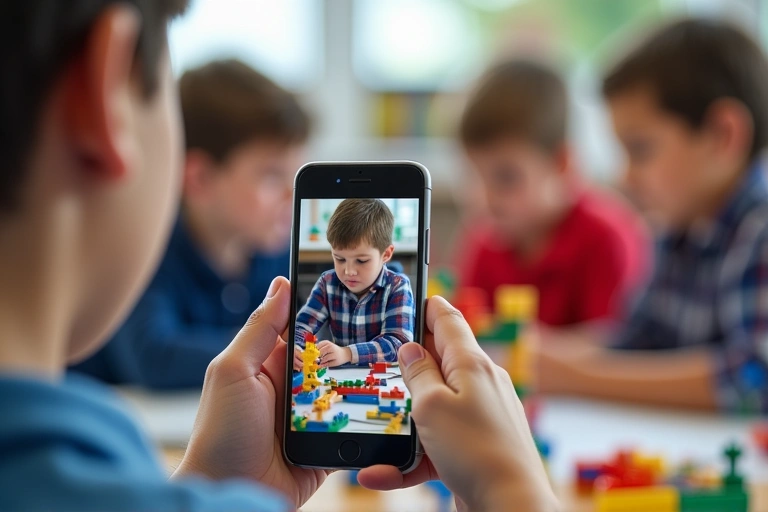
If voice notes opened the door, video and photo observations have blown it wide open. Adding a visual layer to micro-observations isn't just an upgrade; it's a fundamental transformation of what's possible. A short video clip captures not just what a child achieved, but how they achieved it. It shows their concentration, their collaboration with peers, their problem-solving process, and the sheer joy of success. This visual evidence is unparalleled in its clarity and impact. Within an integrated platform, a teacher can capture a short video, tag the relevant students, add a quick caption, and instantly link the moment to specific EYFS or Key Stage objectives. What was once a time-consuming administrative task becomes a seamless, powerful workflow that takes seconds. This creates a library of tangible, irrefutable evidence that supports assessments, informs planning, and validates teacher judgements far more effectively than any written note ever could.
To truly understand a child's learning journey, we must not only see the destination but witness the steps taken, the stumbles overcome, and the spark of discovery in their eyes.
This visual evidence becomes the bedrock of a modern, efficient assessment system. It provides concrete examples for parents’ evening discussions, offers clear evidence for moderation with other schools, and builds a powerful portfolio of a child's progress over their entire school career. For the first time, we're not just describing learning; we're showing it.
Turning Observations into Conversations
Perhaps the most profound impact of video observations is on parent engagement. Report cards and data charts are informative, but they rarely create an emotional connection. Sharing a short video of a child reading a sentence aloud for the first time, confidently explaining their maths strategy, or working creatively with friends fosters a powerful home-school partnership. It provides parents with a unique window into their child's world at school, helping them understand their child's strengths and challenges in a real, tangible way. This transforms communication from periodic, formal reporting into an ongoing, positive conversation. It builds trust and empowers parents to continue the learning journey at home, equipped with a true understanding of what their child is doing at school. When a parent receives a push notification and sees their child thriving, it reinforces the value of the school and celebrates success in a way that resonates deeply.
- Sarah Jones, Headteacher, Oakwood Primary School
This level of engagement is a cornerstone of outstanding educational practice, and modern school communication tools are making it easier than ever to achieve. It moves the conversation beyond attendance and behaviour to be squarely focused on learning and progress.
Smarter, Not Harder: How AI Supercharges Observations
Capturing thousands of video, photo, and voice observations creates a rich dataset, but it also presents a new challenge: how do you make sense of it all without drowning in information? This is where Artificial Intelligence becomes the teacher's most powerful ally. The true revolution in edtech isn't just about capturing data; it's about using AI to analyse it. Parent Portal’s AI engine works quietly in the background, processing the accumulated observations for each child. It identifies patterns, highlights areas of consistent strength, flags potential learning gaps, and even suggests next steps. Instead of spending hours trawling through records, teachers receive automated summaries that give them an at-a-glance overview of each child's progress. The most significant impact of this AI integration comes during report writing season. The AI Report Writing Assistant analyses a child's entire observation history—the voice notes, the video evidence, the curriculum tags—and generates unique, personalised, and evidence-based report comments. This single feature can save a teacher dozens of hours, freeing them up to focus on what they do best: teaching.
- AI-Powered Progress Analysis: Automatically identifies trends, strengths, and next steps from all observations.
- AI Report Writing Assistant: Generates unique, evidence-based report comments from observation data, saving hours of work.
- AI Feedback Generator: Creates constructive, encouraging feedback on student work.
- Concept Explainer: Simplifies complex topics into child-friendly language.
This isn't about replacing teachers; it's about augmenting their professional judgement with powerful tools. The AI provides the data-driven foundation, and the teacher adds the final, crucial layer of personal insight and nuance. It’s a genuine solution to reduce teacher workload while simultaneously improving the quality and depth of student feedback.
What's Next for EdTech in 2025 and Beyond?
As we look towards edtech in 2025, the defining trend is integration. The era of disjointed apps for communication, payments, booking, and assessment is ending. The future lies in a single, unified school admin software where every component works together. This is where the power of observation data truly multiplies. The same video observations that inform report cards can also be used to automatically generate pre-meeting reports for parents' evenings, giving teachers and parents a rich, evidence-based starting point for their discussion. AI can analyse observation trends to suggest differentiated homework tasks, which can be assigned and tracked within the same platform. Achievements captured on video can be celebrated through an integrated digital rewards and house points system, making recognition immediate and visible to parents. This creates a virtuous cycle where every piece of information enriches the others, providing a 360-degree view of the student without creating extra work. It’s a holistic approach that connects teaching, learning, administration, and parent communication into one powerful, streamlined ecosystem.
Embracing the Future of School Communication and Assessment
The journey from the humble clipboard to AI-powered video micro-observations represents a paradigm shift in education. We now have the tools to capture the richness of the learning process, share it in meaningful ways with parents, and use intelligent systems to analyse the data efficiently. This technology is not a distant vision for the future; it's available today. By embracing these integrated platforms, school leaders can empower their staff, deepen their community engagement, and, most importantly, significantly reduce teacher workload. The result is a more dynamic, responsive, and supportive educational environment where technology works for the teacher, not the other way around, allowing more time to be spent on the human connections that lie at the heart of great teaching.
Comments