
How Micro Observations Reduce Assessment Workload
The Unseen Burden of Assessment
For any teacher or school leader, the word 'assessment' often comes with a sigh. It’s an essential part of education, the bedrock upon which we build our understanding of a child's progress. Yet, it has also become one of the single greatest contributors to teacher workload. The hours spent on clipboards, sticky notes, and lengthy written narratives—often late into the evening—are a familiar story. We meticulously document learning, but the process of documentation itself can feel overwhelming, detracting from the very moments we aim to capture. But what if there was a way to reclaim that time while gathering even richer, more authentic evidence of learning? This is the promise of micro-observations, a transformative approach that is changing the assessment landscape for the better.
From Marathon Notes to Meaningful Moments
Traditional assessment methods often feel like a marathon. We aim to write detailed accounts of a child's activities, linking them to specific curriculum objectives and detailing next steps. While the intention is good, the reality is problematic. These methods are slow, often written retrospectively, and can miss the fleeting, spontaneous sparks of brilliance that happen every minute in a busy classroom. It’s a process that encourages us to hunt for 'evidence' rather than naturally observe learning as it unfolds. The result is often a mountain of paperwork that is difficult to collate, analyse, or share effectively with parents.
Micro-observations flip this model on its head. Instead of long-form narratives, they focus on capturing learning in short, sharp bursts. Think of a 30-second voice note describing how a child just used a new piece of vocabulary in their play, a quick photo of a group collaborating to build a tower, or a short video of a student finally mastering a tricky maths concept. These are small, in-the-moment captures that are quick to record and rich with context. They document the process of learning, not just the polished final product.
By capturing learning as it happens, we shift from being scribes to being present observers. The focus returns to the child, and the technology handles the administrative heavy lifting.
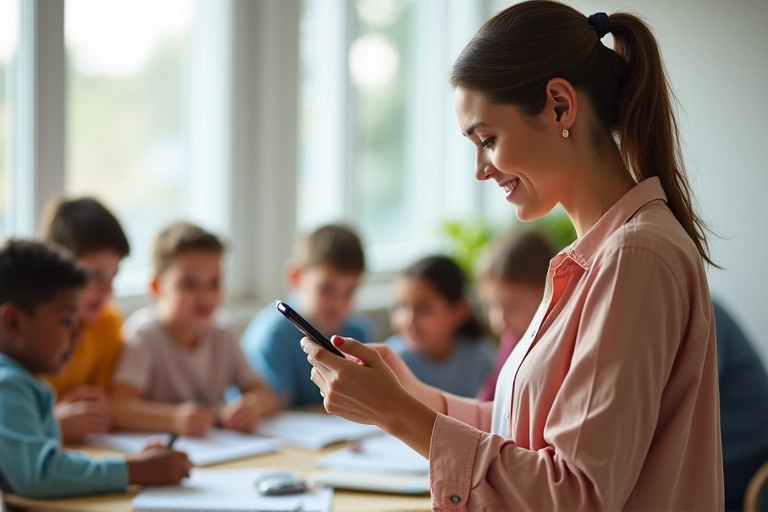
Using a platform like Parent Portal, this process becomes seamless. A teacher can use their device to record a quick voice note about a child’s breakthrough. The app can automatically transcribe it, tag the relevant child, and allow the teacher to link it to EYFS or National Curriculum objectives with a few taps. What might have taken 10-15 minutes to write down is now captured, transcribed, and logged in under 60 seconds. The time savings, compounded over weeks and months, are immense.
Unlocking Deeper Insights with AI
One of the biggest challenges with traditional observations is making sense of them. A folder full of paper notes is just that—a collection of individual data points that requires hours of manual review to identify patterns. This is where modern school admin software truly shines. When hundreds of micro-observations are collected digitally, they form a powerful, longitudinal dataset for each child. This is where the real magic happens.
Parent Portal’s AI-Powered Progress Analysis transforms your collection of micro-observations into actionable intelligence. Instead of manually sifting through notes, the AI automatically:
- Identifies learning patterns and developmental trends.
- Highlights strengths and areas needing more support.
- Suggests personalised next steps and teaching strategies.
- Generates evidence-based comments for report writing.
This AI-driven analysis does the heavy lifting, serving up insights that would have been nearly impossible to spot manually. A teacher can instantly see a summary of a child's progress in communication and language, supported by dozens of timestamped observational notes. This not only validates their professional judgment but also equips them with concrete evidence to inform their planning. It transforms assessment from a retrospective task into a proactive tool for shaping future learning, fundamentally reducing the cognitive load and planning time for teachers.
Building Bridges: Enhancing Parent Engagement
The benefits of micro-observations extend far beyond the classroom door. For parents, the school day can feel like a black box. A formal report twice a year provides a summary, but it rarely captures the texture of their child's daily school life. Sharing curated micro-observations changes this dynamic completely. A parent receiving a notification with a photo of their child proudly showing off their emergent writing, or a short audio clip of them contributing to a class discussion, is powerful. It’s a window into their world.
This steady stream of small updates builds a rich, evolving picture of a child’s school journey. It moves the conversation with parents away from a single, high-stakes parents' evening and towards an ongoing, collaborative dialogue. When parents' evening does arrive, both teacher and parent are already on the same page, armed with a shared understanding of the child’s recent progress, strengths, and challenges. The meeting becomes a more strategic conversation about next steps, rather than a simple download of information.
– Sarah, Year 1 Teacher
This approach fosters a true home-school partnership, where parents feel informed, included, and empowered to support their child's learning at home. It’s a key aspect of improving parent engagement, turning a school communication tool into a community-building platform.
Making Assessment Meaningful Again
Ultimately, technology should serve pedagogy. The goal isn’t just to be more efficient; it's to make assessment a more meaningful and supportive practice. By reducing the administrative burden, micro-observations free up teachers to do what they do best: teach. They can spend more time interacting with children and less time with their heads buried in paperwork. The introduction of tools like Parent Portal's AI Report Writing Assistant is a perfect example. The system analyses all the voice notes, photos, and progress data gathered over a term and generates unique, personalised, evidence-based report comments for each child. This saves dozens of hours per teacher, eliminating one of the most time-consuming tasks of the year while producing higher-quality reports.
As we look towards EdTech in 2025 and beyond, the focus is squarely on reducing teacher workload and leveraging technology to enhance, not replace, great teaching. Shifting to a model of micro-observations, supported by smart, integrated school admin software, is a critical step in this direction. It restores assessment to its rightful place: a dynamic, insightful, and manageable tool that celebrates progress and guides every child towards their full potential. It’s time to give your teachers the gift of time and make assessment work for them, not against them.
Comments