
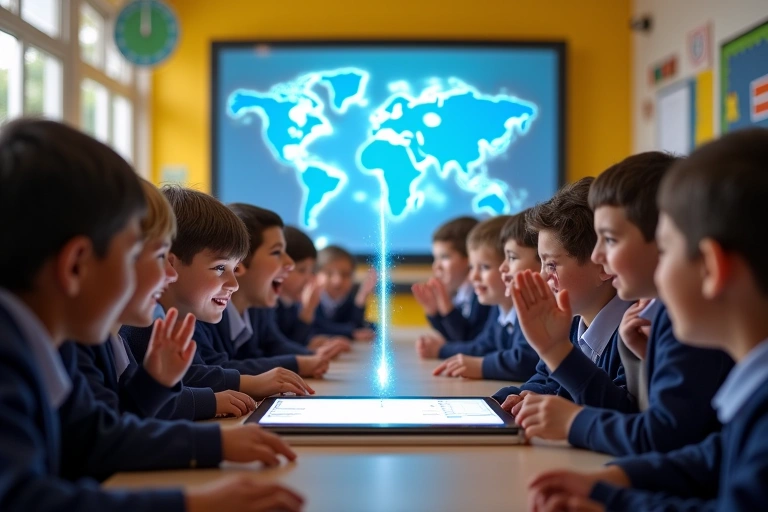
Cultural Studies: Connecting with Partner Schools Through Messaging
Enriching Education in a Globalised World
In today's interconnected world, teaching global citizenship is no longer a niche part of the curriculum; it's an essential component of a well-rounded primary education. We want our pupils to appreciate diverse cultures, understand different perspectives, and see themselves as part of a global community. Cultural studies and school partnership programmes are fantastic ways to achieve this, but they often come with significant logistical challenges. Traditional pen-pal schemes suffer from long delays, while one-off video calls can feel staged and lack continuity. How can we create an authentic, ongoing connection between students in different parts of the world without adding an overwhelming administrative burden to our teaching staff?
The answer lies in leveraging the power of modern education technology. By using an integrated school communication platform, schools can create a secure, dynamic, and persistent digital space where students and teachers from partner schools can connect, collaborate, and share their lives in real-time. This transforms cultural exchange from a series of isolated events into a rich, continuous conversation that embeds itself into the daily life of the classroom.
The goal of education is not to increase the amount of knowledge but to create the possibilities for a child to invent and discover, to create people who are capable of doing new things.
Rethinking how we approach these partnerships opens up a world of possibility. Instead of just exchanging letters or static project files, imagine classrooms sharing the sights and sounds of their day, collaborating on a science project across continents, and celebrating each other's festivals as they happen. This is the new reality of cultural studies, powered by intuitive and secure digital tools.
Beyond Pen-Pals: A Digital Bridge for Partner Schools
For years, the 'shoebox project' or the international pen-pal letter were the gold standards for school linking. While well-intentioned, these methods are fraught with issues. Letters get lost, emails land in spam filters, and the significant time lag between communications makes it difficult to build any real momentum or personal connection. Teachers spend hours photocopying, posting, and chasing responses, taking valuable time away from teaching and learning. The administrative overhead can quickly outweigh the educational benefits, often leading to these valuable projects fizzling out after an initial burst of enthusiasm.
What schools need is a 'digital bridge' – a single, shared environment that removes the friction of communication. A platform like Parent Portal, typically used for parent communication, can be brilliantly repurposed for inter-school collaboration. By creating a dedicated, secure group for the partner classes, teachers from both schools can co-moderate a space where children share updates, media, and messages. This approach maintains safeguarding and oversight while empowering pupils to take the lead in their learning. Suddenly, a school in Manchester can share a video of their rainy sports day with a partner school in Nairobi, who can respond instantly with a picture of their sun-baked playground. This is where real understanding begins.
Parent Portal provides the essential features to make your global partnership a success:
- Dedicated Messaging Groups: Create a private, secure space for partner classes to communicate, moderated by teachers from both schools.
- Photo & Video Sharing: Students and teachers can share visual moments from their day, from classroom activities to cultural celebrations.
- Multi-Language Support: Automatic message translation breaks down language barriers, making your partnership truly inclusive.
- Cloud Document Sharing: Teachers can easily share lesson plans, project briefs, and resources in a shared, secure drive.
This shift from asynchronous, high-effort communication to a real-time, low-effort model is a game-changer. It not only saves teachers countless hours but also makes the experience far more engaging and authentic for the students involved. The connection becomes a living part of their school week, not just a task to be completed.
Fostering Authentic Connections One Message at a Time
The real magic happens in the small, everyday interactions. A secure instant messaging feature allows students to move beyond formal introductions and share the little details that make up their lives. A pupil can share a photo of the 'strange' lunch they are having, only for their partner overseas to reply with a picture of something very similar. They can record short video messages showing off their school uniform or teaching their new friends a phrase in their local language. These micro-interactions build empathy and dismantle stereotypes far more effectively than a formal lesson ever could.
Using features originally designed for learning observations, teachers can capture and share high-quality moments of learning and cultural life. Imagine a teacher recording a 30-second voice note of the class singing a traditional song or taking a photo of a science experiment in progress. Tagging the 'partner class' group instantly shares this moment, inviting questions and comments. This creates a shared, longitudinal scrapbook of the partnership, documenting the journey and providing a rich resource for future reflection. This method dramatically reduces teacher workload; what once required downloading, emailing, and uploading files can now be done in a few taps on a classroom tablet.
Furthermore, this digital approach enhances parent engagement. When updates from the partner school appear in the same feed as school announcements and homework assignments, parents are brought directly into the experience. They can see their child developing a global perspective, ask questions about the project at home, and celebrate the connections being made. It extends the learning beyond the classroom walls and reinforces the value of the school's commitment to global education.
Leveraging AI to Deepen Understanding and Reduce Workload
Modern edtech platforms are increasingly integrating AI to act as a powerful teaching assistant, and this technology can be uniquely applied to cultural exchange projects. For instance, teachers can use an AI Concept Explainer to break down complex cultural or religious topics into simple, age-appropriate language for their class before sharing information with their partners. An Activity Ideas Generator can suggest collaborative project ideas tailored to the age groups and curriculum objectives of both schools, sparking creativity and ensuring the project remains educationally robust.
When a partner class shares a story or a piece of text about their local area, a teacher can use an AI Comprehension Generator to instantly create a set of differentiated questions, turning a simple shared resource into a targeted reading activity. The built-in translation features, often powered by AI, are perhaps the most powerful tool of all, ensuring that no child is excluded due to a language barrier. This fosters a truly inclusive environment where every student can participate fully. These tools don't replace the teacher; they augment their ability to create rich, varied, and impactful learning experiences while saving them precious time on resource creation.
Conclusion: Creating the Citizens of Tomorrow
The future of effective cultural studies lies not in static textbooks but in dynamic, lived experiences. By repurposing powerful school communication tools, we can dissolve the distance between partner schools and create vibrant communities of learning that span the globe. This approach fosters authentic student relationships, deepens cultural understanding, and significantly reduces teacher workload associated with traditional linking projects. It boosts parent engagement by making the project visible and accessible, turning a classroom activity into a whole-school celebration of global connection.
As we look towards edtech 2025 and beyond, platforms that combine communication, teaching tools, and school admin software into one seamless whole will become indispensable. They empower schools to be more ambitious in their curriculum design and more effective in their delivery. By building these digital bridges, we are not just teaching children about the world; we are giving them the tools, the confidence, and the curiosity to become active, compassionate global citizens.
Comments