
Voice-Recorded Observations: EYFS and KS Best Practices
The Challenge of Capturing Authentic Learning
Every teacher knows the feeling. You’re in the middle of a bustling classroom, a moment of pure learning magic unfolds, and you scramble for a sticky note or your observation clipboard. A child in your EYFS setting finally masters sharing, articulating their reasoning with surprising clarity. A Year 4 student has a 'lightbulb moment' during a group maths problem. By the time you’ve found a pen and jotted it down, the note is often a cryptic summary: “T. shared bricks well” or “S. understood division.” The richness, the nuance, and the child's own voice are lost. The pressure to document learning often forces us to reduce profound moments to sterile bullet points, creating administrative work that pulls us away from the very children we are trying to observe.
Unlocking Richer Insights: The Power of Voice
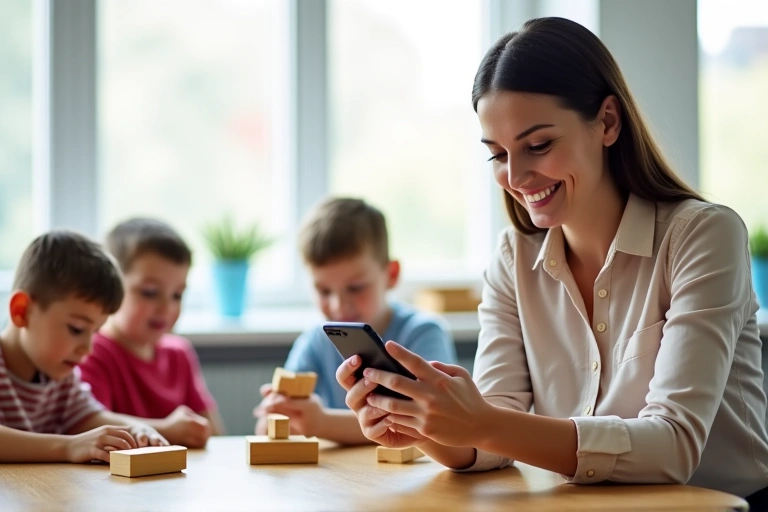
What if you could capture the entire moment, with all its context and colour, in just 30 seconds? This is the power of voice-recorded observations. Instead of writing, you speak. In a fraction of the time it takes to type or write, you can record a detailed, descriptive account of the learning you've just witnessed. It’s a method that is less intrusive, more detailed, and fundamentally more human. It captures not just what a child did, but how they did it—their tone of voice, their choice of words, their excitement, their hesitation. This shift from written to verbal documentation is a cornerstone of modern, efficient school admin software and a powerful tool for reducing teacher workload.
The best observations are not just seen; they are heard, felt, and understood in the context of the moment.
By capturing the spoken word, we create a data point that is exponentially richer than a hurried note. It’s an authentic piece of evidence that tells a story. But to make this practice truly transformative, we need a framework for using it effectively across different key stages and a system for managing the output.
Best Practices for Voice Observations in EYFS
In an Early Years Foundation Stage environment, learning is fluid, constant, and often happens during child-led play. Voice notes are perfectly suited to this dynamic. Instead of interrupting play to write, practitioners can discreetly record observations on the fly. You can capture a child narrating a story in the small world area, using complex vocabulary and sentence structures. You can record two children negotiating roles in the home corner, providing clear evidence of their Personal, Social and Emotional Development. These short audio clips are invaluable. With a platform like Parent Portal, these voice notes can be automatically transcribed and tagged against specific Development Matters objectives, seamlessly building a rich evidence base for each child’s Learning Journey without adding to your administrative burden.
This method also allows you to capture the child’s actual voice. Recording a short snippet of a child explaining their Duplo model preserves their exact language, pronunciation, and thought process—something impossible to replicate in writing. It provides a longitudinal record of their language development that is both powerful and deeply personal.
Adapting the Approach for Key Stage 1 and 2
While often associated with EYFS, the practice of voice observation is just as powerful, if not more so, in Key Stage 1 and 2. The focus simply shifts from play-based learning to more structured curriculum activities. Think of the opportunities: recording a Year 2 child reading a passage aloud to track fluency and expression; capturing a student’s verbal explanation of their strategy for solving a multi-step maths problem; or documenting a fascinating question asked during a science experiment. These are all powerful moments of formative assessment that are often lost. Voice recording makes capturing them effortless. A quick 60-second voice note provides more insight into a child’s understanding than a ticked worksheet ever could.
These observations, when logged in a system like Parent Portal, can be directly linked to National Curriculum objectives. This creates a robust portfolio of evidence that goes far beyond test scores, demonstrating a child’s progress in reasoning, communication, and critical thinking. It’s an essential part of the edtech 2025 landscape, moving assessment from a static event to a continuous, integrated process.
From Raw Notes to Actionable Intelligence: The Tech Advantage
Recording the voice note is just the start. The real revolution happens when technology takes over. A leading school communication tool should do more than just store your audio files. With Parent Portal, each voice note is automatically transcribed, turning spoken words into searchable text. This instantly solves the problem of trying to find a specific observation from months ago. But the intelligence goes deeper. Using AI, the platform analyses accumulated observations to identify patterns, highlight areas of strength, and even suggest potential next steps for a child. This level of analysis, once the domain of lengthy data meetings, now happens automatically, feeding invaluable insights back to the teacher and significantly reducing planning and assessment workload. This culminates in features like our AI Report Writing Assistant, which uses this bank of rich, voice-captured evidence to help you write personalised, high-quality report comments in a fraction of the time.
Strengthening the Home-School Connection
Effective parent engagement is about creating a genuine partnership, and nothing builds that connection faster than sharing authentic moments of success. Sharing a transcribed voice note or even a short, approved audio clip with a parent is incredibly powerful. It moves communication beyond a generic “had a good day” to a specific, meaningful insight. A parent can read or hear their child excitedly explaining how they conducted a fair test in science or see a photo of their award-winning artwork. This gives parents a real window into the classroom and provides them with wonderful conversation starters at home. Instead of asking “What did you do today?”, a parent can ask, “Your teacher said you wrote a brilliant story about a dragon – can you tell me about it?”. It fosters a deeper appreciation for the work the school is doing and makes parents feel like true partners in their child's education.
Conclusion: The Future of Observation is Here
Voice-recorded observations are not just a novelty; they are a fundamental evolution in teaching practice. When supported by smart, integrated school admin software, this simple change in methodology can have a profound impact. It saves teachers countless hours, improves the quality and depth of formative assessment, provides powerful AI-driven insights into student progress, and dramatically enhances parent engagement. By empowering teachers to capture learning as it happens, we allow them to focus on what they do best: teaching and nurturing the children in their care. The future of assessment is efficient, insightful, and personal, and it starts with pressing 'record'.
Comments