
The Future of Voice Assessment: AI-Powered Insights
The Limitations of Pen and Paper
For decades, classroom observation has been the bedrock of formative assessment, especially in Early Years and Key Stage 1. Teachers, armed with clipboards and sticky notes, diligently try to capture those fleeting 'aha!' moments, the insightful questions, and the collaborative chatter that signify true learning. But this traditional method, while well-intentioned, is fraught with challenges. The reality is that recording meaningful written observations in a busy classroom of thirty children is a near-impossible task. It's time-consuming, often distracting from the flow of teaching, and inevitably leads to a record that is incomplete and subjective. The nuance of a child's tone, the hesitation before a breakthrough, the confidence in their explanation – these crucial indicators are lost in translation to text. Furthermore, collating these paper notes, identifying patterns, and using them to inform planning is a monumental administrative burden that contributes significantly to teacher workload. We are capturing a fraction of the data and struggling to make effective use of it.
Capturing Authentic Learning, One Voice at a Time
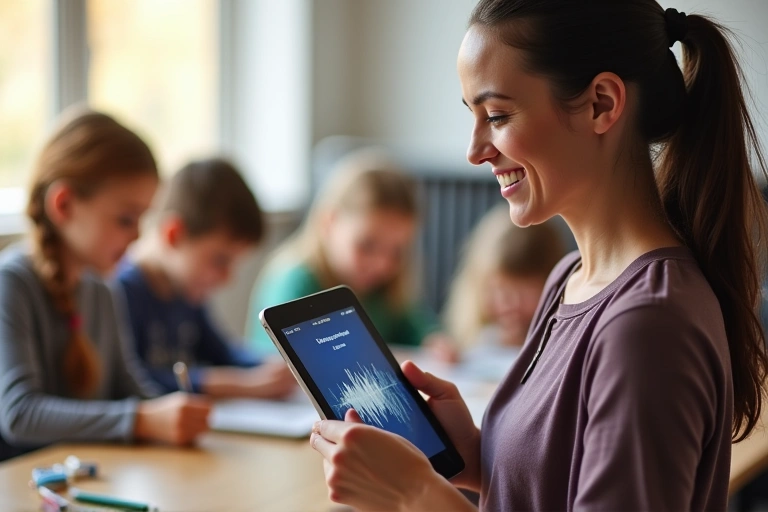
What if we could capture the richness of these learning moments without the limitations of pen and paper? This is where technology offers a transformative solution. Imagine being able to record a quick 30-second voice note as a child explains their reasoning in a maths problem or describes a character from a story. This is the simple yet powerful premise behind voice-recorded observations. Instead of frantically scribbling a summary, teachers can capture the child's authentic voice, preserving the exact wording, intonation, and thought process. This method is not only faster and more efficient, allowing teachers to gather evidence without breaking the rhythm of the lesson, but it also provides a far richer, more authentic data source. It is evidence of learning in its purest form, direct from the source. The focus shifts from the teacher's interpretation to the child's actual expression, providing a foundation for more accurate and insightful assessment.
The unfiltered voice of a child is the most authentic evidence of learning we can possibly capture. It reveals not just what they know, but how they think, their confidence, and their unique way of connecting ideas.
This shift towards capturing voice isn't just about creating a more vibrant record; it's about fundamentally changing the nature of the evidence we collect. It moves assessment from a secondary, interpreted act to a primary, direct one. This raw data is the key, but the real revolution lies in what technology can do with it next, turning these simple audio clips into a powerful engine for educational insight and helping to reduce teacher workload significantly.
From Transcription to Transformation: The Role of AI
Capturing the voice is just the first step. The true magic happens when Artificial Intelligence is applied to these recordings. This is where the future of assessment, and indeed `edtech 2025`, is heading. When a teacher records a voice observation using a platform like Parent Portal, a sophisticated process unfolds in the background. First, the audio is instantly and automatically transcribed into text. This immediately makes the observation searchable, saving the teacher from ever having to type up notes again. But the AI goes far beyond simple transcription. It analyses the content of the observation, identifying key vocabulary, understanding the concepts being discussed, and even suggesting links to specific curriculum objectives, whether from the EYFS Development Matters framework or the National Curriculum. This is where AI moves from a simple `school admin software` tool to a genuine teaching assistant. It intelligently processes unstructured verbal data and gives it structure and meaning, a task that would take a human hours to complete. By analysing patterns across multiple observations, the AI builds a detailed picture of each child's progress, pinpointing strengths and identifying potential areas for development before they become significant gaps.
Parent Portal's AI analyses voice observations on multiple levels.
1. Transcription: It accurately converts speech to text.
2. Curriculum Linking: It identifies keywords and concepts, automatically suggesting links to EYFS or National Curriculum objectives.
3. Pattern Recognition: Over time, it tracks vocabulary growth, confidence levels (by analysing tone and hesitation), and recurring misconceptions.
4. Insight Generation: It synthesises this data into clear, automated summaries for teachers, highlighting strengths and suggesting next steps.
This intelligent analysis provides teachers with a level of insight that was previously unattainable. It can highlight if a child consistently uses past tense incorrectly, or if their use of scientific vocabulary has expanded dramatically over a term. These are the golden nuggets of information that drive effective differentiation and personalised learning, and they are delivered automatically, saving teachers from the data-crunching and allowing them to focus on what they do best: teaching.
Actionable Insights for Smarter Teaching and Deeper Engagement
The ultimate goal of any assessment tool is to improve teaching and learning. AI-powered voice assessment achieves this by providing teachers with deep, actionable insights. Instead of relying on gut feelings or incomplete notes, educators have a wealth of evidence-based information at their fingertips. This empowers them to plan interventions with precision, tailor lessons to address specific misconceptions highlighted by the AI, and create truly differentiated learning experiences. The benefits extend far beyond lesson planning. Consider parents' evenings. With systems like Parent Portal, teachers can review a child's entire observation history, including AI-generated summaries, before a meeting. They can even share a specific voice clip with a parent, allowing them to hear their own child's progress. This transforms the conversation from a discussion about grades and scores to a celebration of the learning journey, dramatically improving `parent engagement`. This powerful connection between home and school, facilitated by clear and tangible evidence, is one of the most significant advantages of modern `school communication tools`. For the student, knowing their voice is literally being heard and valued is a powerful motivator. For the parent, hearing their child explain how a plant grows is infinitely more meaningful than a checkmark on a report card.
– C. Davies, Headteacher
Looking Ahead: The Future of Assessment is Listening
By embracing this technology, schools are not just adopting a new tool; they are adopting a new philosophy. They are moving towards a model of continuous, authentic, and efficient assessment that places the child at the centre. Each voice note, each AI-analysed insight, contributes to a rich, longitudinal narrative of a student's growth. This `student progress tracking` is dynamic, telling a story of development over time that static, end-of-term exams simply cannot. The cumulative data can even be used by AI to assist in writing personalised, evidence-based report card comments, transforming a weeks-long, stressful task into a manageable and meaningful exercise. The future of voice assessment powered by AI is not about replacing teachers, but about augmenting their professional judgement and freeing them from administrative burdens. It’s about giving them superpowers: the ability to be in multiple places at once, to recall every significant learning moment, and to see the invisible patterns of progress in their classroom. As we look towards the next generation of educational technology, it's clear that the most powerful tools will be those that listen, analyse, and empower. The future of assessment is bright, and it sounds like the voice of a child learning.
Comments