
Speech-to-Text Technology: How It Works in Educational Settings
The Sound of Progress: Embracing Voice in the Modern Classroom
In the bustling environment of a primary school classroom, time is the scarcest resource. Teachers are constantly juggling lesson delivery, individual support, behaviour management, and the ever-present mountain of administrative tasks. One of the most time-consuming yet crucial tasks is documenting student progress. For decades, this has meant scribbling hasty notes on a clipboard, trying to capture the magic of a learning breakthrough while simultaneously managing twenty other students. The result? Often, vital context is lost, and the administrative burden eats into evenings and weekends. But what if capturing a detailed, rich observation was as simple as speaking a few sentences? This is the promise of speech-to-text technology, a transformative tool that is redefining what’s possible for school communication and teacher workload.
What Exactly Is Speech-to-Text Technology?
At its core, speech-to-text, also known as Automatic Speech Recognition (ASR), is a technology that converts spoken language into written text. While the concept isn't brand new—think of early dictation software—the recent advancements in Artificial Intelligence (AI) and machine learning have made it incredibly accurate, fast, and versatile. Today’s ASR systems can understand different accents, filter out background noise, and transcribe with a precision that was once science fiction. In an educational setting, this isn't just a novelty; it's a powerful engine for efficiency. Instead of typing, teachers can simply talk, turning their thoughts, observations, and feedback into organised, usable data instantly. This simple shift is a cornerstone of modern edtech, forming the backbone of innovative school admin software designed for the demands of 2025.
From Fleeting Moments to Formative Assessment
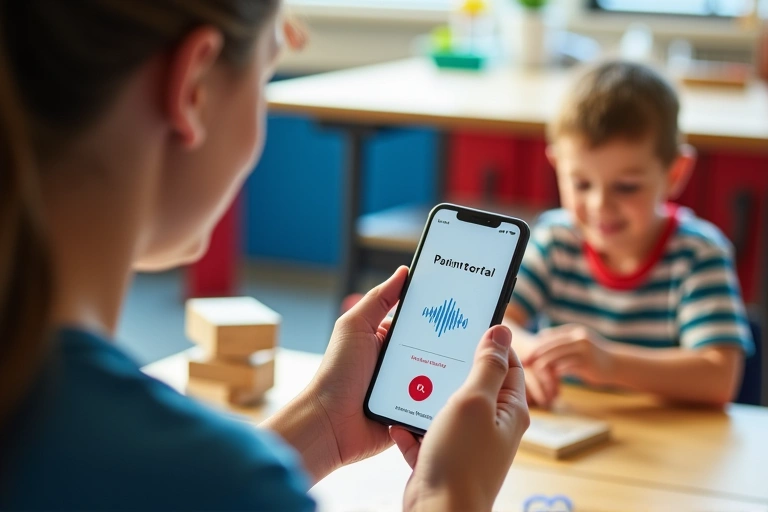
Every teacher knows the feeling: you spot a child suddenly grasp a difficult concept, collaborate brilliantly with a peer, or use a new piece of vocabulary perfectly. These are the golden nuggets of learning. The challenge is capturing them authentically. By the time you find a pen and paper, the moment may have passed, or the child’s exact words are forgotten. Photos are great, but they lack the narrative context. This is where speech-to-text changes the game, particularly through features like Parent Portal’s Voice-Recorded Observations. Imagine a teacher noticing a student in an EYFS setting successfully build a structurally sound bridge with blocks. Instead of making a mental note to write up later, they can pull out their device, open the app, and record a 30-second voice note: "Leo just spent ten minutes experimenting with different bridge designs. He discovered that a wider base made it more stable and explained to his friend that 'it won't wobble now'. He showed great persistence and problem-solving skills."
1. Record: Use your phone or tablet to record a quick 30-60 second voice note capturing a learning moment as it happens.
2. Transcribe: Our AI instantly and automatically converts your spoken words into accurate text.
3. Tag & Link: Add captions, tag the relevant student or group, and link the observation directly to EYFS or National Curriculum objectives.
4. Share: With a tap, the observation—complete with the original audio and transcription—can be securely shared with parents, building a comprehensive learning journey.
This process takes seconds, not minutes. The observation is captured in rich detail, including the teacher's immediate analysis and the child’s own words. It’s a powerful way to reduce teacher workload while simultaneously increasing the quality of assessment evidence. By making observations this effortless, teachers can capture far more data points, leading to a much deeper and more accurate understanding of each child’s development over time.
- Chloe R., Reception Teacher
The cumulative effect of these micro-observations is profound. They build a longitudinal, evidence-rich profile for every student, moving beyond static data points to create a living story of their progress. This makes tracking against age-related expectations more accurate and meaningful, providing a solid foundation for planning and reporting.
Unlocking Wider Potential Across the School
While transforming classroom observations is a major benefit, the applications of speech-to-text technology extend far beyond. It’s a versatile tool that can streamline various aspects of school life, enhancing both teaching and administration. Think about creating resources. A teacher could use a concept explainer tool to dictate a complex scientific idea in simple terms, with the AI transcribing and even helping to structure it for different learning abilities. The same principle applies to generating feedback. Instead of typing out lengthy comments on homework, a teacher can speak their thoughts, providing more detailed, nuanced, and encouraging feedback in a fraction of the time. This is a key advantage for platforms that integrate homework submission and feedback tools.
The ability to capture a child's exact wording or a teacher's fleeting insight in the moment is a game-changer; it turns ephemeral interactions into permanent, valuable data for tracking progress.
Furthermore, this technology is a powerful enabler for accessibility and inclusion. Students with dyslexia or other writing barriers can dictate their stories and answers, allowing them to express their knowledge and creativity without being hindered by the mechanics of writing. For schools with diverse communities, speech-to-text can be paired with translation features. A teacher can record an update in English, and the platform can transcribe and translate it, ensuring vital information reaches parents with English as an Additional Language (EAL). This an integral part of creating a truly effective parent engagement strategy.
The AI Superpower: Turning Words into Actionable Insight
Simply converting speech to text is powerful, but the real magic happens next. Modern edtech platforms like Parent Portal don't just stop at transcription; they use AI to analyse the accumulated text. All those voice-recorded observations create a massive, rich dataset unique to each child. AI algorithms can then sift through this data to identify patterns, strengths, common misconceptions, and areas for development. Is a child consistently using creative language? Is a group struggling with a particular maths concept? This AI-powered analysis provides teachers with automated summaries and actionable insights that would be impossible to uncover manually. It can even suggest next steps or teaching strategies tailored to a child's learning preferences. This closes the loop, turning quick observations into data-driven pedagogy that improves outcomes. The ultimate expression of this is the AI Report Writing Assistant, which uses this wealth of transcribed, evidence-based observation data to generate personalised, unique report comments. It eliminates the single most time-consuming task for many teachers, freeing them up to focus on what they do best: teaching.
Speaking the Future of Education and Communication
Speech-to-text is not merely a feature; it’s a fundamental shift in how we manage information in schools. It directly tackles the critical issue of teacher workload, giving educators back their valuable time. By making documentation effortless, it facilitates a richer, more continuous form of assessment that benefits students, teachers, and parents alike. Platforms that embed this technology at their core are not just school communication tools; they are comprehensive partners in teaching and learning. As we look towards edtech in 2025 and beyond, technologies that are intuitive, efficient, and directly supportive of the teaching process will lead the way. By empowering teachers to use their voice, we are creating smarter schools, fostering stronger parent engagement, and building a more detailed, compassionate understanding of every child's journey.
Comments