
Progress Tracking in Reception: A Digital Approach
The Reception year is a magical time of discovery, where learning happens not in neat, linear steps, but in bursts of creativity, curiosity, and collaboration. For teachers and school leaders, capturing and understanding this progress is both a privilege and a profound challenge. How do we document a child’s sudden grasp of a concept during water play, or their blossoming social skills while building a den? The fluid, play-based nature of the Early Years Foundation Stage (EYFS) framework demands an approach to progress tracking that is equally dynamic and responsive. For too long, this has meant a reliance on cumbersome, paper-based systems that often fail to capture the true essence of a child's development. But as technology evolves, a new horizon is emerging for EYFS assessment—one that is digital, intuitive, and genuinely insightful.
Moving Beyond Sticky Notes and Clipboards
Anyone who has worked in an early years setting is familiar with the traditional tools of the trade: clipboards for anecdotal notes, cameras for printing photos, and vast folders filled with paper observations. While born from a desire to be thorough, this method presents significant obstacles. Observations scribbled on sticky notes can get lost, handwritten notes can be hard to decipher, and the sheer volume of paperwork is overwhelming. Teachers spend countless hours after school collating these disparate pieces of evidence, painstakingly cross-referencing them with Development Matters statements, and trying to weave them into a coherent narrative of progress for each of the thirty children in their care. This administrative burden not only contributes to teacher workload but also creates a time lag. A wonderful 'lightbulb' moment captured on a Monday might not be fully documented and shared with parents until weeks later, by which time its immediacy and impact are lost. It’s a system that captures an endpoint, but often misses the magic of the journey.
Capturing Authentic Learning Moments Digitally
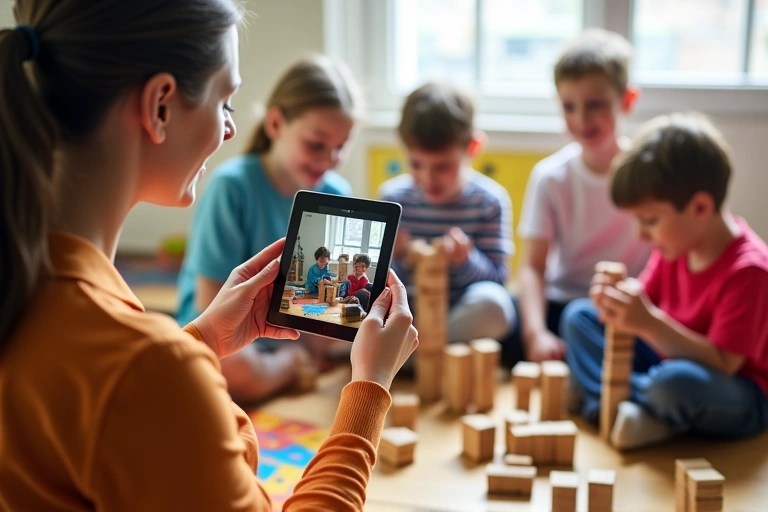
Imagine being able to capture the richness of a child's learning without ever interrupting the flow of their play. This is the promise of a modern, digital approach to progress tracking. Instead of fumbling with a notepad, a teacher can use a device to record a quick 30-second voice note. In that short clip, they can capture a child explaining how they balanced the blocks in their tower, using new vocabulary to describe their creation, or negotiating a role with a friend. These voice observations are powerful because they capture not just what a child did, but their thought process, their language, and their confidence. Platforms like Parent Portal are designed for this very purpose. With a few taps, a teacher can record a voice note, snap a photo, or take a short video, instantly tagging the relevant child or group. The observation is securely saved, time-stamped, and ready for analysis. This in-the-moment documentation drastically reduces teacher workload and, more importantly, produces a far more authentic and nuanced record of development.
From Observation to Insight: Linking to EYFS
Creating an observation is only the first step; the real value comes from connecting it to a child's overall learning journey. This is where digital systems truly outshine their paper-based counterparts. Once a voice, photo, or video observation is captured in a platform like Parent Portal, the teacher can immediately link it to specific objectives within the EYFS framework, whether it's Development Matters or Early Learning Goals. There’s no need to manually search through documents or spreadsheets. The system presents the relevant learning areas, allowing the teacher to tag the observation with just a click. This seamless integration transforms a simple moment into a valuable piece of evidence. It builds a rich, longitudinal picture of each child's progress over time, all stored within their secure digital learning profile. It ensures every observation has a purpose, contributing to a deeper understanding of the child’s strengths and areas for growth.
Capturing a child's learning process is not about ticking a box; it's about understanding the journey of their thinking, their curiosity, and their unique way of seeing the world.
By making the linking process effortless, technology empowers educators to focus on the quality of their observations and interactions, rather than getting bogged down in the associated administration. The focus shifts from paperwork to pedagogy, where it truly belongs.
The Power of AI in Early Years Assessment
As these digital observations accumulate, a vast and detailed dataset is created for each child. Manually analysing this to spot trends and patterns would be a monumental task. This is where Artificial Intelligence (AI) becomes an indispensable teaching assistant. Modern school admin software can now leverage AI to analyse all accumulated observations, providing insights that would be nearly impossible to uncover manually. The system can automatically transcribe voice notes, identify recurring themes in a child's learning, and highlight their progress against age-related expectations. More than just tracking data, the AI can synthesise it. It can generate automated summaries that highlight strengths, flag potential areas for development, and even suggest personalised teaching strategies and next-step activities to support that child. This isn't about replacing the teacher's professional judgement; it's about augmenting it with powerful, data-driven insights. It's the ultimate tool to reduce teacher workload while simultaneously enhancing the quality of assessment.
This intelligent support allows teachers to move from data collection to data interpretation, using their expertise to act on the insights provided. It makes differentiation more achievable and ensures that no child's progress goes unnoticed.
Strengthening the Home-School Partnership
One of the most transformative aspects of a digital progress tracking system is its ability to build a powerful and continuous dialogue with parents. When observations are shared through a secure platform like Parent Portal, parents are no longer passive recipients of a termly report. They receive real-time notifications, giving them a window into their child’s world at school. They can see a photo of their child mastering the climbing frame, hear a voice note of them counting to twenty, or watch a short video of them engaging in a group activity. This regular, positive communication fosters incredible parent engagement. It helps parents understand the purpose behind play-based learning and gives them the confidence and knowledge to support that learning at home. It demystifies the EYFS and creates a genuine partnership, where teachers and parents work together from a shared understanding of the child’s progress and experiences. Communication becomes a two-way street, creating a supportive community around every learner.
- Sarah Jones, EYFS Lead, Oakwood Primary School
This shared narrative strengthens relationships and ensures that when formal consultations like parents' evenings occur, the conversation is already warm and well-informed, focusing on collaboration for the child's benefit.
Informing Next Steps and Reporting with Confidence
A continuous stream of well-documented, curriculum-linked evidence is the foundation of effective planning and reporting. With a digital system, teachers can easily filter observations to see a child's progress in a specific area of learning, or review the overall development of the whole class. This allows for truly responsive planning, where activities can be tailored to meet emerging needs and interests. The benefits extend to more formal reporting, too. The daunting task of writing end-of-term reports is made significantly easier and more meaningful. Utilising tools like an AI Report Writing Assistant, teachers can generate personalised, evidence-based comments based on the wealth of observation data collected throughout the term. The AI synthesises the voice notes, photos, and progress records to create unique paragraphs that reflect the child's individual journey, saving teachers hours of work while producing higher-quality reports. This robust evidence base also makes parents' evenings more productive, allowing for focused, data-rich conversations about achievements and next steps.
Embracing the Future of EYFS Assessment
Adopting a digital approach to progress tracking in Reception is about more than just efficiency; it's a fundamental shift towards a more authentic, insightful, and collaborative form of assessment. By leveraging tools like voice observations and AI analysis, schools can empower their teachers to do what they do best: teach. The administrative burden is lifted, allowing for more time to be spent on high-quality interactions with children. The insights generated provide a deeper understanding of each child, enabling more personalised support. And by opening a real-time window into the classroom, these school communication tools foster unprecedented levels of parent engagement. This is the future of assessment in the early years and a key trend in edtech for 2025 and beyond. It’s an approach that respects the unique nature of EYFS learning, values the professional expertise of teachers, and places the child's developmental journey at the very centre of everything. By combining human-led observation with intelligent technology, we can ensure every child's progress is not only tracked but truly understood.
Comments