
Baseline Assessment Made Simple with Digital Tools
Why Baseline Assessment is a Teacher’s Greatest Tool (and Biggest Headache)
The first few weeks of the academic year are a whirlwind of new names, new routines, and boundless energy. Amidst this flurry of activity lies one of the most critical tasks for any teacher or early years practitioner: baseline assessment. This initial evaluation is not about testing or grading; it's about understanding. It’s the process of establishing each child’s starting point in their personal, social, emotional, and academic development, creating a benchmark against which all future progress can be measured.
A well-executed baseline assessment is invaluable. It informs planning, enables effective differentiation, and helps identify children who may need extra support right from the outset. However, the traditional methods can be a significant source of stress and a major drain on time. Piles of checklists, anecdotal notes scribbled on stray papers, and the pressure to formally observe every child in a multitude of contexts can quickly become overwhelming. This administrative burden often means that by the time the data is collated, it’s already out of date, and the teacher is left exhausted before the first half-term is even over.
Moving Beyond Clipboards: The Power of Digital Observation
The challenge with traditional baseline assessments is that they often capture a staged snapshot rather than an authentic moment. True learning often happens spontaneously—in a conversation with a peer, during unstructured play, or in a flash of personal discovery. How can a teacher realistically capture these fleeting, yet deeply insightful, moments for 30 children? This is where technology steps in to revolutionise the process, moving assessment from a cumbersome administrative task to a seamless part of the daily teaching flow. Modern school communication tools are evolving into powerful platforms for tracking progress and reducing teacher workload.
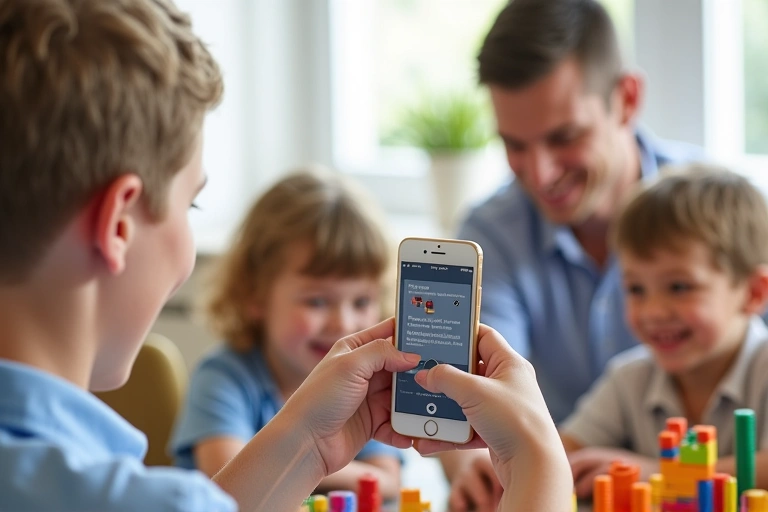
Imagine replacing the clipboard and pen with the smartphone in your pocket. Instead of trying to write detailed notes while managing a busy classroom, you can capture rich evidence in seconds. This shift to digital isn't just about convenience; it's about collecting better, more authentic data. It allows educators to document learning as it happens, preserving the context, the language, and the emotion of the moment. This approach provides a far more holistic and accurate picture of a child than any single worksheet or formal observation ever could.
The goal of baseline assessment isn't to generate a score, but to understand a story. It’s the first chapter in a child’s learning journey for that academic year.
With a comprehensive platform like Parent Portal, these digital observations become the building blocks of a deep and meaningful student profile, created with minimal effort and maximum impact. The focus returns to the child, not the paperwork.
Capturing Authentic Learning Moments in Seconds
Parent Portal was designed with the realities of a busy classroom in mind, offering tools that make capturing high-quality observations quick and intuitive. The key is to integrate assessment into the natural rhythm of the day. Instead of setting aside dedicated ‘observation time’, teachers can document progress on the fly.
One of the most powerful features for this is Voice-Recorded Observations. When a teacher overhears a child using fantastic new vocabulary or explaining their reasoning to a friend, they can simply raise their phone and record a quick 30-second voice note. There’s no need to stop the flow of the activity or try to remember the exact wording later. The audio clip captures the child's own voice and expression, providing rich, qualitative data. This is automatically transcribed within the Parent Portal app, saving the teacher from typing up notes later.
Similarly, Photo and Video Observations add a vital visual dimension. A photograph of a complex block tower can showcase fine motor skills, spatial awareness, and perseverance far more effectively than a written description. A short video clip of children collaborating on a task can provide evidence of communication, teamwork, and problem-solving skills. With Parent Portal, a teacher can snap a photo or short video, tag the relevant children, and add a quick caption in moments.
Crucially, every observation can be instantly linked to curriculum objectives, whether it's the EYFS Development Matters framework or specific Key Stage National Curriculum goals. This simple tagging process turns a collection of moments into a structured evidence base, ready for analysis and planning, completely eliminating the need for manual cross-referencing.
From Raw Data to Rich Insights: How AI Reduces Teacher Workload
Capturing data is only half the battle. The real magic happens when that data is transformed into actionable insight without adding to a teacher's to-do list. This is where Parent Portal's integrated AI becomes a teacher’s most valuable assistant. The platform collates all the voice, photo, and video observations and uses AI to perform a powerful analysis.
The system's AI-Powered Progress Analysis sifts through hundreds of observation points for each child to identify patterns, strengths, and potential areas for development. It might highlight that a child consistently demonstrates strong leadership skills in group activities or note that their use of mathematical language is advancing rapidly. These automated summaries provide teachers with a high-level overview of their class, helping them to spot trends and plan next steps with an evidence-based approach. This dramatically reduces the cognitive load and time spent manually reviewing notes.
All of this information feeds directly into each child’s unique Student Learning Profile. This isn’t a static document but a living, breathing record of their journey. At the start of the year, it provides a deep and nuanced baseline built from dozens of authentic moments. As the year progresses, it grows into a rich longitudinal picture of their development, tracking progress over time in a way that is easy to visualise and understand. For school leaders and admin staff, this provides a consistent, school-wide approach to tracking and evidencing progress, a key requirement for inspections and school improvement planning.
– Sarah, EYFS Lead, a UK Primary School
Building a Foundation for Strong Parent Partnership
An effective baseline assessment process does more than just inform teaching; it lays the groundwork for a strong and collaborative partnership with parents. When parents feel informed and involved from the very beginning, their engagement and support for the school skyrockets. Parent Portal bridges the gap between the classroom and home, making this connection seamless.
During those first few crucial weeks, teachers can choose to share specific, positive observations with a child’s parents through the app. Receiving a photo of their child happily engaged in an activity or a note about a kind act can do wonders to alleviate a parent's 'first day' anxieties. It also gives them a genuine insight into their child's life at school, opening the door for more meaningful conversations at home. This simple act builds trust and demonstrates a shared commitment to the child's wellbeing and progress.
Furthermore, all the rich baseline data collected is neatly organised and ready for the first parents' evening. Teachers no longer need to spend hours preparing, trying to recall specific examples for each child. With Parent Portal, they can review a child’s progress profile, complete with transcribed voice notes and visual evidence, right before a meeting. The platform's AI can even generate meeting summaries, ensuring that key discussion points and agreed actions are captured accurately, creating a clear and productive dialogue about the child's ongoing development.
The Future of Assessment is Here
The pressure on schools to do more with less is immense, and teacher workload remains a critical issue. The tools we use must not only be effective but also efficient. When it comes to baseline assessment, the choice is clear: we can either continue with laborious paper-based systems that drain time and energy, or we can embrace digital solutions that enhance our insights and give us back our most precious resource—time to teach.
Parent Portal redefines what's possible, transforming baseline assessment from a periodic, stressful event into a continuous, insightful, and almost invisible process. By empowering teachers to capture authentic learning moments effortlessly and using AI to handle the heavy lifting of analysis, it delivers a truer, deeper understanding of every child. This is the future of assessment—smarter, simpler, and profoundly more effective for teachers, parents, and, most importantly, the students themselves.
Comments