
How to Identify Learning Gaps Through Voice Observation Patterns
Beyond the Tick Box: The Richness of Voice Observation
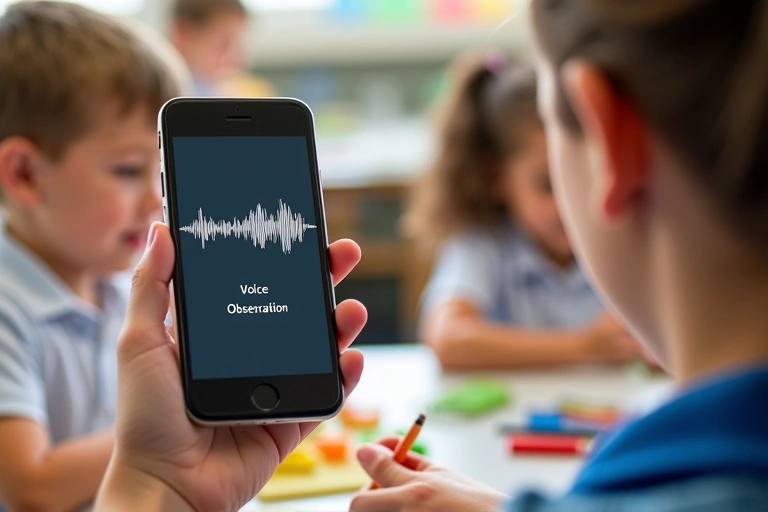
In the bustling environment of a primary school classroom, teachers are masters of multitasking. Amidst the swirl of questions, activities, and interactions, the core challenge remains the same: how do we truly know what each child understands? Traditional assessment methods, from worksheets to formal tests, provide snapshots of learning, but they often miss the nuances—the hesitation before an answer, the creative (but incorrect) reasoning, the spark of a new idea. This is where the power of listening comes in. Voice observation, the practice of capturing short, in-the-moment audio recordings of students, is emerging as a revolutionary tool for formative assessment.
Unlike time-consuming written notes, a quick 30-second voice recording captures the authentic, unfiltered monologue of a child explaining their thinking. It preserves their tone, their confidence, and the specific vocabulary they use. This method is not about adding another task to a teacher's plate; it’s about working smarter. With a platform like Parent Portal, these voice notes can be recorded with a single tap, automatically transcribed, and tagged to curriculum objectives, creating a rich, longitudinal picture of a child’s journey. This is a powerful way to reduce teacher workload while gathering far more insightful data.
Turning Anecdotes into Actionable Insights
A single voice observation is a valuable anecdote. It might capture a wonderful 'lightbulb moment' or a funny misunderstanding. But the real magic happens when you collect these anecdotes over time and begin to see patterns emerge. This is the shift from qualitative data to powerful, actionable analytics. By analysing a collection of voice notes, teachers can move beyond a gut feeling and pinpoint specific learning gaps with evidence-backed certainty.
What kind of patterns should you be listening for? The clues are often subtle but incredibly revealing. Look for patterns in language and vocabulary. Is a child consistently using basic terms, or are they beginning to incorporate more complex, subject-specific language? Notice patterns of confidence and hesitation. Does a student speak fluently about number bonds but pause and use filler words like "um" and "ah" when discussing fractions? This points directly to a specific area of uncertainty. Voice notes are also the single best way to uncover misconceptions. Hearing a child explain that you 'plus' the numbers on the top and bottom to add fractions reveals a fundamental misunderstanding that a worksheet might miss.
Listening to how a child explains their thinking reveals more about their understanding than a hundred multiple-choice questions ever could.
By regularly capturing these moments, you build a unique data set for every child. This is the foundation of truly personalised learning and effective intervention, turning your classroom observations into a cornerstone of your assessment strategy and one of the most effective school communication tools at your disposal for internal planning.
A Practical Guide to Analysing Voice Observation Patterns
So, how can busy teachers realistically analyse these patterns without spending hours listening back to recordings? The key is a structured approach, augmented by smart technology. Start by focusing on a specific domain. Instead of trying to analyse everything at once, dedicate time to reviewing observations tagged with 'Reading Comprehension' or 'Scientific Enquiry'. By narrowing your focus, the patterns become much clearer.
Compare a child’s observations over time. Listen to a recording from September and another from November on the same topic. Can you hear a tangible progression in their confidence and vocabulary? This provides powerful evidence of progress for reports and parents' evenings. It's also vital to compare across different contexts. A child who is silent during whole-class carpet time might be a chatterbox when explaining their block construction to a friend. This pattern suggests a confidence or social communication gap, not necessarily a knowledge gap, allowing you to create a more supportive environment for them to share their ideas. The rise of Edtech 2025 is all about using technology to unlock these deeper insights.
Step 1: Record. Capture a quick 30-60 second voice note of a child explaining their work, right from your phone or tablet.
Step 2: Tag. With one tap, link the observation to a curriculum area, like ‘Development Matters’ or a specific Key Stage objective.
Step 3: Accumulate. Effortlessly build a bank of observations over a few weeks, forming a rich audio learning journey.
Step 4: Analyse. Parent Portal's AI analyses the transcribed text and audio data, automatically identifying recurring themes, vocabulary usage, and potential misconceptions, presenting you with an actionable summary.
Using an integrated platform with AI capabilities transforms this process. What would take a teacher hours of manual work—listening, transcribing, and cross-referencing—can be done in minutes. AI can flag when a child repeatedly uses the same incorrect term, track the development of their questioning skills, and even suggest next steps, making it an indispensable part of your school admin software ecosystem.
From Insights to Intervention: Closing the Learning Loop
Identifying a learning gap is only half the battle. The ultimate goal is to close it. The detailed patterns revealed through voice observation provide the perfect roadmap for targeted, effective intervention. If analysis shows a child consistently struggles to articulate their reasoning in maths, you can plan a small intervention group focusing on mathematical language and sentence stems. If you notice a group of children are using very descriptive language in their imaginative play, you can challenge them with more advanced story-writing prompts.
This approach also revolutionises parent engagement. Instead of a generic report comment like "Sarah needs to be more confident in maths," you can share a secure audio clip during a parents' evening. You can say, "Here’s a clip of Sarah explaining her work in September, and here's one from last week. Can you hear how much more confident she sounds when talking about multiplication?" This makes progress tangible for parents and builds a powerful home-school partnership. You can even use tools like Parent Portal's AI Homework Generator to create personalised tasks that directly address the gaps you've identified, creating a seamless loop from observation to intervention to reinforcement.
Embracing the Sound of Learning
The sound of a vibrant classroom is the sound of learning. By harnessing those sounds, we can tune in to the individual needs of every child like never before. Voice observation patterns offer a window into a child's mind, revealing a depth of understanding that is impossible to capture on paper. It allows us to see not just what a child knows, but how they know it. When supported by intelligent school communication tools and admin software, this practice moves from a novel idea to an essential, sustainable part of modern pedagogy.
By embracing this approach, schools can build a culture of continuous, low-stakes assessment that meaningfully informs teaching, dramatically reduces teacher workload, and provides every child with the precise support they need to flourish. It’s about listening closely, understanding deeply, and acting decisively to ensure no child's learning gap goes unnoticed.
Comments