
Using Voice Notes to Track Progress Toward Learning Objectives
In the bustling environment of a primary school classroom, magical learning moments happen in a flash. A child finally grasps a tricky concept, a quiet student confidently leads a group discussion, or a unique question reveals a completely new way of thinking. The challenge for educators has always been how to capture these fleeting, authentic instances of progress without disrupting the flow of learning. Traditional pen-and-paper observations, often written up at the end of a long day, can feel retrospective and time-consuming. But what if you could capture the nuance, the tone, and the exact wording of that breakthrough moment in just 30 seconds? This is the power of voice-recorded observations, a transformative tool that is revolutionising how schools track progress towards learning objectives.
The Shift from Static Notes to Dynamic Voice
For years, teacher observations have relied on written notes. While valuable, this method has its limitations. It forces teachers to summarise, paraphrase, and often lose the specific language or developmental leap a child has made. It's difficult to jot down a detailed sentence a child used to explain their reasoning while simultaneously managing a group activity. The result is often a backlog of paperwork that consumes precious planning time and offers only a filtered view of student progress.
Modern edtech platforms like Parent Portal are reimagining this process. By integrating simple, powerful tools into the daily classroom workflow, they empower teachers to capture richer evidence more efficiently. At the heart of this evolution is the voice note, a simple yet profound feature that allows teachers to record quick 30-60 second audio clips directly from a smartphone or tablet. This isn't just about saving time; it's about capturing a higher quality of evidence that informs teaching and assessment in a more meaningful way.
How Voice-Recorded Observations Work
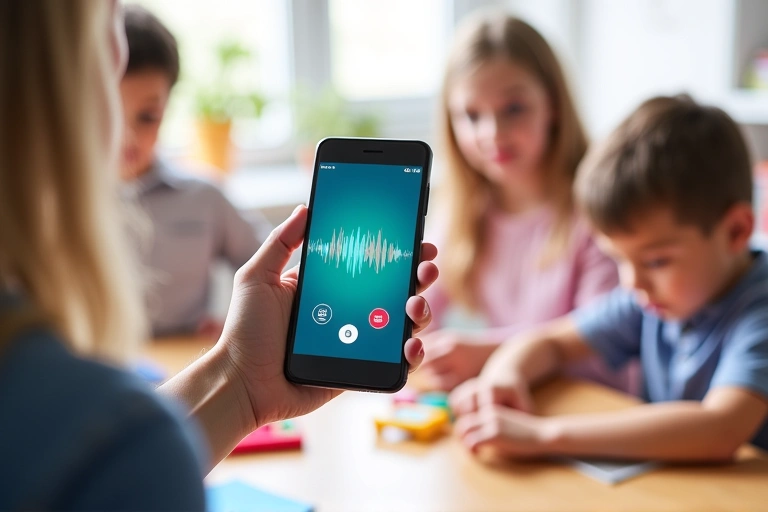
The process is designed for speed and simplicity, ensuring it fits seamlessly into a busy school day. When a teacher witnesses a key learning moment, they simply open the Parent Portal app, select the child or group of children, and start recording. They can capture a child reading a passage aloud, explaining a mathematical strategy, or collaborating with peers on a science experiment. This short audio clip becomes a powerful piece of evidence.
Crucially, the technology does the heavy lifting. The voice note is automatically transcribed, turning spoken words into searchable text. Teachers can then tag the observation with specific curriculum objectives, whether from the Early Years Foundation Stage (EYFS) framework or the Key Stage National Curriculum. In less than a minute, the teacher has created a rich, multi-faceted record: the original audio, a full transcription, and a direct link to a learning objective. This single action begins to build a comprehensive, longitudinal picture of each child's development.
Capturing learning as it happens, in the child's own voice, provides a depth of evidence that written notes alone can never match.
This approach moves assessment from a summative, end-of-term task to a formative, continuous dialogue. Each observation is a data point that is both qualitative and quantitative, providing unparalleled insight into a student's journey. Instead of relying on memory or brief written notes, teachers have a library of primary-source evidence at their fingertips.
From Raw Observation to AI-Powered Insight
A collection of voice notes is powerful, but the true transformation comes when technology helps you make sense of it all. This is where Parent Portal's AI-powered progress analysis comes into play. As teachers accumulate observations for each child, the system begins to identify patterns, strengths, and potential areas for development. The AI can analyse vocabulary progression, spot recurring misconceptions, or highlight a student's growing confidence in a particular subject. It automates the 'join-the-dots' process that teachers would otherwise have to do manually.
For school leaders and teachers, this provides an incredible strategic advantage. Imagine receiving an automated summary that says, "Jada has used increasingly complex conjunctions in her spoken explanations over the past month, meeting her writing target." Or, "Leo consistently struggles to explain his subtraction process after reaching 10, suggesting a need to reinforce number bonds." These are the actionable insights that drive truly personalised learning and targeted intervention.
Voice notes aren't just faster—they're richer. A 60-second voice note can contain 150-180 words, capturing detailed explanations and thought processes.
Parent Portal's AI automatically transcribes these notes, making them searchable and analysable, saving teachers hours of administrative time each week.
This data directly feeds into the AI Report Writing Assistant, generating unique, evidence-based report comments in seconds.
This data-driven approach doesn't replace professional judgement; it enhances it. It provides teachers with the evidence they need to back up their intuition and plan their next steps with confidence. It also dramatically reduces workload, particularly around assessment periods and report writing time.
Reducing Workload and Increasing Impact
The number one pressure facing the education sector is teacher workload. Anything that adds to the administrative burden without a clear impact on learning outcomes is a liability. Voice observations do the opposite—they reduce admin while increasing impact. The time saved by speaking an observation instead of typing it is significant. When this is multiplied across a class and throughout a term, it adds up to hours of reclaimed time that can be reinvested into planning, teaching, and supporting students.
Furthermore, features like the AI Report Writing Assistant leverage the accumulated voice note data to do the heavy lifting of report writing. The system analyses a child’s progress, evidenced by their own words in the voice notes, and generates personalised, high-quality comments. Teachers then review, edit, and approve these comments, ensuring their professional voice leads the process but without the hours spent starting from a blank page. It's a prime example of how technology can handle the administration, freeing up educators to focus on the art of teaching.
- Year 2 Teacher
Engaging Parents in the Learning Journey
One of the most exciting benefits of voice-recorded observations is the ability to strengthen the home-school partnership. With a secure approval workflow, teachers can choose to share specific observations with parents directly through the Parent Portal app. Hearing their own child explain a concept in their own words is infinitely more powerful for a parent than reading a line in a report. It makes progress tangible and a cause for celebration at home.
This feature provides a window into the classroom that parents rarely get to see. They can hear their child's developing confidence, their curiosity, and their triumphs. It opens up conversations at home about what they are learning and makes parents active partners in the educational journey. This level of parent engagement is a proven driver of better student outcomes, and voice notes provide a simple, secure, and incredibly effective way to foster it.
In conclusion, the simple act of recording a voice note is setting in motion a sophisticated process that is reshaping education. It offers a more authentic method of assessment, provides deep, AI-driven insights, significantly reduces teacher workload, and transforms parent engagement. By embracing tools like voice-recorded observations, schools are not just adopting new technology; they are adopting a more effective, efficient, and human-centred approach to tracking and celebrating student progress.
Comments