
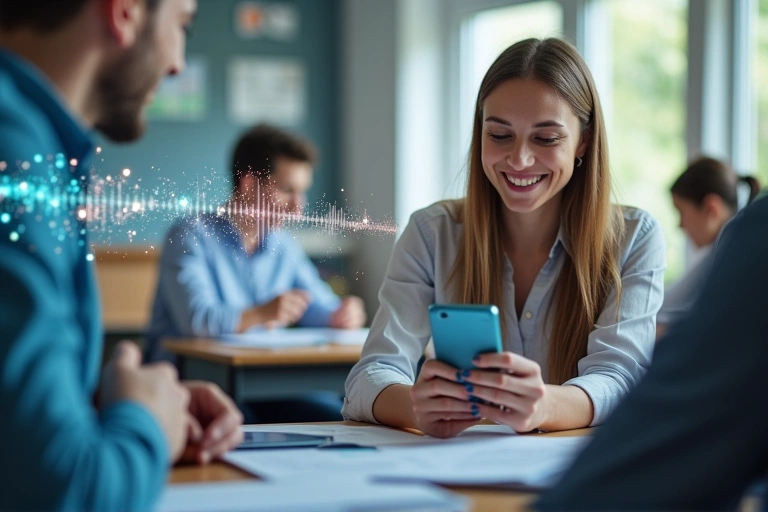
How AI Identifies Themes and Patterns in Voice Observations
From Fleeting Moments to Formative Data
In the vibrant, fast-paced environment of a primary school classroom, countless valuable learning moments occur every single hour. A child finally grasps a tricky maths concept, another helps a friend without being asked, or a group collaborates with surprising ingenuity on a creative task. These are the golden nuggets of formative assessment, the authentic, in-the-moment indicators of progress. The challenge for educators has always been how to capture these fleeting events without disrupting the flow of learning or creating an unmanageable administrative burden. This is where voice-recorded observations have become a game-changer. Using a tool like Parent Portal, teachers can record quick 30 to 60-second audio notes on their device, capturing the essence of a moment with ease. It’s faster and more natural than stopping to type, allowing teachers to preserve the rich context and nuance of a child's learning. But this efficiency creates a new challenge: a sea of data. A single teacher might accumulate hundreds of audio clips over a term. Manually listening back, transcribing, and looking for patterns would defeat the purpose of saving time. This is where the true innovation lies—not just in capturing the data, but in making sense of it.
Decoding Learning: How AI Processes Voice Notes
Once a voice observation is recorded, Parent Portal’s powerful Artificial Intelligence engine gets to work, transforming raw audio into structured, actionable insights. This process isn't magic; it's a sophisticated sequence of technological steps designed to understand language and context. The first step is transcription. The AI converts the spoken words into written text with a high degree of accuracy, providing the foundational data for all subsequent analysis. This alone is a significant time-saver, eliminating the need for manual typing. Next, the system employs a technology called Natural Language Processing (NLP). In simple terms, NLP is a field of AI that gives computers the ability to read, understand, and interpret human language. Instead of just seeing a string of words, the AI begins to understand their meaning and relationship to one another. During this phase, it performs entity and keyword extraction. It scans the transcribed text to identify and tag crucial pieces of information. For example, it can recognise subjects ("reading," "science," "PE"), specific curriculum concepts ("fractions," "phonics," "vertebrates"), and observable skills ("problem-solving," "leadership," "fine motor control"). It even identifies social and emotional language, noting words like "frustrated," "proudly," "working together," or "independently."
This is far more than a simple keyword search. The AI analyses the context to understand the sentiment and meaning. It can differentiate between a note that says, "Sam is struggling with his number bonds to 10" and one that says, "Sam proudly explained his number bonds to 10 to a friend." Finally, the AI performs a thematic analysis. By aggregating all the tagged observations for a specific child, it begins to group them into coherent themes. It cross-references dozens or even hundreds of data points, connecting disparate moments to build a comprehensive, longitudinal picture of the child’s journey. This is the crucial final step where individual data points are woven together into an insightful narrative of progress over time.
Revealing the Bigger Picture: What the AI Finds
The true power of this AI-driven analysis lies in its ability to surface patterns that would be nearly impossible for a human to spot amidst the daily rush of classroom life. By collating and categorising observations over weeks and months, the system provides teachers with a dashboard of powerful insights that can fundamentally shape their teaching practice. For instance, the AI can clearly highlight academic strengths and areas for development. It might collate five separate observations of a child, Maya, excelling in descriptive writing during different activities, confirming a clear strength. Simultaneously, it might flag that across multiple maths sessions, Maya has been consistently observed avoiding tasks involving multiplication. This isn't a one-off bad day; it's a pattern that requires targeted support. Beyond academics, the system excels at tracking social and emotional development. It could reveal a pattern that a typically reserved child, Leo, has started to offer ideas in group work, a subtle but significant step in his confidence that might otherwise go unnoticed. This kind of insight is invaluable for supporting the whole child. Furthermore, the AI can help identify a child’s dominant learning preferences. Does a student light up when activities are hands-on? Are their most insightful contributions made during class discussions? The AI can detect these trends, helping teachers differentiate their approach and create a more inclusive learning environment. It’s this ability to connect the dots between isolated moments that elevates voice observations from simple records to a cornerstone of personalised education.
By turning qualitative, in-the-moment observations into quantitative, analysable data, we empower teachers to see the unseen and understand each child's story more deeply than ever before.
This automated analysis doesn't just reveal patterns; it connects them directly to formal assessment frameworks. This helps bridge the gap between anecdotal evidence and curriculum objectives, ensuring every observation has a purpose.
Parent Portal’s AI doesn’t just identify themes; it can link them to specific objectives within the EYFS Development Matters framework and the National Curriculum for Key Stages 1 and 2. When the AI detects a pattern related to a child's ability to 'retell a story in their own words,' it can automatically tag this against relevant Communication and Language ELGs or English curriculum standards. This provides instant, evidence-backed tracking of progress against age-related expectations, making assessment more continuous, accurate, and far less time-consuming.
This level of detailed, automatic analysis has a profound impact on how teachers prepare for and engage in their professional duties, particularly when it comes to reporting on student progress. The feedback from educators using these tools highlights a significant shift in their workflow and effectiveness.
– C. Davies, Year 2 Teacher
Smarter Workflows, Not Harder Work
The ultimate goal of educational technology should be to empower educators, not overwhelm them. The AI analysis of voice observations is a prime example of how technology can genuinely reduce teacher workload while simultaneously increasing professional impact. The most immediate benefit is the massive amount of time saved. The hours previously spent sifting through anecdotal notes, trying to recall specific moments, and manually aligning them to assessment frameworks are now handed back to the teacher. This shifts the focus from administration to action. With AI-generated summaries at their fingertips, teachers are equipped with a clear, evidence-based understanding of each child. This allows for more informed and targeted planning. A teacher can quickly identify a small group of children who are all showing a similar gap in understanding and plan a focused intervention, all based on data gathered organically throughout the school day. This proactive approach is far more effective than waiting for a formal test to reveal a problem. This data-rich environment also revolutionises parent communication and reporting. Parent Portal's AI Report Writing Assistant can use the analysed observation data to generate draft report comments that are personalised, unique, and full of evidence, saving teachers from the dreaded "comment bank." When it's time for parents' evenings, teachers are better prepared than ever, able to lead conversations grounded in a rich history of specific, logged moments of learning, fostering stronger parent engagement.
The Future of Formative Assessment is Here
The integration of AI into school communication and administration tools is not a far-off vision for EdTech in 2025; it's happening right now. By intelligently analysing voice observations, platforms like Parent Portal are transforming formative assessment from an often-burdensome task into a seamless and deeply insightful process. This technology doesn't seek to replace a teacher's professional judgement but to augment and empower it. It handles the laborious task of data-sifting, freeing educators to focus on the human side of teaching: building relationships, designing creative learning experiences, and providing targeted support where it's needed most. By uncovering the hidden stories within everyday classroom interactions, this AI-powered approach builds a richer, more holistic understanding of every child, strengthening the vital partnership between school and home and paving the way for a more personalised and responsive education for all.
Comments