
The Cumulative Effect: How Micro Observations Build Understanding
Moving Beyond the Snapshot
In the vibrant, fast-paced environment of a primary school classroom, moments of genuine insight happen constantly. A child suddenly grasps a tricky maths concept, another shows unexpected empathy towards a classmate, or a group collaborates on a building project with surprising ingenuity. These are the moments that truly define learning and development. Yet, for many educators, they are also fleeting. By the time you sit down with a mountain of paperwork at the end of the day, the specific nuance of that breakthrough can be lost. Traditional methods of observation, often formal and scheduled, risk missing this authentic, in-the-moment learning. They provide a snapshot, a single frame from a feature-length film. While useful, these snapshots rarely tell the whole story. They can be time-consuming to conduct, stressful for the child, and add significantly to a teacher’s administrative burden. We need a way to move beyond the static snapshot and embrace the full, dynamic narrative of each child's journey.
The Power of the Small Moment
This is where the concept of micro-observations comes in. Instead of relying solely on infrequent, long-form assessments, this approach focuses on capturing tiny, frequent glimpses of a child's day. It might be a quick photograph of a sentence they’ve written, a short video of them explaining their science experiment, or even a 30-second voice note of a teacher's thoughts after a guided reading session. Individually, each observation is just a small data point. A single photo doesn't define progress, and one voice note doesn't tell a complete story. The magic lies in their aggregation. When collected consistently over days, weeks, and terms, these small moments weave together to form a rich, detailed tapestry of a child's progress. This cumulative effect is what transforms assessment from a series of isolated events into a continuous, evolving story of growth and understanding.
When we focus on the whole child, we see not just what they know, but who they are becoming. The small moments are where the real learning is revealed.
This approach allows educators to see patterns that would otherwise be invisible. It highlights a child's preferred learning style, tracks the gradual development of a skill, and provides concrete evidence of progress that is grounded in authentic, everyday classroom life. It's formative assessment in its truest sense: an ongoing dialogue that informs teaching and celebrates every step of the learning journey.
Making Observation Effortless
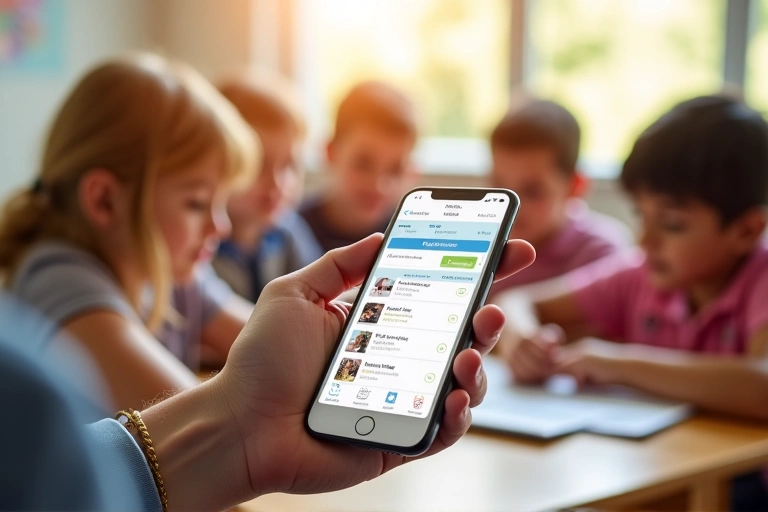
The key to a successful micro-observation strategy is making it seamless. It cannot be another time-consuming task on a teacher's endless to-do list. This is where modern school communication tools become indispensable. Imagine spotting a moment of learning and, instead of scrambling for a sticky note, simply using your school's app to record a quick voice memo. You speak your observation—what the child did, what it demonstrates, and a potential next step—and the technology does the rest. It’s captured, logged against the student's profile, and ready to be reviewed later. This is how you reclaim those fleeting moments. The friction between observing and recording is removed, making it possible to build a rich bank of evidence without disrupting the flow of the lesson. Technology serves not as a distraction, but as an extension of the teacher's professional focus, helping to reduce teacher workload while increasing the quality of assessment.
This means a 30-second spoken note is instantly converted into searchable text, tagged to the relevant student, and ready to be linked to EYFS or National Curriculum objectives.
This ease of capture extends to visual evidence too. Sharing a photo of a student's 'star work' or a video of a group presentation with parents is no longer a complex process. It’s a few taps on a device. A platform that integrates these tools ensures that every piece of a child's story can be captured with minimal effort and maximum impact, linking directly to their personal learning profile.
Connecting the Dots: The AI Advantage
So, you’ve gathered hundreds of these micro-observations. You have a rich database of photos, videos, and transcribed notes. What happens next? Sifting through this data manually would be an overwhelming task. This is where the next wave of edtech for 2025 is already making a difference. AI-powered progress analysis is the engine that turns this raw data into actionable insight. By analysing the accumulated observations for a child, AI can identify patterns, highlight areas of consistent strength, and flag concepts where a child might need more support. It can generate automated summaries of progress over a half-term, providing educators with an evidence-based starting point for report writing and parent consultations. Instead of relying on memory or isolated test scores, teachers have a longitudinal record of development at their fingertips. This analytical power is a game-changer for effective and efficient school administration and pedagogy, providing a clear view of both individual and cohort progress.
– Sarah Knight, Headteacher
This isn't about replacing the teacher's professional judgement; it's about augmenting it. The AI does the heavy lifting of data organisation and pattern recognition, freeing up teachers to do what they do best: interpret the findings, plan targeted interventions, and nurture each child's potential.
Building Stronger Home-School Partnerships
Perhaps the most profound impact of sharing micro-observations is on parent engagement. For many parents, their child’s school day is a black box. They ask, "What did you do today?" and get the classic response: "Nothing." Micro-observations change that. Receiving a photo of their child proudly holding up a piece of artwork, or a notification celebrating the 'Star of the Day' with a specific reason, creates a powerful connection. It provides a window into their child's world and gives them specific, positive talking points for conversations at home. This isn't just about communication; it's about collaboration. When parents can see the learning journey as it unfolds, they become active partners in their child's education. They understand the process, see the small wins, and feel more connected and supportive of the school's mission. Effective school communication tools bridge the gap between home and school, an essential component for any modern learning community.
The Future of Formative Assessment
The cumulative effect of micro-observations represents a paradigm shift in how we view student progress. It is a move away from high-pressure, infrequent testing and towards a more humane, holistic, and continuous model of assessment. It honours the process of learning, not just the outcome. By leveraging smart school admin software and communication platforms, this powerful approach is no longer a theoretical ideal but a practical reality for schools across the UK. It reduces teacher workload, deepens pedagogical understanding, and strengthens the vital partnership with parents. As we look towards the future of education, embracing the small moments might just be the biggest step forward we can take.
Comments