
Voice Observations as Evidence in Parent Consultations
The Challenge of Meaningful Parent Consultations
Parents' evening. It’s a cornerstone of the school year, but for many teachers, it’s a marathon of back-to-back meetings fuelled by coffee and a desire to provide meaningful feedback. The challenge is immense: how do you condense weeks of learning, progress, and nuanced social interactions into a ten-minute conversation? We rely on mark books, hastily written notes, and our own memory. But often, the feedback can feel generic. We say things like, “She’s doing well in maths,” or “He needs to contribute more in class.” While true, these statements lack the vivid, tangible evidence that helps parents truly understand their child’s school experience.
What if you could do more than just tell a parent about a learning moment? What if you could let them hear it? This is the transformative power of using voice observations as evidence in parent consultations. It’s a shift from reporting on learning to sharing the process of learning itself, creating richer conversations and stronger home-school partnerships.
What Exactly Are Voice Observations?
At its core, a voice observation is a short, verbal note recorded by a teacher in the moment. Using a platform like Parent Portal, a teacher can capture a 30-60 second audio clip directly on their phone or tablet. It could be a child excitedly explaining how they solved a tricky maths problem, a group of children collaborating on a science experiment, or a student finally mastering a difficult sentence structure. These aren't polished performances; they are raw, authentic snippets of everyday learning.
Crucially, this technology isn't just about recording audio. In Parent Portal, these voice notes are automatically transcribed, making them searchable and easy to review. Teachers can tag children, link the observation to specific curriculum objectives (like EYFS Development Matters or National Curriculum goals), and share them directly with parents. This simple act of capturing a moment creates a powerful piece of evidence that is both qualitative and deeply personal.
Instead of a summary of progress, you provide a window into the learning journey itself. It shifts the conversation from what a child achieved to how they are thinking, trying, and growing.
This approach moves beyond static data points. A test score tells you a child got 8 out of 10, but a voice observation can capture the 'aha!' moment when they understood the concept behind the two questions they got wrong. This is the kind of insight that truly empowers parents to support their child's learning at home.
Transforming Vague Feedback into Vivid Evidence
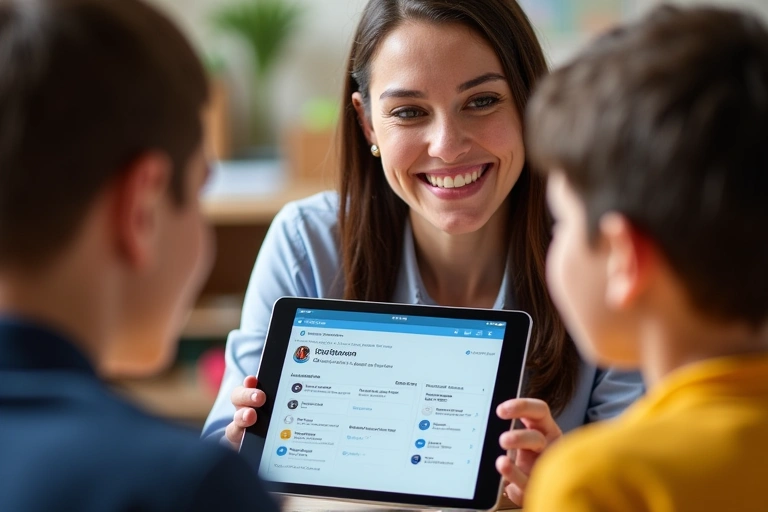
Let's picture a typical parent consultation. You might be discussing a child's reading fluency. Without concrete evidence, you might say, “Leo’s reading is becoming more expressive.” The parent nods, but the feedback is abstract. Now, imagine a consultation powered by voice observations. Instead of that generic statement, you open your tablet, navigate to Leo's profile in Parent Portal, and say, “I want you to hear something from a few weeks ago.” You play a 30-second clip of Leo reading in a slightly robotic tone. Then you say, “Now listen to him reading this week.” You play another clip, and this time the parent hears their child’s voice filled with expression and confidence, pausing for commas and raising his voice for question marks. The progress isn't just reported; it's demonstrated.
This method is incredibly effective across all subjects and key stages. Struggling with a child’s engagement? Play a voice note of them enthusiastically debating a topic in a history lesson. A parent is concerned about their child’s friendships? Share a captured moment of positive, collaborative play in the construction area. This evidence-based approach builds trust and gives parents a genuine sense of connection to their child’s daily life at school.
This level of detailed, qualitative evidence is particularly vital in Early Years Foundation Stage (EYFS) settings, where progress is less about test scores and more about developing skills and characteristics of effective learning. Hearing their child articulate a thought or negotiate with a peer provides parents with invaluable insight that a written report could never fully convey.
Reducing Teacher Workload, Not Adding to It
The immediate reaction from any time-poor teacher might be scepticism: “Another thing to do? I don’t have time for this.” This is the most surprising benefit of a well-integrated voice observation system. It actually reduces teacher workload. Think about the time it takes to write a detailed observation note. You have to stop what you're doing, find a pen and paper or open a laptop, type it all out, and ensure you capture the details accurately. This process can take several minutes and often pulls you away from the children.
In contrast, recording a voice observation is incredibly fast. You see a learning moment, you tap a button, speak for 30 seconds, and you’re done. The whole process takes less than a minute. You can capture dozens of these rich, detailed moments throughout the week in the time it would have taken to write a handful of traditional notes. This efficiency makes it one of the most effective school communication tools available.
- Sarah, Year 2 Teacher
The time-saving benefits extend beyond the initial capture. When it comes to report writing, Parent Portal’s AI Report Writing Assistant can analyse all the tagged voice observations and progress data for a child and generate unique, evidence-based report comments. It eliminates the struggle of trying to remember specific examples from months ago. The evidence is already there, logged and organized, ready to be synthesized. This is a prime example of how modern school admin software can directly impact and improve the core task of teaching.
Building a Richer Picture of Student Progress
Parent consultations are a single point in time, but learning is a continuous journey. Each voice observation acts as a digital breadcrumb, creating a detailed, longitudinal trail of a child’s development. Over a term or a year, this collection of audio clips builds a rich, multi-faceted student learning profile. Teachers and school leaders can see patterns emerge, track progress against age-related expectations, and identify the need for support or extension work far more effectively.
This complete history—combining voice notes, photo observations, and homework submissions—is neatly organised within Parent Portal. When preparing for a consultation, everything is in one place. There’s no need to cross-reference multiple systems or dig through paper files. It’s an integrated, holistic view that supports every child’s journey. By embracing tools that facilitate this deeper level of parent engagement, schools are not just improving communication; they are building a more supportive and transparent learning culture, setting a new standard for edtech in 2025 and beyond.
Comments