
Micro Observations for Behaviour Tracking: What Really Works
Beyond Stickers and Sad Faces: The Limits of Traditional Behaviour Tracking
For decades, the landscape of primary school behaviour management has been dominated by visual, often public, systems. We’ve all seen them: the traffic light on the wall, the sticker chart with empty squares, the cloud that moves from sunny to thunderous. While well-intentioned, these methods are increasingly showing their age. They operate on a foundation of public reward and shame, which can be counterproductive for an anxious child or one who struggles with emotional regulation. More importantly, they offer a snapshot in time with zero context. A name on the ‘red’ light tells you what happened, but it tells you nothing about why. Was the child tired, hungry, overwhelmed by a task, or upset about something that happened at playtime? Traditional systems lack the depth to answer these crucial questions, leaving teachers to firefight symptoms rather than address root causes. This approach not only misses vital opportunities for genuine support but also creates a significant administrative burden, turning behaviour management into a reactive cycle of discipline rather than a proactive process of development.
Behaviour is communication, a signal that tells us a child needs help, not punishment.
When we reframe our perspective to see behaviour as a form of communication, our entire approach shifts. The goal is no longer to simply stop a ‘bad’ behaviour, but to understand what the child is trying to tell us. This is where a more nuanced, data-rich strategy becomes essential. It’s time to move beyond the surface level and start building a deeper understanding of each child’s world.
The Shift to Micro-Observations: Capturing the Full Picture
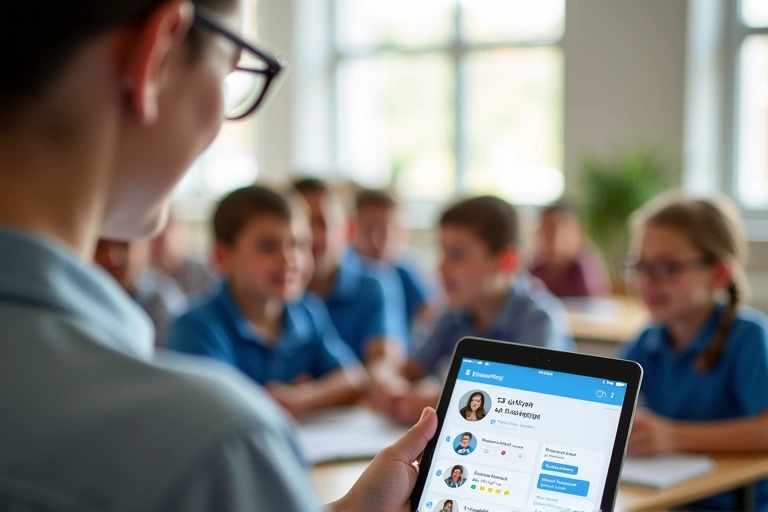
Enter the concept of micro-observations. Instead of just noting major incidents, this approach involves frequently capturing small, objective snippets of a child's day. A micro-observation isn't a lengthy essay; it’s a quick, factual note. It could be positive: “Samir helped Tia tidy the book corner without being asked.” It could be a point of concern: “Jasmine struggled to focus during phonics, putting her head on the table.” Or it could be neutral and contextual: “Class was very noisy during the group activity, and Leo seemed overwhelmed.” The power lies in the accumulation of these small data points. When collected consistently, they begin to weave a rich tapestry that reveals patterns, triggers, and progress over time. Modern school admin software is making this easier than ever. With a tool like Parent Portal, a teacher can use a quick 30-second voice-recorded observation to capture a moment as it happens. The note is automatically transcribed and logged against the student’s profile, creating a longitudinal record with almost zero disruption to the lesson.
This method transforms behaviour tracking from a simple log of misdemeanours into a powerful diagnostic tool. It’s no longer about catching children out; it’s about tuning in to their needs. This evidence-based approach empowers teachers to provide support that is targeted, timely, and truly effective because it’s based on a real understanding of the individual child.
Cultivating a Positive Culture with Data-Driven Reinforcement
One of the most significant benefits of a micro-observation system is its ability to powerfully support positive reinforcement. Traditional systems often have a negative bias, focusing disproportionately on what went wrong. In contrast, making a conscious effort to log small positive actions fundamentally shifts the classroom dynamic. When a teacher makes a quick voice note about a child showing kindness, demonstrating resilience, or trying hard on a difficult task, it creates a bank of positive evidence. Platforms like Parent Portal integrate this directly with digital rewards systems. An observation about excellent teamwork can be instantly linked to awarding house points, with leaderboards creating a sense of collective achievement. Parents can receive a notification celebrating their child’s achievement, turning a small positive moment at school into a point of pride at home. This constant stream of positive recognition builds student self-esteem and creates a culture where effort and good character are just as visible and celebrated as academic success. It motivates students intrinsically and shows them, with concrete evidence, that their positive contributions are seen and valued.
By systematically capturing the good, we balance the narrative. This ensures that when challenging behaviour does occur, it’s viewed as one part of a complex picture, not the defining characteristic of a child. It’s this balanced evidence that helps build resilient, confident learners and a more supportive school community.
This testimonial reflects a growing trend among forward-thinking school leaders. The move towards data-informed behaviour support is not just an idea; it's a practical strategy being implemented in schools today, yielding tangible results for staff, students, and parents alike.
Unlocking the 'Why': From Behavioural Data to Actionable Insights
A single behavioural incident is just noise. A dozen incidents logged over a month is data. When that data is analysed, it becomes insight. This is the true power of consistent micro-observation. By looking at a child's complete observation history, a teacher or SENCO can start asking deeper questions. Does challenging behaviour peak during unstructured playtimes? Is there a pattern of anxiety before maths lessons every Tuesday? Does a student thrive in small group work but become withdrawn during whole-class instruction? Manually sifting through records to find these patterns is time-consuming, but this is where AI-powered progress analysis becomes a game-changer. Modern school communication tools can analyse accumulated observations to automatically highlight trends, potential triggers, and correlations that a busy teacher might miss. This reduces teacher workload and provides sophisticated insights that can inform individualised support plans, interventions, and even simple classroom adjustments. This data-driven approach is critical for supporting students with additional needs but is beneficial for all children, ensuring every student gets the tailored support they need to flourish.
From Confrontation to Collaboration: Engaging Parents Effectively
The ‘end of day’ phone call to a parent about their child’s behaviour is a conversation no teacher enjoys and no parent wants to receive. It often feels confrontational and presents a one-sided, negative view of the day. Micro-observations completely change this dynamic. When it’s time for a parent consultation, a teacher isn't relying on memory or a few negative anecdotes. Instead, they have a balanced, evidence-based record. They can open Parent Portal and say, “Let’s look at Maya’s month. You can see here she received rewards for her fantastic effort in spelling and for being incredibly kind to a new student. We have also noticed a pattern here, where she seems to find concentrating after lunch quite difficult. Let’s talk about that together.” This transforms the conversation from a report into a partnership. Parents feel included, not accused. They can see the school is working to understand their child, not just to discipline them. Sharing this rich picture, complete with photos and positive observations, builds trust and creates a collaborative team around the child, which is the cornerstone of effective parent engagement and a key goal of modern edtech in 2025.
Making it Work: How Technology Reduces Workload, Not Increases It
The most common objection to a more detailed tracking system is, predictably, workload. Teachers are already stretched to their limits. The crucial point to understand is that the right technology reduces workload. A 30-second voice note is faster than writing in a logbook or updating a spreadsheet. An AI-generated summary of a child’s progress for a report is infinitely quicker than manually reviewing months of notes. Having all observations, attendance data, and academic progress in one place for a parents’ evening saves hours of preparation. The goal of a platform like Parent Portal is not to add tasks, but to make existing tasks more efficient and far more impactful. By automating data analysis and streamlining communication, this technology frees up teachers to do what they do best: teach and connect with their students. This is the future of school admin software—making complex processes simple, insightful, and human-centred.
Comments